
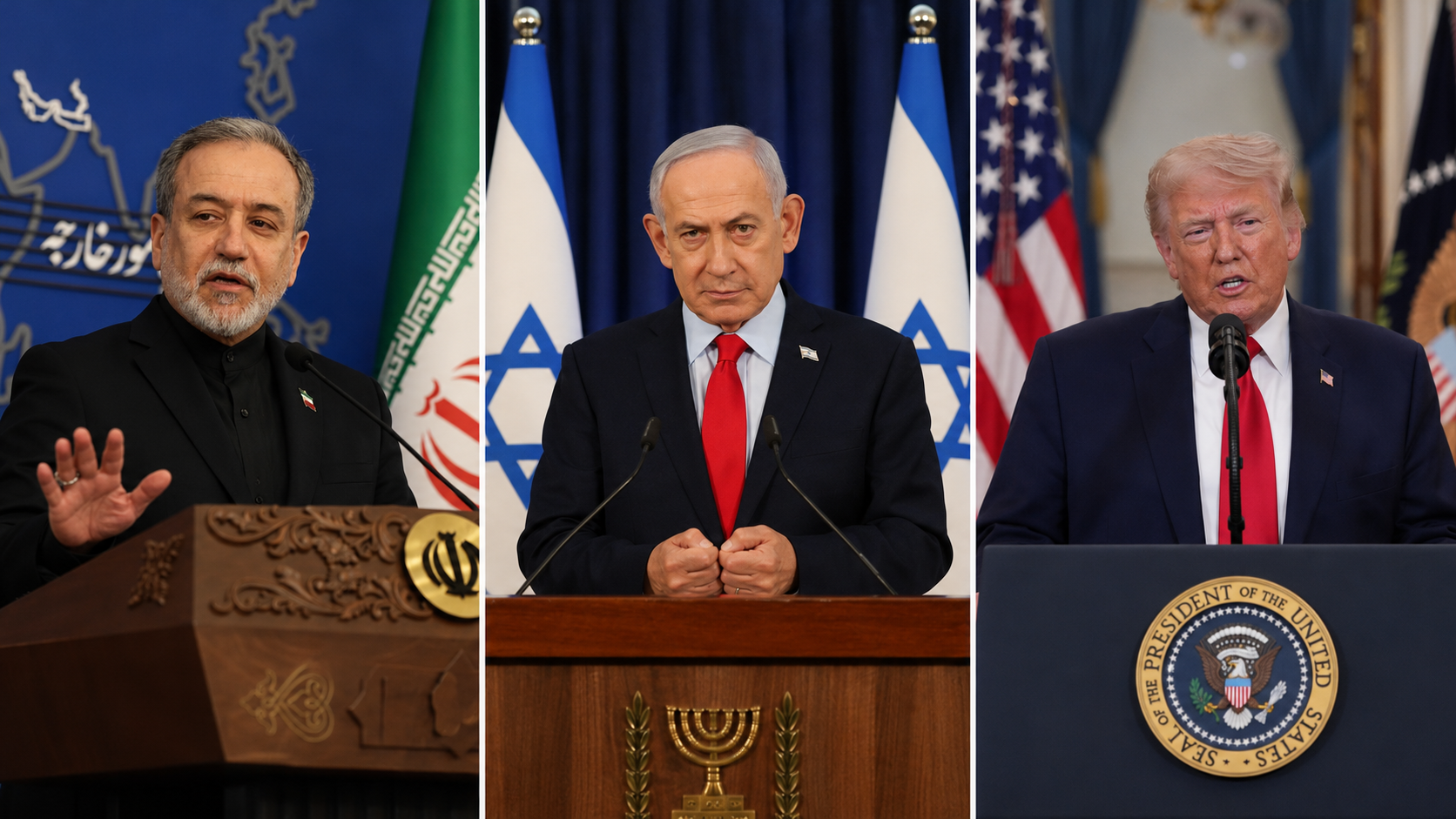
On 28 February 2026, the United States and Israel launched a military campaign against Iran. As strikes and retaliation spread, the three governments offered competing explanations of why the fighting was necessary, whom it was intended to protect and what it should accomplish. Their statements addressed citizens living with the consequences, foreign governments whose support they sought, and adversaries whose decisions they wanted to influence.
Iran presented itself as a sovereign state defending its rights against aggression. Israel described a preventive campaign against an interconnected system of nuclear, missile and proxy threats. The United States offered several rationales for an operation it portrayed as overwhelming, limited and capable of compelling an agreement. These accounts gave different meanings to the same political vocabulary: defense, deterrence, restraint and victory.
This article reconstructs each narrative by identifying recurring frames and the relationships between them. It distinguishes the central account of why the war is necessary, the roles assigned to the parties, the conduct presented as legitimate, and the conditions offered for ending the conflict.
Which Sources Have Been Analyzed
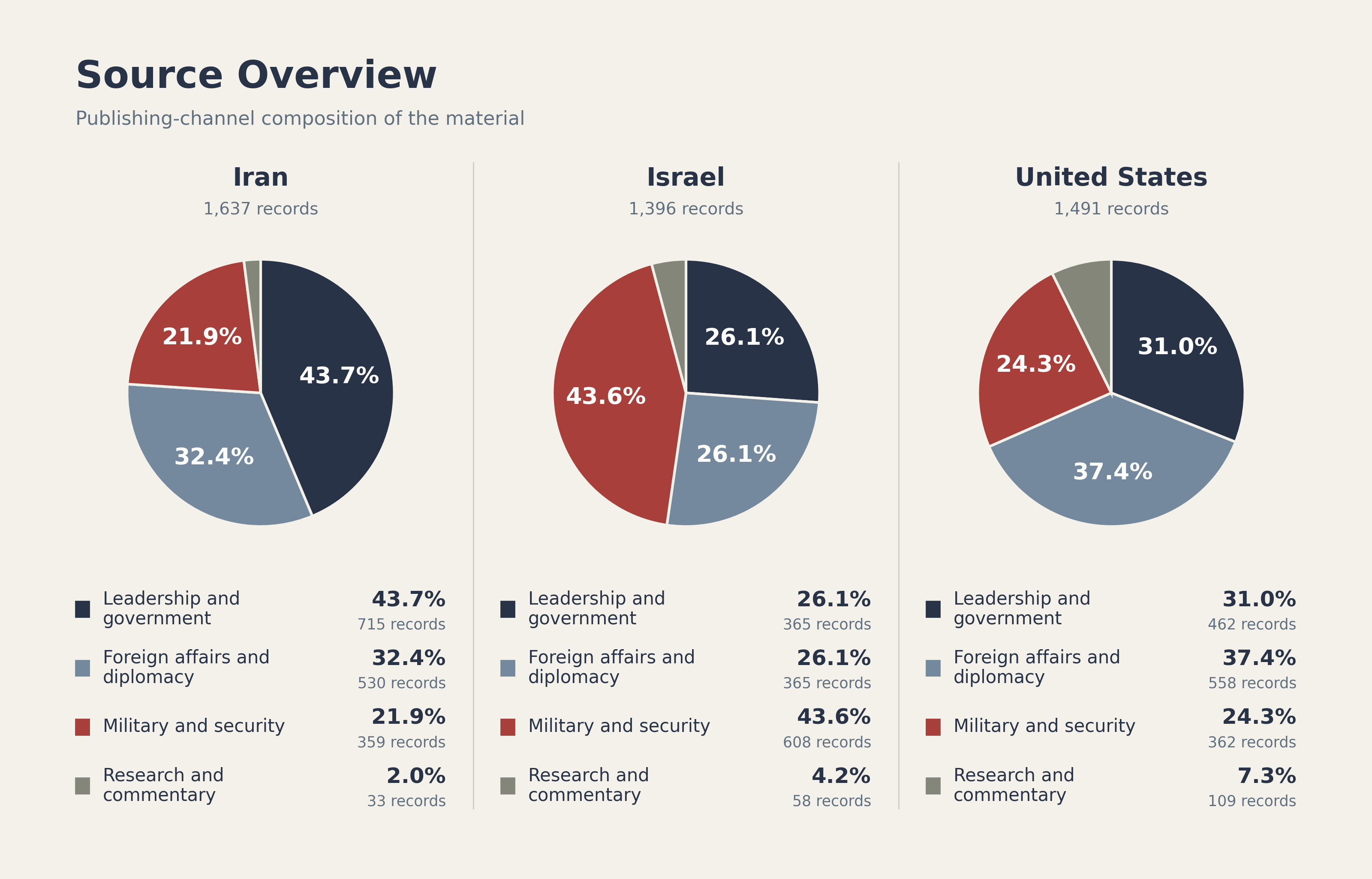
In order to answer these questions, a large body of official communication has been compiled and analyzed. The Source Stack contains 4,524 records of communication dated between 14 February and 8 April 2026: 1,637 attributed to Iran, 1,396 to Israel and 1,491 to the United States. A record refers to a collected source entry rather than necessarily a unique statement. Entries include short social media posts as well as longer statements and articles. Exact-text checks were used to identify duplicates. In the qualitative analysis, identified cross-posts and translated reproductions were treated as circulation of the same statement rather than confirmation. These entries cover the immediate pre-conflict phase, the outbreak of fighting on 28 February and communication surrounding the April ceasefire. The Source Stack reflects the availability of retrievable material and covers material available from the respective sources directly or indexed entries. However, it is not a statistically representative sample.
The collection was designed to cover major political and military communicators: heads of state and government, presidential and government offices, foreign ministries and ministers, armed forces and defense institutions, UN missions and ambassadors, and selected senior officials. It also contains think-tank and policy commentary. Such commentary helps locate official messages within a wider political and strategic debate, but its authors’ arguments are distinguished from statements made on behalf of a government. The graphic below summarizes the composition of this source base.
The analysis used AI-assisted reading of the source material to group passages according to the arguments they made about threats, responsibility, legitimate action and success. These arguments were compared across speakers and dates to identify recurring explanations, changes and contradictions. A frame is treated as central where its recurrence and explanatory role make it important to the justification, conduct or intended outcome of the war. The analysis also examines contradictions, ambiguous statements and differences between institutions. Coding decisions and translations were reviewed through subsequent AI checks, while an editorial review of selected quotations and interpretations was performed manually.
The object of analysis is what these sources communicated. Claims about civilian casualties, target destruction, legal entitlement and enemy intentions cannot be verified by this analysis and are attributed to the respective party accordingly. The material shows how the three governments sought to make their actions intelligible and legitimate. It does not establish whether audiences accepted that account, whether centrally coordinated instructions produced similar wording, or whether the stated military effects occurred.
Legalism and Retaliation
Iran Overview
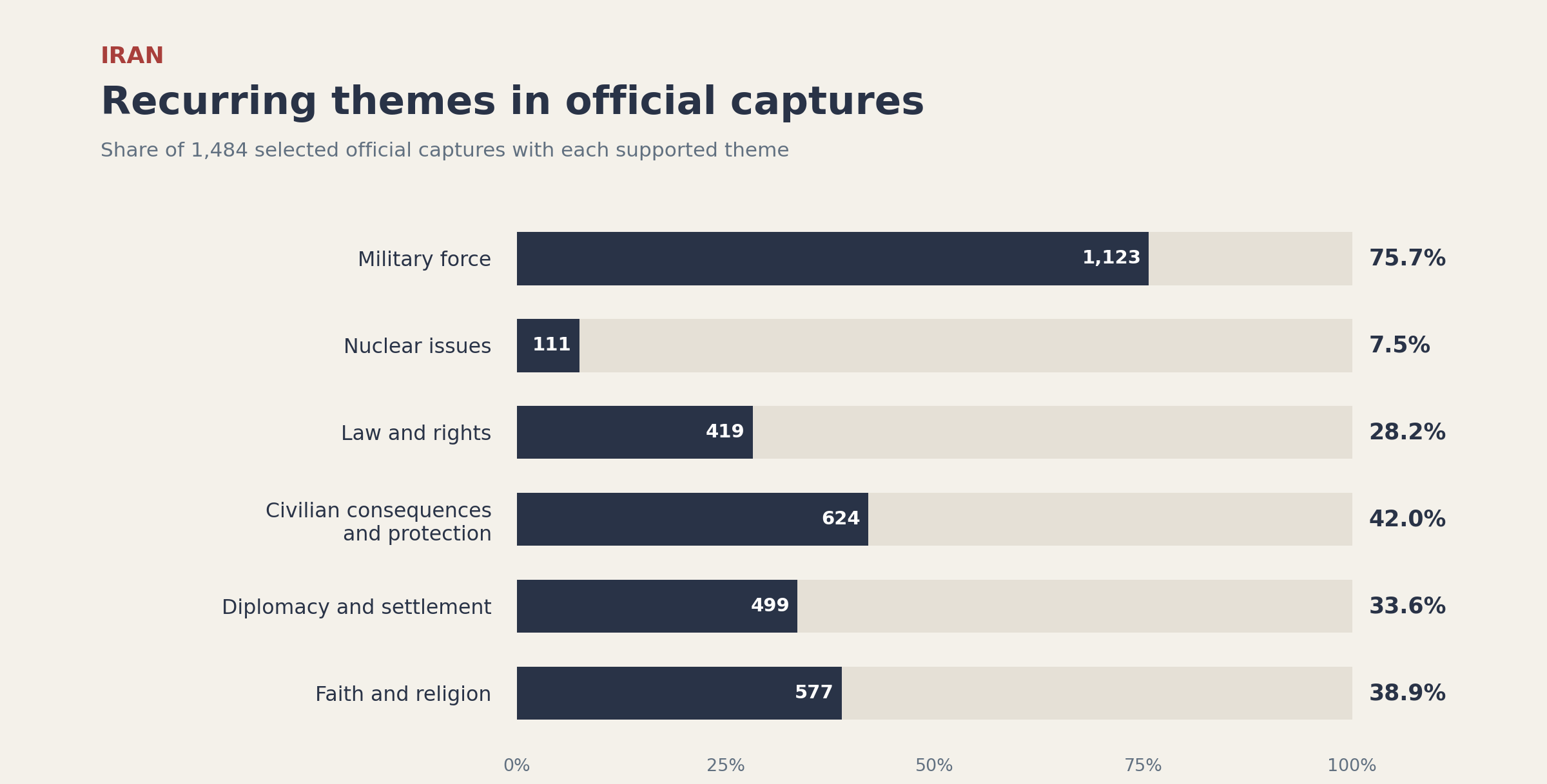
Iran portrayed itself as a peaceful, ancient and Islamic-revolutionary nation attacked by the United States and Israel in the midst of diplomacy. Its central claim is that the nation remains capable of governing itself and defending its rights despite attempts to destroy its leadership or turn its people against the state. Civilian sacrifice, continued public participation, uninterrupted services and retaliatory reach become different forms of evidence for that claim. Endurance is also presented as a source of control over the war’s duration and its political conclusion. The wider resistance front connects national defense to a project of regional transformation. Negotiations must consequently appear to consolidate the rights and authority preserved by resistance, while the state retains the ability to resume force if those gains are denied. These arguments draw on several recurring themes, whose frequency in the collected Iranian communication is shown below.
Iran named its response to the February 2026 US-Israeli attacks ‘Operation True Promise 4’, continuing the sequence that included ‘Operation True Promise III’ during the June 2025 war. The naming reinforced the claim that attacks on Iran would continue to receive a military response. Official descriptions of the conflict as an ‘imposed war’ assigned responsibility for its outbreak to Washington and Israel, presenting Iran’s use of force as a defensive response rather than a decision to initiate hostilities.
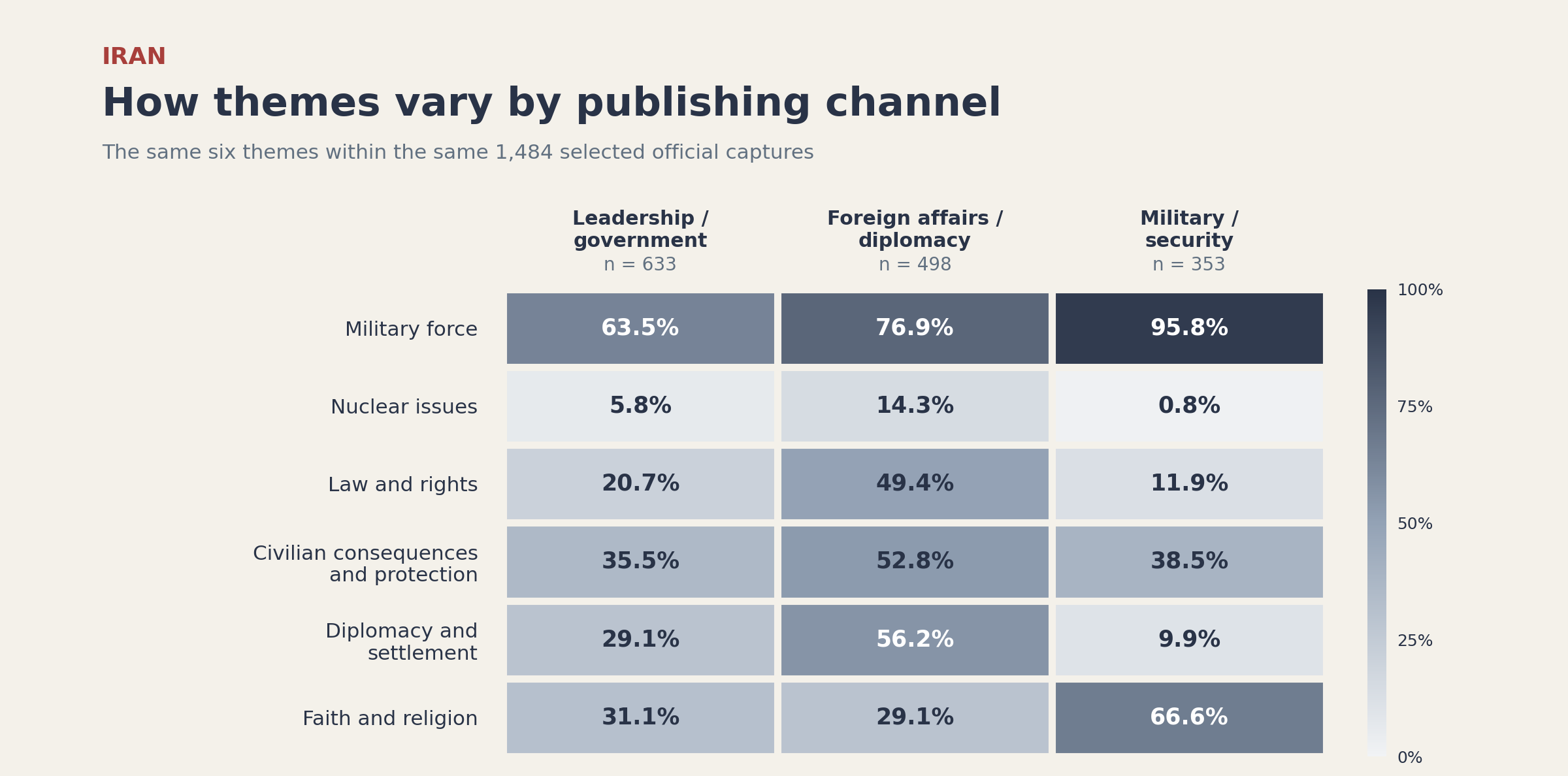
The channel comparison below shows how thematic emphasis varies within this broader account. The Foreign Ministry, foreign minister and UN mission supply its principal legal and diplomatic arguments. Sepah News emphasizes operational military updates, retaliation accounts and religiously framed statements. Government and presidential channels combine civilian-harm reporting with routine governance accounts, while the leadership’s communication stresses continuity, national endurance and Islamic-revolutionary commitment. Senior officials on X sometimes use sharper, more idiomatic appeals to Western political debates.
The following subsections examine the main narrative frames alongside the supporting appeals that sustain them.
Legal Rights and Diplomatic Restraint
Legalism is a central organizing frame within Iran’s diplomatic and international-facing communication. The initial attacks, Iranian military responses, nuclear rights and the use of regional territory are repeatedly discussed through specific legal instruments. This register is especially associated with the Foreign Ministry and UN mission.
In response to this act of aggression, the Islamic Republic of Iran will exercise its inherent and legal right to self-defense in accordance with Article 51 [...]. Accordingly, all bases, installations, and assets of the hostile forces in the region are considered legitimate military targets.
1 Mar, mfa.gov.ir
The recurring anchors are Article 51 of the United Nations (UN) Charter on self-defense and Article 2(4) on the prohibition of force. Iranian diplomats also invoke General Assembly Resolution 3314, particularly its provision concerning territory placed at another state’s disposal for aggression, to argue that regional hosts are responsible for attacks launched from their territory.
References to the Non-Proliferation Treaty and the International Atomic Energy Agency (IAEA) extend the same rights-based argument to the nuclear dispute. Pezeshkian’s 17 February statement pairs a denial of weapons ambitions and an offer of verification with refusal to abandon peaceful nuclear industry. Khamenei’s communication on the same date links that industry to medicine, agriculture and energy.[2] The nuclear program is presented as the country’s capacity to develop and govern ordinary life. External verification procedures may be negotiated, but abandoning the technological capacity itself is presented as surrendering a national entitlement.
We are ready for any verification in this regard. However, we will not accept abandoning Iran’s peaceful nuclear industry for medical, agricultural, industrial and other purposes.
17 Feb, Pezeshkian (dolat.ir)
Diplomatic efforts are an anchor for Iranian argumentation. The Foreign Ministry’s 28 February statement stresses that the US-Israeli attack occurred while negotiations were underway and presents Iran’s participation in those talks as evidence that it had sought to prevent war. This places responsibility for the transition from negotiation to violence on Washington and Israel. Iran’s nuclear and missile capabilities cease to be the primary question. The conduct of the states attacking it becomes the issue that the international community is asked to judge.
This renewed military aggression by the United States and the Zionist regime has occurred while Iran and the United States were in the midst of a diplomatic process.
28 Feb, en.mfa.gov.ir
The 28 February statement also says Iran entered negotiations despite anticipating another attack, in order to demonstrate its position before the international community. Diplomacy thus serves a second purpose beyond reaching an agreement: participation becomes evidence that the state had exhausted a peaceful route.
The nuclear dispute sharpens the argument about failed protection against external aggression. Araghchi’s 17 February disarmament speech contrasts Iran’s membership of the Non-Proliferation Treaty with Israel’s position outside it, and accuses a treaty depositary, the United States, of attacking a member alongside a non-member.[5] His 5 April letter extends the accusation to the credibility of IAEA safeguards and warns that institutional failure could erode other states’ confidence too. The intended audience includes governments that rely on the same arrangements. Iran asks them whether accepting verification and treaty obligations still secures the protection those institutions are supposed to provide.
Recent developments have shown that any assurances from the Agency, even if given, cannot be relied upon as a guarantee of national security, the protection of national interests, or the inalienable rights of States to the peaceful use of nuclear energy.
5 Apr, Araghchi letter to the UN (mfa.gov.ir)
In consequence, Iranian communication connects the stated breach of legal rights to a legitimate right of retaliaton. International law supplies the account of illegal actions and the rights that must be restored. Military resistance is presented as necessary because the institutions charged with protection have failed. Force is presented as necessary in securing an enforceable settlement and preventing a repetition of illegal actions. The narrative therefore preserves an appeal to the legal order while arguing that its promises cannot substitute for Iran’s own capacity to respond to its violation.
Reversing Victim and Aggressor
Closely connected to legalism is criticism of international bodies, especially the UN Security Council. Following the Council’s 11 March resolution condemning Iranian attacks on neighboring states, Iran argued that the institution had reversed the roles of victim and aggressor. The dispute concerned the chronology used to assign responsibility: a resolution centered on Iran’s regional attacks appeared, in Tehran’s account, to detach those actions from the US-Israeli attack that preceded them.
The very purpose of this biased and politically motivated text [...] is clear: to reverse the roles of victim and aggressor [...]. Today it is Iran; tomorrow it could be any other sovereign State.
12 Mar, Amb. Iravani (newyork.mfa.ir)
This allows Iran to defend the authority of international law while challenging the institutions applying it. The appeal to other sovereign states broadens the stakes: accepting this reversal would, Iran argues, establish a precedent that could later be used against them. Legal vocabulary therefore serves both a claim to protection within the international order and a condemnation of its selective enforcement.
Civilian Harm and the Minab School Strike
Iranian communication repeatedly inventories damage to homes, hospitals, schools and cultural sites. The strike on the Minab girls’ school on 28 February becomes a particularly prominent reference point across diplomatic, presidential and military statements. It condenses a complex argument into an immediately recognizable image: children killed in a campaign justified by the attackers as a response to a security threat.
Over 150 schoolgirls in the southern Iranian city of Minab were murdered [...]. Children whose feet did not even reach the floor from their school desks — how exactly were they an 'imminent threat' [...]?
1 Mar, Iran UN Mission X
The question of how schoolchildren could constitute an imminent threat directly contests the adversary’s justification for war. Minab also connects mourning to demands for accountability and retaliation.
Civilian-harm reporting also describes what is at stake in national survival. Pezeshkian’s 2 March distinction between hospitals as life and schools as the nation’s future makes each damaged institution signify something beyond its immediate function. Later Foreign Ministry accounts of attacks on universities and the Pasteur Institute, alongside the response to threats to return Iran to the Stone Age, portray the campaign as an assault on knowledge, health and Iranian existence.[9, 10] This challenges the adversary’s distinction between fighting the governing system and supporting its people: harm to the country’s means of reproducing ordinary life is offered as evidence that the population itself is under attack.
Attacks on hospitals strike at life itself. Attacks on schools target a nation's future.
1 Mar, Pezeshkian X
Martyrdom and the Meaning of Loss
The language of shahadat, or martyrdom, repeatedly gives death a religious meaning, particularly in leadership and armed-forces communication. Killed leaders, soldiers and civilians are placed within a tradition of righteous sacrifice. Loss is acknowledged, but its significance is redefined: the death of a defender can affirm the cause rather than demonstrate its futility.
The lofty spirit of the leader [...] Imam Khamenei, joined the kingdom of heaven by drinking the nectar of martyrdom in the holy month of Ramadan.
1 Mar, Supreme National Security Council statement (dolat.ir)
Attacks on senior leaders could be read as evidence of a state unable to protect its own leadership. Martyrdom recasts those losses as an obligation to remain loyal and continue resistance. It supplies a political and religious reason why material loss should not produce submission.
Martyrdom also makes retaliation a duty owed to particular people. Mojtaba Khamenei’s 12 March message describes every killed Iranian as an independent case in a continuing process of accountability, gives special weight to Minab, and links reparations to the seizure or destruction of enemy assets if payment is refused. The state is presented as the custodian of an obligation that survives the immediate battle.
Every member of the nation martyred by the enemy constitutes an independent case in the file of revenge.
12 Mar, Mojtaba Khamenei (farsi.khamenei.ir)
Institutional Continuity and National Cohesion
Institutional continuity supplies a complementary answer to the killing of senior figures. Where martyrdom explains the meaning of death, succession messaging explains why government and resistance can continue. A 6 March publication on Khamenei’s website republished his earlier account of the Assembly of Experts to argue that leadership selection prevents an interruption in the Islamic system.
The existence and establishment of the Assembly [of Experts] means that the movement of the Islamic system does not stop; no interruption occurs.
6 Mar, Earlier remarks by Ali Khamenei republished (farsi.khamenei.ir)
The subsequent announcement of Mojtaba Khamenei’s selection on 8 March turned that principle into a public demonstration of succession under attack. Allegiance to the successor and continued military activity could then be presented as evidence that the system had survived attempted decapitation. This is crucial to the wider narrative: later retaliation and negotiations are presented as acts of a continuing sovereign authority, rather than concessions by a state whose political center has collapsed.
The Assembly of Experts [...], despite the acute war conditions and direct threats by the enemies against this popular institution [...], did not hesitate for a moment in the process of selecting and introducing the leadership of the Islamic system and, in accordance with the duties stipulated in the Constitution and the internal regulations of the Assembly of Experts, put the necessary measures and arrangements on its agenda to hold an extraordinary session and introduce the new leader.
8 Mar, mfa.gov.ir
Continuity is also located in the population. In his 12 March message, Mojtaba Khamenei credits the people with maintaining the country’s authority during the absence of a leader and commander-in-chief. His 20 March Nowruz message presents unity across religious, cultural and political differences as thwarting the enemy’s effort to detach the population from the governing system. The Government Information Council had already called for common resistance on 28 February while acknowledging public grievances.[16] These statements allow disagreement with domestic conditions to coexist with defense of the country. They also contest the US-Israeli appeal to separate Iranians from their rulers: official Iranian communication represents public participation as the reason that separation cannot be accomplished by bombardment.
It was you, the people, who led the country and guaranteed its authority.
12 Mar, Mojtaba Khamenei (farsi.khamenei.ir)
Public gatherings serve both as a claimed demonstration of political authority and as an instruction to keep reproducing it. The population’s continued presence is offered as evidence that external pressure has failed to make it withdraw. Participation thus becomes a means of maintaining the authority it is invoked to demonstrate.
Routine government communication supplies a practical counterpart. The opening government notice assures citizens about medicine, fuel, basic goods and banking.[18] Aref’s 28 March account links municipal reconstruction and continued services to the presence of people in the streets and fighters in the field. Such reporting makes governing capacity part of the war’s meaning: a state that continues to provide for citizens is presented as capable of surviving attacks on its leadership and infrastructure.
The path of serving the people and progressing the country will continue without interruption, even in wartime conditions.
28 Mar, Vice President Aref (dolat.ir)
The Nowruz message also makes economic performance part of defense. Mojtaba Khamenei identifies longstanding economic and managerial weaknesses as an opening for enemy exploitation, then describes livelihoods, infrastructure and the creation of public wealth as means of countering economic war.[20] Continued services and production acquire a further strategic meaning: they are supposed to reduce the vulnerability through which pressure could turn citizens against the state. Acknowledging shortcomings can thus support the resistance narrative when attached to an official promise to address them.
The appeal to cohesion also places limits on acceptable public disagreement. The Nowruz message describes media attention to weaknesses as a possible contribution to the enemy’s campaign against national unity.[21] Praise for a population with different political backgrounds therefore sits alongside pressure to subordinate criticism to collective defense. The narrative invites a broad national constituency while reserving official authority to decide when disagreement becomes harmful to the nation.
I therefore recommend that our domestic media, despite the intellectual, political and cultural differences they may possess, seriously refrain from concentrating upon points of weakness.
20 Mar, Mojtaba Khamenei (farsi.khamenei.ir)
The concern with cohesion belongs to a wider account of war against minds and hearts. A 25 February commentary describes psychological and media warfare as continuing between military confrontations, with fear, rumors and the presentation of surrender as reasonable designed to remove citizens from the defense effort. Mojtaba Khamenei’s 20 March account connects the earlier military conflict, January events described as a coup, and the present war within an ongoing hostile campaign. They make political passivity, as well as active opposition, interpretable as an effect of enemy pressure.
The victims of cognitive war are not killed; they are removed from the defense front through passivity or by joining the enemy.
25 Feb, commentary on khamenei.ir
An 18 February Sepah News interview with the head of IRGC intelligence, Majid Khadami, places economic pressure, cognitive operations and domestic unrest within a campaign to preserve a condition of “neither war nor peace”.[24] This supplies an official security account alongside the commentary about hearts and minds. Military attack, sanctions and pressure on the domestic political sphere are represented as instruments that can substitute for one another. A lull in bombing therefore need not mean that the campaign against Iran has ended.
There is a different proposed answer to that vulnerability in the wider policy discussion. A 21 February SCFR essay argues that foreign exploitation of protest is best countered through governance reform, transparent institutions and legal channels for peaceful demands, while distinguishing protest from organized violence. This is an author’s prescription, rather than a government commitment. It shows that the Source Stack contains an argument for strengthening security by preserving political participation, alongside official pressure to restrain criticism during war.
The first strategy is to strengthen legal mechanisms to express demands and protest peacefully.
21 Feb, scfr.ir
Continued Operations and Control over Duration
Sepah News devotes extensive coverage to military operations. A recurring format combines a numbered wave of Operation True Promise 4, a religious code phrase, a target list and claims of successful strikes. Technical descriptions of missiles and drones sit alongside invocations of Shiite religious figures. This is a reporting format through which the broader claim of effective resistance is made visible.
The "twenty-seventh" wave of Operation Sadiq's Promise 4 with the blessed code "Ya Haider Karar peace be upon him" was successfully implemented during a combined drone and missile operation against American and Zionist targets.
7 Mar, sepahnews.ir
The serial structure has a distinctive function. Each additional wave presents retaliation as an ongoing capacity rather than an isolated response. Named weapons and locations give the claims specificity, while reported penetration of enemy defenses challenges the image of US and Israeli military invulnerability.
The strategic claim behind continued operations concerns who can determine the war’s duration. Araghchi’s 1 March post invokes lessons from American campaigns to Iran’s east and west and identifies “Decentralized Mosaic Defense” as the reason attacks on the capital cannot dictate the outcome. The IRGC spokesperson’s 8 March claim that the armed forces could sustain six months of intense war similarly disputes the prospect of a quick collapse. Dispersed capacity and institutional replacement are presented as depriving decapitation and bombardment of their expected political result.
Bombings in our capital have no impact on our ability to conduct war.
1 Mar, Araghchi X
The Armed Forces have the capability to continue at least six months of intense war at the current operational tempo.
8 Mar, IRGC Spokesperson (sepahnews.ir)
This turns time into a resource that Iran claims to possess and the aggressor must pay for. Resistance is expected to erode opposing forces and raise the political and economic costs of continuing until the enemy accepts a different settlement. The claim reaches beyond deterring another attack: Iran presents itself as able to frustrate the present attempt at coercion by sustaining the conflict on terms the opponent cannot cheaply terminate.
The same reasoning contests the indicators through which military decline might be inferred. Ghalibaf’s 11 March post says large early salvos were intended to blind enemy defenses and that fewer missiles can now reach chosen targets. A possible sign of depleted capacity is recast as evidence of a completed preparatory task and improved efficiency. Serial waves establish continuing agency, while this explanation protects the claim of effectiveness when the volume of launches changes.
Now, Iran can target any location it chooses with fewer missiles.
11 Mar, Ghalibaf X
Retaliation
Retaliatory rhetoric links the costs Iran suffers to costs it promises to impose. Some statements specify reciprocal categories, such as infrastructure for infrastructure. Others threaten a response exceeding equivalence. The two formulations share a deterrent purpose but establish different expectations about the scale of punishment.
Today we establish the rule of "an eye for an eye" — without ceremony, without exception. If they start a war against infrastructure, we will undoubtedly target infrastructure.
10 Mar, Ghalibaf X
This time the equation will no longer be an eye for an eye; wait!
27 Mar, IRGC Aerospace Force Commander Mousavi quoted by farsi.khamenei.ir
The movement from reciprocal language to threats of punishment beyond equivalence broadens what resistance is claimed to permit. Diplomatic statements continue to emphasize lawful defense, while military and political voices stress the costs the adversary must suffer. This is a tension between registers within Iran’s communication.
The target category also expands through claims about participation in the enemy’s war. The IRGC’s 31 March notice identifies American technology and other companies as contributors to targeting and threatens their regional facilities in response to assassinations. Employees and nearby residents are warned to leave. The communicative move is to recategorize commercial infrastructure as part of the machinery of aggression, then present attacks on it as retaliation with prior warning. That claimed connection extends the reach of punishment while preserving an asserted distinction between the target and people around it.
Since the main element in designing and tracking terrorist targets are American ICT and AI companies, in response to these terrorist operations, from now on, the main institutions effective in terrorist operations will be our legitimate targets.
31 Mar, IRGC notice No. 51 (sepahnews.ir)
Other statements extend the target category through different kinds of association. The IRGC’s 14 March bank warning uses reciprocity with attacks on Iranian banks, and its 29 March university warning applies a similar logic to universities identified with the United States and Israel.[33, 34] Ghalibaf’s 22 March post invokes financial support for the American military and explicitly addresses purchasers of Treasury bonds. Alongside the technology-company notice, these statements move from operational contribution to financing and affiliation with an enemy state. Each connection broadens who can be made to bear the costs of war.
U.S. Treasury bonds are stained with the blood of Iranians.
22 Mar, Ghalibaf X
Prior warnings and opportunities to prevent retaliation are part of the justification. Recipients are told that changing their conduct, distancing themselves or pressing Washington to act can avert an attack. Responsibility is thereby pushed outward onto the state, institution or people given the warning. This asserted opportunity to avoid harm supports Iran’s presentation of restraint, while the widening grounds for inclusion create a tension with its initial emphasis on hostile military assets. Notice and asserted association do not establish that a proposed target is lawful.
Iran’s international-facing communication makes a parallel claim to restraint. Araghchi’s 10 March interview denies intentional attacks on civilians, distinguishes unintended harm from deliberate targeting, and accuses the United States of deliberately striking civilian facilities. The UN mission’s 7 March statement offers a further explanation for some non-military impacts, suggesting that US electronic defenses may have diverted projectiles.[36] These claims give audiences ways to reconcile civilian harm with Iran’s account of lawful resistance.
There may be collateral damage, but that is not our plan.
10 Mar, Araghchi interview (mfa.gov.ir)
Military communication sometimes gives civilian experience a more affirmative role in the account of retaliation. Sepah News on 19 March presents prolonged Israeli shelter life as an effect of Iranian strikes, and its 1 April account associates shelter confinement with the Passover holiday.[38] Such passages make fear and disruption part of the evidence that resistance has imposed a cost. This sits uneasily alongside the diplomatic emphasis on unintended civilian harm. Celebrating civilian distress does not by itself prove intentional targeting of civilians, but it shows that their experience can be incorporated into the claimed achievement of operations.
Life in the shelter has become the daily routine of the Zionists, and sometimes they cannot come out.
19 Mar, IRGC operational account (sepahnews.ir)
Asymmetric Adversary Characterization
Israel and the United States are characterized differently. Israel is almost never called simply "Israel". Iranian official sources commonly use terms such as ‘the Zionist regime’ and ‘the occupying regime’, alongside accusations of child-killing and genocide. This vocabulary challenges Israel’s political legitimacy and associates it with a continuous record of wrongdoing. Israel is mostly treated as a unitary, essentially criminal actor and a consideration of Israeli society as a prospective partner against Israeli government actions is not evident in the material examined for this analysis.
The Israeli regime has committed the most heinous crimes with complete impunity over the past eight decades. [...] There is no crime that it has not committed and no red line that it has not crossed.
17 Feb, dolat.ir
As the conflict progresses, Iranian sources issue direct threats against Israel and prominent Israeli figures such as Netanyahu. Such passages illustrate the intensity of adversary characterization without establishing that every Iranian institution employed identical language. More severe explicit threats are almost exclusively found within Sepah News communication.
The unknown fate of the criminal Zionist Prime Minister [...] reveals the crisis and the weakness of the Zionists. If this child killer is alive, we will continue to pursue and kill him with force.
15 Mar, sepahnews.ir
The United States receives a parallel but different treatment. Formal references to the US government coexist with descriptions such as ‘American terrorists’ or ‘the terrorist army’. At the same time, officials explicitly distinguish the American people from the government’s policies.
We do not regard the American people as our enemy. We regard the policies of the U.S. government against Iran as hostile.
20 Feb, mfa.gov.ir
Appeals to American Opinion
The distinction between the American government and public permits severe threats against leaders alongside appeals to Americans who might reject the war. Iranian officials present US involvement as serving Israeli interests at American expense. Araghchi’s response to Rubio’s account of the war’s immediate trigger, for instance, frames American intervention alongside Israel as political subordination.
Mr. Rubio admitted what we all knew: U.S. has entered a war of choice on behalf of Israel. [...] Shedding of both American and Iranian blood is thus on Israel Firsters. American people deserve better and should take back their country.
3 Mar, Araghchi X
References to American protests, such as a Marine’s floor protest in Congress or the “No Kings” protesters, and criticism reinforce this attempt to separate the public from the administration.[44, 45] Its distinctive feature is the use of the opponent’s political vocabulary: ‘Israel Firsters’ challenges the administration’s claim to put America first. Iranian communication thus seeks support without requiring Americans to endorse Iran’s government. It asks them to see the war as contrary to their own interests.
The same engagement reaches the opponent’s central vocabulary. Larijani’s 5 March post uses the deaths of the Minab schoolgirls to challenge “peace through strength”. Pezeshkian’s 6 March post juxtaposes Netanyahu’s appeals to Iranians, Americans and his domestic audience as evidence of audience-dependent deception.[46] These are efforts to expose inconsistency inside the adversary’s account. They ask audiences to reinterpret the opponent’s own language of peace and liberation through the harm attributed to its actions.
With the mass martyrdom of innocent girls from Minab in a school at the hands of American-Israeli criminals, the theory of “peace through strength” has been stained with blood.
5 Mar, Larijani X
Pezeshkian’s 1 April letter gives this appeal a longer history and a test Americans can apply themselves. It moves from the 1953 coup through sanctions and attacks during negotiations, locating distrust in repeated US choices rather than an inherited hostility toward Americans. It also points to Iranian graduates working in Western universities and technology firms and invites readers to consult people who have visited Iran. Familiar encounters with Iranians are offered as a way to challenge the threatening image attributed to US messaging. The letter combines an indictment of American policy with recognition of Americans’ ability to reach a different judgment.
Do these realities align with the distortions you are being told about Iran and its people?
1 Apr, Pezeshkian X
The hierarchy assigned to the two adversaries differs across these appeals. Araghchi’s 3 March appeal and Pezeshkian’s 1 April letter to Americans cast Washington as acting for Israel. Mojtaba Khamenei’s 1 April letter to Hezbollah instead calls Israel America’s regional proxy, placing the struggle within resistance to American domination. Both formulations describe an interconnected hostile front, but reverse the relationship of direction and dependence. Audience adaptation could help explain this reversal, although differences between speakers and occasions also remain possible explanations.
Without a doubt, perseverance, resistance and patience in the face of the most stubborn enemies of the Islamic world, namely America and its proxy force in the region - the cruel Zionist regime - were among the most prominent characteristics of the martyred Imam.
1 Apr, Mojtaba Khamenei letter to Hezbollah (farsi.khamenei.ir)
Regional Solidarity and Security Order
Regional states receive a dual message. Expressions of neighborliness coexist with warnings about the use of their territory by US forces. Iranian officials describe attacks on American facilities as directed against the United States, while urging host governments to prevent those facilities from being used against Iran. This is a coercive choice presented in the language of regional solidarity.
The countries of the region must either prevent the United States from using their territory against Iran themselves, or we will prevent it.
7 Mar, Larijani X
This argument also challenges the security bargain between neighboring states and Washington. Mojtaba Khamenei’s 12 March message urges the closure of American bases and describes the US promise of security as a lie.[51] The neighbors are offered friendship while being told that hosting US forces exposes them to the conflict. Iranian coercion is thereby represented as revealing the danger of dependence on an external protector. The promise of a safer region remains conditional on those governments changing the arrangements Iran identifies as the source of insecurity.
The tension between regional friendship and coercion becomes especially visible in the handling of apology. On 7 March, Pezeshkian apologized to neighbors affected by Iran’s responses and announced a conditional instruction against attacking them unless attacks originated from their territory. Araghchi’s 8 March explanation said Trump had misread the initiative as weakness and destroyed the possibility of de-escalation.[52] His 18 March interview described apology as strength and honor while assigning responsibility for regional harm to the original American attack.[53] Iran thus tries to acknowledge injured neighbors without abandoning either its justification for retaliation or its claim to political resolve.
We apologize to neighbors affected during our responses to enemy aggression.
7 Mar, Pezeshkian X
The various explanations for harm should be kept distinct. A conditional apology acknowledges that regional people were affected. Claims of unintended damage or diverted projectiles dispute targeting or responsibility for particular impacts. Leadership claims that some attacks were false flags deny Iranian involvement altogether.[55] These arguments perform different tasks and cannot be combined into one factual explanation. Their coexistence reveals the difficulty of preserving good-neighborliness while widening retaliation, without demonstrating an internal dispute over command.
Hormuz extends the same reasoning beyond the bases. In his 12 March message, Mojtaba Khamenei explicitly called for continuing the leverage associated with closing the strait. The implication is that Iran’s insecurity cannot be confined to Iran: regional hosts and the wider economy also have something to lose if attacks continue. This creates pressure for intervention on behalf of a ceasefire, but strains the claim of good-neighborliness by exposing neighboring societies and third parties to the costs of resistance.
The leverage of closing the Strait of Hormuz must definitely continue to be employed.
12 Mar, Mojtaba Khamenei X
The diplomatic treatment of Hormuz adds a claim to regulated passage. The Foreign Ministry’s 22 March statement denies that the strait is closed and offers safe passage to non-hostile vessels that meet its conditions and coordinate with Iranian authorities. It also insists that any future maritime security arrangement respect Iranian rights and involve those authorities. This presents Iran as an indispensable participant in regional order, with authority to distinguish legitimate commerce from assistance to its attackers. The leadership’s language of closure and the ministry’s language of conditional passage differ, but both claim a capacity to determine the terms on which transit can occur.
Non‑hostile vessels belonging to or associated with other countries, provided they do not participate or cooperate in the aggressive operations against Iran and comply with the declared safety and security rules and measures, may benefit from safe passage through the Strait of Hormuz in coordination with the competent Iranian authorities.
22 Mar, en.mfa.gov.ir
Araghchi’s 22 March formulation also links freedom of navigation to freedom of trade. This rejects a division in which the international community protects passage through the strait while accepting restrictions on Iran’s economic exchange. Maritime order is presented as reciprocal, and Iran’s capacity to interrupt it as a means of forcing recognition of its own economic rights.
Freedom of Navigation cannot exist without Freedom of Trade.
22 Mar, Araghchi X
There is also a positive account of what should replace reliance on American protection. Ghalibaf’s 20 March Eid message proposes bilateral and multilateral security and economic agreements among regional states, grounded in Islamic brotherhood. The government’s 8 April presentation of its demands includes the withdrawal of US combat forces.[59] The proposed settlement would alter the source and distribution of regional security, giving local states a common framework while excluding the external actor portrayed as producing insecurity. This official regional project is more concrete than the wider commentary about multipolarity.
Through bilateral and multilateral security and economic agreements, we can establish a new system in the region from which all its countries benefit: stable and trustworthy security, without the enemies of Islam and humanity being able to infiltrate it.
20 Mar, Ghalibaf Eid message X
The promise of relations without Iranian domination coexists with demands that neighboring governments change their security arrangements and with Iran’s assertion of authority over passage through Hormuz. The tension is substantive: the proposed order claims to restore the region’s own agency, yet Iran’s capacity to impose costs supplies leverage over which choices its neighbors can safely retain. Islamic and regional solidarity provide a language of common benefit, while coercion is used to move states toward the arrangement Iran advocates.
Resistance Front and Revolutionary Horizon
The resistance front gives this regional horizon an ideological and military element. Mojtaba Khamenei’s 12 March message identifies resistance as inseparable from the values of the Islamic Revolution and thanks Hezbollah and Iraqi and Yemeni actors for their participation. Quds Force commander Esmail Qaani’s 20 March message praises the front’s capacities while claiming that its members entered the war independently.[61] Sepah News then presents the 31 March wave as part of an expanding effort involving Iranian forces and those partners.[62] Solidarity, claimed autonomy and combined operational effects all support the same account of a front larger than the Iranian state.
We regard the countries of the Resistance Front as our best friends, and resistance and the Resistance Front as an inseparable part of the values of the Islamic Revolution.
12 Mar, Mojtaba Khamenei (farsi.khamenei.ir)
That front connects two political horizons. Immediate resistance is justified as defending Iran against attack. The 31 March IRGC account also describes a longer process of eroding US and Israeli power in preparation for a final struggle over Jerusalem. A 13 March IRGC statement explicitly links the liberation of Quds to the destruction of Israel, using the designation “usurper”.[64] The communication therefore includes a revolutionary objective that extends beyond restoring Iran’s prewar security. Presenting the entire system only through peaceful self-defense would leave that declared horizon unexplained.
We have considered a long-term horizon for the erosion of the power of the Zionist regime and the American army in the region in order to prepare the ground for the final battle and the movement of the Islamic Ummah towards the occupied Jerusalem.
31 Mar, IRGC account of wave 88 (sepahnews.ir)
The front also defines the geographic scope of an acceptable peace. Araghchi’s 18 March interview requires an end to war across the region, and the government’s 8 April demands specifically include Lebanon’s Islamic Resistance.[66] His 8 April post treats continued Israeli fighting in Lebanon as incompatible with Washington’s ceasefire commitment. Partner protection is thereby placed inside Iran’s own test of settlement. This resists an outcome in which Iran pauses its operations while its allies remain exposed, and makes US responsibility include the conduct of Israel on another front.
The ball is in the U.S. court, and the world is watching whether it will act on its commitments.
8 Apr, Araghchi X
Civilizational Durability
Iran’s antiquity is set against the comparative youth of the United States and Israel to portray national endurance as deeper than any military campaign. This recurring self-presentation becomes a direct reply to coercive threats in the UN mission’s 2 April statement, issued after Trump’s threat to “bomb Iran back to the Stone Age”. Civilizational continuity is offered as a limit on what military destruction can accomplish.
Iran’s civilisation spans more than 7,000 years, whereas the U.S. is scarcely 250 years old. [...]. Such a civilisation cannot be destroyed by bombing.
2 Apr, Iran UN Mission
This shifts the scale on which damage should be interpreted. Buildings and military assets may be destroyed, but the nation is represented as something longer-lived than either the attackers or the current war. The register can also speak beyond a specifically revolutionary constituency: defending Iran’s historical existence offers a basis for national solidarity that does not require identical attitudes toward its political institutions.
The civilization being defended is also presented as capable of future development. Pezeshkian’s 1 April letter points to advances in education, healthcare and technology, while Araghchi’s 29 March response to attacks on universities says knowledge cannot be bombed away.[69] Ancient continuity and modern scientific achievement reinforce one another: the nation’s depth explains why coercion cannot extinguish it, and its ability to reproduce knowledge explains how it can continue despite physical destruction.
Israel and its partner-in-crime believe that knowledge can be bombed away.
29 Mar, Araghchi X
The appeal to national continuity can include citizens beyond the majority religion. Ghalibaf’s 5 April posts honor a Christian Iranian killed in the conflict and relate Christian sacrifice to defense of the country.[71, 72] His 7 April post invokes damage to a Tehran synagogue to accuse Zionism of hostility to authentic religiosity.[73] These examples bring religious minorities inside the national constituency while preserving the distinction between Judaism and the “Zionist” enemy. They support a broad claim about who belongs to Iran, without establishing how widely that claim is accepted.
Moral Authority and the Critique of the West
Civilizational comparison also contests the moral authority claimed by the West. A 26 February essay on Khamenei’s website uses the Epstein case to argue that liberal individualism and weakened religion have produced moral decline. This is policy commentary on an official platform, but the motif also circulates through statements by senior officials. Its role is to challenge the standing of Western leaders to judge Iran in the language of humanity and human rights.
The Epstein case should not be regarded merely as the crimes of one individual. [...]. The decline of the United States is not limited to economic indicators or military power. It is also a decline of moral authority and soft power.
26 Feb, farsi.khamenei.ir
Ali Khamenei’s 17 February post treats the “morally corrupt island” as an outcome of Western civilization and liberal democracy.[75] Larijani’s 13 March post contrasts Iranian leaders’ claimed presence among the people with American leaders on Epstein’s island.[76] Ghalibaf’s 23 March post then places Gaza and Iran on one side of a moral division and the “Epstein class” and child torturers on the other. Civilian suffering, elite corruption and the loss of Western moral authority are brought into a common accusation.
The world is either with Gaza and against this colonial terror regime, or it stands with the Epstein class and child torturers. There is no middle ground.
23 Mar, Ghalibaf X
Multipolarity and Resistance to US Primacy
A broader geopolitical interpretation appears in commentary from the Strategic Council of Foreign Relations. In a 21 March essay, the council’s secretary, Seyed Jalal Dehghani Firouzabadi, argued that the war could accelerate a multipolar order, weaken US alliances and shift power toward China. Endurance could therefore matter beyond the survival of the state itself. This is an interpretation within Iran’s wider policy discourse, rather than a position attributable to every official institution.
The most important structural consequences of the Ramadan war are as follows: facilitating and accelerating the formation and establishment of a multipolar international order; Strengthening the triple management model of America, China and Russia in the international balance of power system; Weakening America's shaky alliances and deepening the trust gap with allies; Redefining the role and function of NATO and transatlantic relations due to the deepening of the gap between America and Europe; Weakening the internal cohesion and then the functioning of NATO in the international system; Disruption of the balance of power in the Asia-Pacific region in favor of China; The shift in the balance of global power from the United States to China.
21 Mar, scfr.ir
Ceasefire and the Consolidation of Victory
Prominent 8 April statements cast the ceasefire as an outcome compelled by Iranian resistance. Rather than accepting the pause as evidence of exhaustion, the Supreme National Security Council’s account presents Washington as having accepted Iran’s negotiating framework. At the same time, military communication distinguishes a temporary ceasefire from a final end to the war.
Supreme National Security Council: The criminal US has been compelled to accept Iran's 10-point proposal.
8 Apr, Iran_GOV X
It is obvious that a temporary ceasefire does not mean the end of the war, and Islamic Iran considers the official end of the war only dependent on the full realization of all its legitimate demands [...].
8 Apr, sepahnews.ir
The conditions offered for peace precede the final ceasefire announcement. Pezeshkian’s 11 March formulation requires recognition of rights, reparations and guarantees against future aggression. The government’s 8 April presentation adds continued control over Hormuz, recognition of enrichment and the lifting of sanctions.
The only way to end this war, ignited by the Zionist regime and the United States, is recognizing Iran's legitimate rights, payment of reparations, and firm international guarantees against future aggression.
11 Mar, Pezeshkian X
The return to negotiations requires an additional explanation because diplomacy has already been presented as a setting for American betrayal. Pezeshkian’s 8 April calls with the Japanese and Pakistani prime ministers describe acceptance of the ceasefire as a responsible exercise of power, conditional on genuine commitments.[82, 83] The Islamic Propaganda Coordination Council’s statement that day, published by Sepah News, makes negotiations the continuation of the battlefield and of the people’s presence in the streets. Diplomatic engagement is thus authorized as the conversion of resistance into enforceable gains. The earlier narrative of betrayal remains available to explain why trust must be conditional.
This is the victory of the field and the presence of the street, which will be translated into the language of diplomacy in the coming days, and the huge capital is at the disposal of Iran's senior negotiators.
8 Apr, Islamic Propaganda Coordination Council statement (sepahnews.ir)
Pezeshkian’s ceasefire message retains public cohesion as a measure of achievement. Its promise to continue together in diplomacy, defense, the streets and service provision makes the population’s participation part of the settlement’s meaning. The claimed political result is an ability to remain a collective actor despite the violence.
Our being together is victory.
8 Apr, Pezeshkian (president.ir)
Public cohesion also protects the authority to negotiate. The Coordination Council urges trust in the Supreme National Security Council, warns against doubts and divisive comments, and calls for continued public presence and readiness for whatever course the leadership chooses.[86] Official decisions must appear to embody the strength of the public, while the public is asked to avoid interpretations that would recast negotiation as abandonment of sacrifice. This is an effort to govern the meaning of a pause as well as the conduct of the war.
A prewar IPIS essay by Seyed Mohammad Hosseini makes a less absolute victory logic explicit. On 22 February, it argues that both parties could construct a victory narrative from an agreement, even one materially more favorable to Washington, because American acceptance of a give-and-take relationship would confer prestige and status on Iran. The article is an expert’s interpretation and expressly does not represent the institute’s position. The essay offers a possible lens for interpreting the prestige attached to negotiation with Washington, but does not establish that this logic underlies the later official language of enemy capitulation.
The state of the negotiations shows that it is possible to reach an agreement from which both sides can construct a victory narrative.
22 Feb, ipis.ir
Victory remains divided between acceptance of a framework and its implementation. Ghalibaf’s 8 April post says three provisions were already violated, citing Lebanon, an airspace intrusion and denial of enrichment. These are his allegations, but they show how a claim that Washington accepted Iran’s basis for talks can coexist with rejection of the conduct following that acceptance. Recognition of the framework, delivery of its terms and a durable end to hostilities are separate thresholds. Celebrating the first leaves grounds for contesting the others and potentially resuming force.
Now, the very “workable basis on which to negotiate” has been openly and clearly violated, even before the negotiations began.
8 Apr, Ghalibaf X
Existential Framing and Proxy Threat
Israel Overview
Israel portrayed the campaign as a decision to seize the initiative before a hostile “regime’s” integrated nuclear, missile and proxy capabilities became too difficult to overcome. The argument connects the trauma of 7 October to a claimed change in how Israel acts: surprise and proactive force replace exposure to surprise attack. Military degradation, public endurance and the US alliance are presented as means of sustaining that initiative. The political horizon extends to an Iranian population freed from its rulers and a wider regional peace, while the military indicators of progress remain more concrete than the conditions for achieving that future. Preserving freedom of action connects these claims: Israel seeks to retain the ability to intervene, prevent the reconstruction of hostile capabilities and shape the conditions under which fighting might end. The graphic below summarizes the broader thematic emphasis accompanying this account of preventive force.
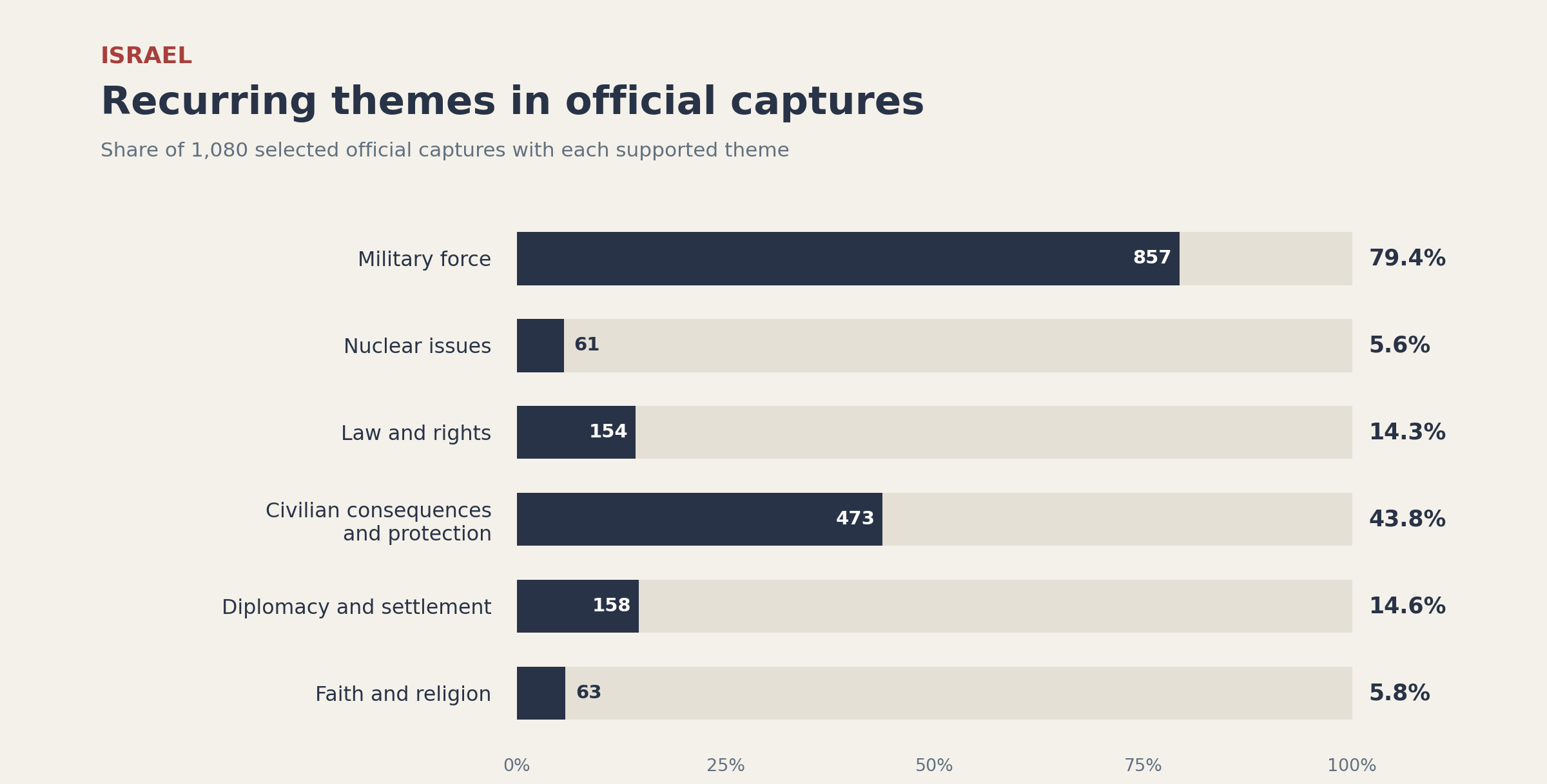
Israel has named the February 2026 military campaign against Iran "Operation Roaring Lion". It is thus a direct continuation of, and a rhetorical escalation from, "Operation Rising Lion", the June 2025 military operation against Iran's nuclear and missile programs. The 2026 campaign is also referred to as a "joint operation" between Israel and the US.
Institutions give different emphases to this account, as the channel comparison below illustrates. The IDF provides operational updates, military explanations and security guidance for the Israeli public, but also legal arguments and explanations of politically consequential targets. The Ministry of Foreign Affairs presents Iran and its partners as an international threat. The prime minister supplies the campaign’s overarching account of historical context, strategic goals and regional order, while the presidency connects the conflict to civilian experience and the wider Jewish world.
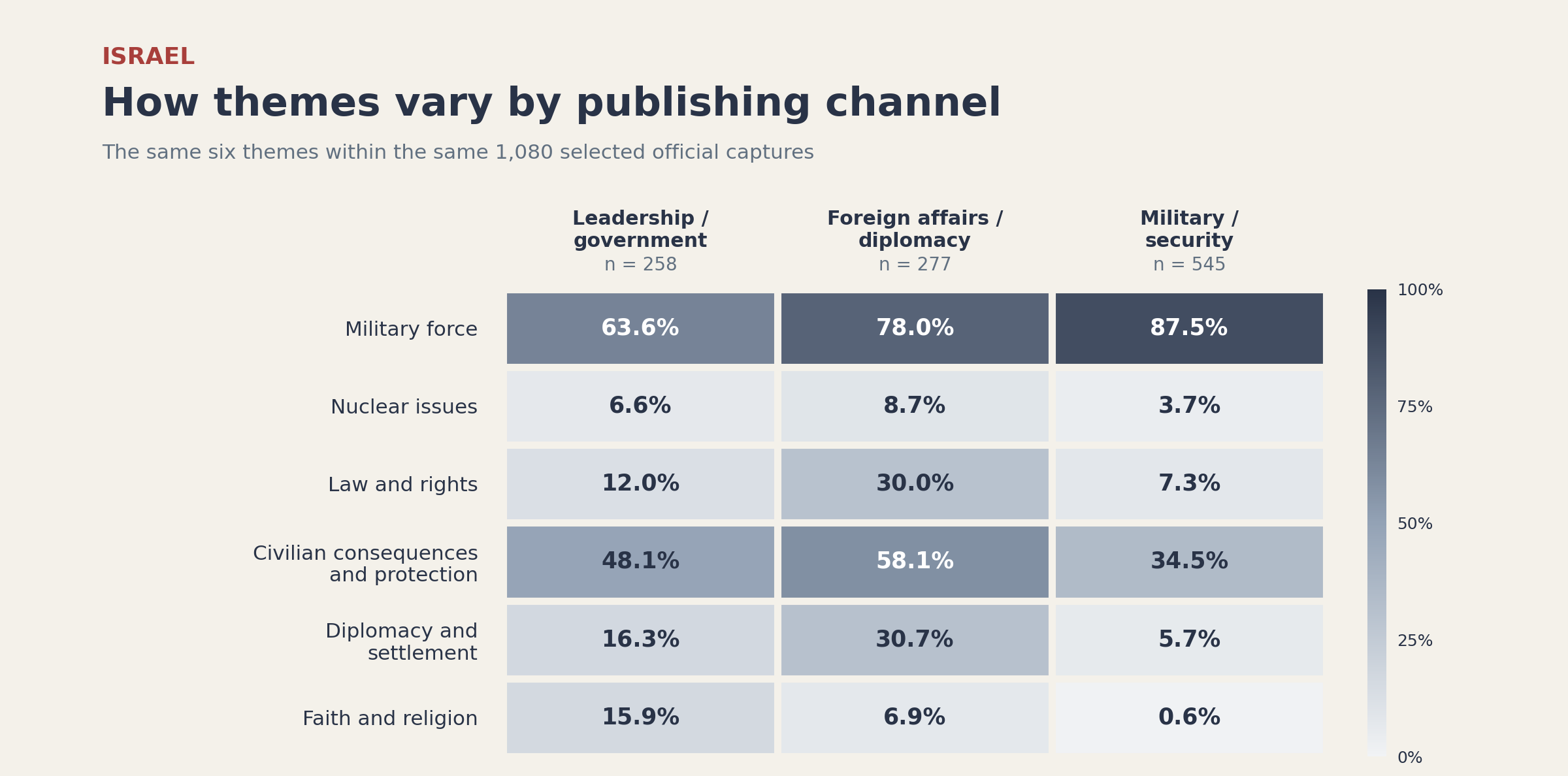
The following subsections examine the main narrative frames alongside the operational formats and supporting appeals that sustain them. Their relationships are central: the account of existential danger explains initiative, initiative requires public endurance, and military success is presented as creating an opportunity for wider political change.
Existential Threat and the Logic of Prevention
A central Israeli narrative portrays the threat from Iran as existential and cumulative. Nuclear ambitions, missiles, allied armed groups and hostile intent are treated as parts of one connected project. The argument is not simply that a dangerous capability exists, but that waiting will make it more costly or impossible to remove.
The IDF and the U.S Armed Forces have launched a broad & joint operation to thoroughly degrade the Iranian terrorist regime and to remove existential threats to Israel over time. The Iranian regime has not abandoned its plan to destroy Israel.
28 Feb, idf.il
This gives the campaign a preventive logic: present force is justified by a future in which Iran might acquire the capacity to deter effective intervention. Framing the threat as an interconnected system also allows action against a broad range of targets to be presented as components of a single defensive undertaking.
The claimed closing window has a specific physical basis in the official account. Netanyahu’s 8 March address describes nuclear and ballistic capabilities being buried beneath mountains to obtain “underground immunity”. The Foreign Ministry’s 11 March post portrays negotiations above ground and construction below ground as a coordinated deception. Waiting is therefore represented as allowing the means of intervention to disappear, even before an immediately usable nuclear weapon is demonstrated. The argument turns an uncertain future threat into a present deadline for action.
Fake negotiations above ground while building missiles and nuclear facilities deep underground. The goal: buying time to get immunity from neutralization.
11 Mar, Ministry of Foreign Affairs X
The IDF adds a distinct argument about the conflict’s temporal boundaries. Its 4 March legal explanation places the operation within a years-long armed conflict involving Iranian direct attacks, proxy activity, cyber operations and covert attacks. Iran is assigned responsibility for initiating that wider confrontation. This shifts the question of who started the war away from the opening strikes of February 2026 and toward an accumulated history of aggression.
Operation “Roaring Lion” was not the initiation of a new armed conflict.
4 Mar, idf.il
Proactive conduct and defensive identity can consequently coexist in the official account. Israel claims the ability to choose the moment of attack while denying that this choice initiated the underlying war. The preventive argument explains why action is necessary now and the continuity argument assigns prior responsibility for the conflict.
Netanyahu embeds the claimed deadline in a broader account of learning after 7 October. His 8 March address describes a “polar shift” toward proactive and surprising operations. On 29 March he repeats the contrast between being surprised and surprising the enemy. The campaign is thus offered as evidence that Israel has changed its own strategic conduct. Success includes restored agency over the sequence of events, not only destruction of Iranian assets. This claim also permits operations across several fronts to be joined as manifestations of the same change in security policy.
Instead of them surprising us, we are surprising them. We are the ones taking action, we are the ones attacking, we are the ones taking the initiative, and we are deep within their territory.
29 Mar, Netanyahu (gov.il)
Proxy Threats and Territorial Security
Hezbollah, Hamas, Palestinian Islamic Jihad and the Houthis are repeatedly placed within an Iranian-centered threat system. The ‘octopus’ metaphor makes the relationship especially clear: action against Iran attacks the head, while operations against allied armed groups attack its arms. Their conflicts are thereby connected to one strategic center.
We have cut off the head of the Iranian octopus, and we are now acting to crush and sever the octopus's arms.
3 Mar, Israel Katz X
This serves as further proof that Hezbollah and Iran are one and the same.
3 Apr, IDF live updates (idf.il)
The framing can attribute both dependence and responsibility to these groups. They are presented as instruments of Iran, yet their entry into the fighting can also be described as a culpable choice. This allows Israeli communication to connect geographically separate operations while holding each adversary accountable.
The connected threat system also underpins a territorial account of protection. Netanyahu’s 19 February speech rejects containment and the accumulation of hostile armed forces near Israel’s borders.[95] His 29 March statement describes security zones in Syria, Gaza and Lebanon as means of preventing invasion and pushing threats away from Israeli communities.[96] Herzog’s 23 March northern visit also invokes strategic depth.[97] These statements place the safety of Israeli communities at the center of a policy that reorganizes the space beyond the border. Forward defense is presented as a lasting correction to the vulnerability exposed on 7 October.
Katz states the spatial consequences particularly explicitly. On 22 March, he connects destruction of homes in Lebanese border villages to the Beit Hanoun and Rafah model in Gaza.[98] On 24 March, he links terrorism and missiles to the absence of homes and residents and says the IDF will control a security zone up to the Litani.[99] His formulation should remain attributed to him rather than treated as identical to every institution’s position. It nevertheless reveals how a narrative of protecting Israeli civilians can authorize an extensive transformation of neighboring civilian space. Success is represented through the geography from which future threats can emerge, as well as through the weapons already destroyed.
Separating the Government from the People
Senior Israeli statements distinguish the criminalized Iranian “regime” from an Iranian population described as oppressed and potentially friendly. Netanyahu’s appeal on 28 February even addresses named ethnic communities and invites them to remove their rulers.
The time has come for all sections of the people in Iran - the Persians, the Kurds, the Azeris, the Baluchis and the Ahwazis - to remove the yoke of tyranny from them and bring a free and peace-loving Iran.
28 Feb, Netanyahu X
For we do not seek to divide Iran. We seek to liberate Iran and live in peace with it.
8 Mar, Netanyahu (gov.il)
There is variation though in how specifically an Iranian political future is described. Gila Gamliel’s 15 February post names Reza Pahlavi as leading Iranians toward freedom and democracy and calls for regime change. Netanyahu’s later appeals place the decisive responsibility on the population without making that named successor the campaign’s declared objective.
The Iranian people, led by Reza Pahlavi, are marching powerfully towards freedom and democracy.
15 Feb, Gila Gamliel X
These appeals establish political transformation as a desired consequence of military action. They do not, by themselves, make the installation of a successor government a defined Israeli military task. Israel presents attacks on Iranian military and government capabilities as creating conditions in which Iranians might remove their rulers. It claims solidarity with the population while assigning the decisive political act on the ground to that population. This leaves the promised liberation unresolved if military capabilities are degraded but the governing system survives, even where narrower security objectives can be presented as achieved.
The liberation account nevertheless has an operational component. Netanyahu’s 8 March address links a plan to destabilize the governing system to threats against Revolutionary Guard personnel who suppress people in the streets. The IDF’s 10 March account of strikes in Ilam names Basij, internal security and intelligence facilities, including an IRGC command center responsible for battalions that suppress protests.[103] Military action is thereby explained as removing instruments of domestic repression, so that an appeal to rise up can be attached to claimed changes in the population’s immediate environment.
Regarding what we will do next in Iran: We have an organized plan with many surprises to destabilize the regime and enable change.
8 Mar, Netanyahu (gov.il)
Netanyahu’s 17 March Nowruz appeal, delivered from an air force command center, gives this relationship a protective image. He addresses Iranians celebrating in the streets while describing Israeli forces as watching from above.[105] A coercive military presence is offered as reassurance to the population and pressure on those who might suppress it. The narrative proposes a relationship between aerial action and popular freedom, but the source does not demonstrate that this relationship can produce a stable political transition.
The effort to enable popular agency is accompanied by interference with political succession. On 8 March, the IDF explains that it struck the Assembly of Experts building to prevent selection of a new leader, placing that objective within attacks on command and control because the supreme leader commands armed forces and affiliated groups.[106] Katz’s 4 March statement threatens any successor who continues the specified hostile and repressive policies, regardless of identity or location.[107] These accounts present political continuity as restoration of a military threat. The tension is therefore specific: Iranians are said to choose their future, while Israel claims authority to obstruct the continuation of a governing system it identifies as threatening.
Measuring Destruction and Recovery
Israel’s military publishes numerical tallies of strikes, targets and destroyed capabilities throughout the campaign. These figures turn an abstract promise to dismantle a threat into apparently observable increments of progress. Their accumulation also helps depict the operation as systematic and advancing.
The IDF continues to strike targets across Iran: More than 3,000 Iranian terror regime targets struck since the start of Operation Roaring Lion
24 Mar, idf.il
In recent days, the Air Force has destroyed 70% of Iran's steel production capacity.
3 Apr, Netanyahu (gov.il)
The units counted are politically significant. A total of targets struck measures activity, while a percentage of production capacity destroyed claims a change in the adversary’s ability to regenerate. The industrial figures also explain what the campaign is intended to deny. Netanyahu’s 3 April statement connects the claimed destruction of steel capacity to IRGC financing and weapons production.[110] On 6 April, he describes petrochemical destruction as dismantling its financial resources.[111] IDF accounts link petrochemicals to export revenue and military materials, the Arak heavy-water plant to nuclear inputs and income, and university facilities to military research.[112, 113, 114, 115] The official target system encompasses the means of reproducing military power, including finance and technical knowledge. Destruction of a factory is offered as a constraint on future recovery, rather than simply another strike completed.
This creates a tension with government/people separation. Productive assets with a place in Iran’s national economy are described through their relationship to regime finance and military production. That classification allows broad economic destruction to be narrated as action against rulers while solidarity with the population is maintained. The population’s ability to rebuild after liberation nevertheless depends on capacities that war may also damage. The narrative explains why these assets are attacked, but it does not establish the full civilian consequences or resolve how destruction and future reconstruction fit together.
Precision and Civilian Protection
A recurring contrast presents Israel as striking “regime” and military targets with precision while accusing Iran of deliberately attacking civilians. It pairs a claim about Israeli conduct with a claim about Iranian intention. The distinction is central to the moral account of the campaign.
While Israel is targeting only regime and military targets, Iran is deliberately striking Israeli civilians.
1 Mar, Ministry of Foreign Affairs X
The IDF operates in accordance with international law and adheres to the principles of distinction, proportionality, and precaution. It targets lawful military objectives such as missile launchers, command centers, and weapons production sites, while incorporating measures to mitigate civilian harm, including the selection of munitions, timing of strikes, and advance warnings where feasible.
6 Apr, idf.il
References to distinction, proportionality and precaution give this contrast a legal vocabulary. Statements about target selection and civilian warnings seek to demonstrate a controlled use of force. Descriptions of Iranian attacks depict civilian harm as intrinsic to the opponent’s methods.
The legal vocabulary also classifies targets. In its account of the Khamenei strike, the IDF’s formal argument rests on his asserted role as commander-in-chief, the anticipated military advantage and proportionality and precaution assessments.[118] Its explanation of targeting the Basij invokes the force’s incorporation into Iran’s armed forces under Iranian law.[119] Calling an opponent a terrorist provides moral condemnation. Identifying the military role supplies a separate claimed legal basis for attack. The narrative combines these arguments.
Claims about warnings likewise need to be read alongside the broader policy they support. The IDF’s 19 March explanation describes its messages to Lebanese civilians as advance warnings rather than compulsory evacuation orders and portrays them as evidence of precautions beyond legal requirements.[120] Katz’s later language about areas having no homes or residents, examined in the discussion of territorial security, describes a more consequential spatial outcome.[121] Individual warnings can be narrated as protection while population absence becomes part of a desired security geography. Precision and precautions at the level of a strike do not, by themselves, resolve the implications of that wider policy.
Israeli accounts also accuse adversaries of operating from civilian settings. IDF reports describe weapons or fighters in schools and other civilian facilities, especially in the Lebanon theater.
Inside the school, troops located hundreds of weapons and combat materials. [...] What made the discovery even more striking were clear markings of the United Nations’ UNHCR agency found within the compound.
27 Mar, idf.il
The communicative function is to redirect responsibility for danger to civilians toward the adversary allegedly using those spaces. It complements the claim of Israeli precision: if a civilian site is struck, the audience has already been given an explanation based on the opponent’s conduct.
The US-Israel Alliance
Military cooperation with Washington is repeatedly personalized through the Trump-Netanyahu relationship. Presenting the campaign as a joint operation demonstrates access to exceptional military power and helps portray Israeli action as part of a major alliance undertaking. Claims about the unprecedented closeness of the two leaders add a political interpretation to operational cooperation.
A short while ago he told me this: 'The relationship between us is a hundred times stronger than any relationship that has ever existed between an American president and a prime minister in Israel.'
12 Mar, Netanyahu (gov.il)
The alliance thus functions as evidence of both capacity and diplomatic standing. It also creates a narrative dependence: the presentation of a shared campaign does not establish identical objectives or identical willingness to continue fighting. Israel’s emphasis on US commitments during the ceasefire seeks to preserve the image of common purpose as the campaign moves from military action toward negotiation.
Alliance communication also defends the autonomy of both partners. Before the campaign, Netanyahu describes Israel as fighting for itself and proposes moving over time from American financial aid toward joint investment and partnership.[124] In his 19 March foreign-press address, he rejects the claim that Israel dragged the United States into war and portrays Trump as acting on his own judgment of American interests.[125] The preferred relationship is between a capable Israeli partner and an autonomous American president. These statements counter the images of Israel as a dependent client and Washington as an instrument of Israeli policy.
The personal alliance can also impose political costs. INSS’s 26 March analysis warns that the war may intensify partisan polarization around Israel in the United States.[126] Its earlier assessment emphasizes possible differences over an acceptable stopping point and recommends presenting the campaign in terms of American interests.[127] The research layer thus distinguishes immediate access to presidential support from the durability of broader American consent. Operational coordination, personal closeness and long-term political support are related resources, but each requires a different claim and faces a different vulnerability.
Public Endurance and Governing Competence
Civilian behavior is part of that account of agency. The IDF spokesperson’s opening message explicitly calls public resilience and adherence to Home Front Command instructions a critical element of campaign success. Netanyahu’s 8 March address similarly joins civilian steadfastness to the determination still required. Protection instructions consequently have a strategic role: the public’s ability to withstand retaliation is represented as sustaining the military’s freedom to continue. Continued incoming attacks need not invalidate initiative if society is said to retain that capacity.
It is necessary to listen to the instructions of the Home Front Command, which are updated from time to time - the resilience of the citizens and the adherence to the instructions save lives and are a critical element in the success of the campaign.
28 Feb, IDF Spokesperson X
The appeal to endurance also involves a claim about governing competence. Netanyahu’s 12 March address says shelter adherence gives the government and military the backing and “breathing room” needed to achieve the campaign’s goals.[129] His 17 March statement pairs determination with promises of expanded compensation and assistance to the North.[130] Citizens are asked to sustain the operation, while the state presents itself as managing the costs imposed on them. Civilian protection thus supports both operational latitude and confidence that continued fighting remains governable.
Military reassurance is more qualified than a promise of complete safety. On 5 March, the chief of the general staff reports substantial launcher destruction but emphasizes that the threat remains and every missile is dangerous.[131] Home Front Command later explains efforts to reduce irrelevant early warnings and balance protection with an effective emergency routine, including education.[132, 133] Such communication makes continuing danger compatible with progress while trying to preserve the public’s ability to live under restrictions.
The research material also emphasizes why endurance should be distinguished from consent to particular war aims. INSS surveys report that support for continuing until the Iranian "regime" is overthrown fell from 63% at the beginning of the campaign to 45.5% in late March.[134, 135] Over the same period, the proportion assessing that the home front could endure more than a month rose from 29% to 56%. The survey conducted on 29–30 March used a weighted sample of 959 adults interviewed in Hebrew and Arabic. It also reported 77% trust in the IDF and 30% trust in the government.[136] These repeated surveys do not establish individual-level change or the effects of official messaging.
Hormuz and Regional Order
Israeli communication extends the threat argument to audiences beyond the region. Netanyahu’s 22 March statement points to claimed Iranian long-range missile activity and pressure on shipping through Hormuz to present the campaign as a defense of wider international interests. The appeal asks foreign governments to view the war through their own exposure to insecurity.
Iran has proven again in the last 48 hours that it is the enemy of civilization and a danger to the free world: targeting children, families, and the elderly with terror missiles, threatening Jerusalem’s holy sites, launching long-range missiles, and trying to blackmail the world through the Strait of Hormuz. I ask the leaders of the free world: what are you waiting for? Israel is fighting not only for itself, but for all of you.
22 Mar, Netanyahu X
This enlarges the constituency Israel claims to protect. Distance no longer guarantees safety if missiles can reach farther, while disruption of maritime trade makes the conflict economically consequential for states outside the immediate battlefield. The argument seeks to convert sympathy into support by making non-participation appear shortsighted.
The global argument is adapted to particular audiences. At his 17 March press conference with Estonia’s foreign minister, Sa’ar connects Iran to the war in Ukraine and warns that maritime coercion could become a problem in the Baltic, Black or Mediterranean seas.[138] The listener’s own security geography makes a distant campaign locally consequential. Netanyahu’s 19 March foreign-press address likewise asks audiences to imagine Iran’s current regional attacks and maritime coercion backed by nuclear warheads.[139]
Sa’ar’s 10 March remarks add a claim about historical judgment. Earlier Israeli attacks on nuclear programs and the example of North Korea are invoked to argue that delayed action can create a danger that becomes impossible to remove.[140] Immediate condemnation is implicitly measured against future recognition of the threat prevented. Calls for de-escalation can consequently be portrayed as increasing the risk of a much larger later escalation. The narrative asks foreign audiences to judge the campaign by the catastrophe claimed to have been avoided.
Military action is also represented as producing a positive regional order. Netanyahu’s 8 March address presents Israeli strength as attracting cooperation while accusing international institutions and Western states of failing threatened populations.[141] On 25 March, he says perceived Israeli strength, military determination and public resilience are creating previously unimaginable alliance opportunities.[142] Protective capacity is offered as a source of political standing: countries should turn toward Israel because it acts effectively against dangers that others have failed to confront. The war is thereby presented as a route to wider peace and Israeli regional indispensability.
The inference from military strength to political acceptance remains contested among Israeli actors. INSS’s 30 March regional-arrangement paper argues that Gulf states may seek stronger defense cooperation while fearing Iranian collapse, prolonged war and Israeli hegemony.[143] Cooperation can reflect shared risk management without acceptance of Israel’s entire preferred regional order. The same paper warns that elevating freedom of action into a sufficient strategy can produce repeated fighting without a political horizon.[144] Preserving the ability to intervene is therefore both a claimed achievement and a possible indication that durable stabilization has not been secured.
Protecting Jewish Communities Abroad
Statements about attacks on Jewish communities abroad connect diaspora insecurity with the danger faced by Israelis. Herzog’s 9 March response to shootings in the Toronto area places both experiences within a shared account of Jewish vulnerability.
This most recent series of shooting attacks on synagogues and Jewish communal institutions in the Greater Toronto Area targeted our sisters and brothers in the Jewish Diaspora while Iranian missiles continue to target our people here in Israel.
9 Mar, Herzog (gov.il)
Diaspora appeals have an operational dimension as well as a solidarity function. The National Security Council’s 5 March notice warns of increased threats to Israelis and Jews abroad in connection with the campaign and issues precautionary guidance.[146] Shared vulnerability can therefore mobilize identification with Israel while also acknowledging that the conflict extends exposure beyond its territory.
Religious and Historical Memory
Israeli leaders also interpret the war through Jewish religious and historical memory, including references to Purim and Passover. The language of recurring enemies links a present security threat to a longer experience of persecution.
We read in this week's parshah "Remember what Amalek did to you." We remember - and we act.
2 Mar, Netanyahu X
This was the case in the exodus from Egypt, this was the case in many generations of exile and persecution, and this is also the case in our generation. In every generation enemies rise up against us.
3 Apr, Netanyahu X
The phrase ‘we remember, and we act’ makes the connection between memory and agency explicit. The state is presented as able to prevent the repetition of historical vulnerability rather than merely commemorate it. This reinforces the argument for acting before an enemy’s capabilities become overwhelming.
Chikli’s 2 March Purim message gives recovered agency a specifically political interpretation. It associates Oslo, withdrawal from Lebanon and disengagement from Gaza with flight from national identity and a condition resembling exile within Israel itself.[149] The end of restraint and containment is presented as restoration of sovereignty. In his formulation, forward action validates who Israel has become as well as what its forces can accomplish; this historical interpretation cannot be assumed to be shared by every Israeli institution.
Historical Persia also supplies a different relationship to the present. Herzog’s 20 March Nowruz message invokes longstanding Persian-Jewish ties and Cyrus the Great as grounds for future friendship.[150] The contemporary rulers can occupy the role of persecutor while the Iranian population is associated with a recoverable history of cooperation. This gives government/people separation cultural substance and presents future peace as restoration of an older friendship. The historical account therefore contains both recurring danger and a claim that Iran itself need not remain an enduring enemy.
Foreign Ministry messages further widen the protective identity by describing alleged Iranian attacks near Jewish, Christian and Muslim holy sites and Israeli protection of the sacred places of all religions. Sa’ar’s 17 March remarks and the ministry’s 30 March post connect this appeal to the religious calendars of the affected communities.[151, 152] Israel is represented as a guardian of shared religious heritage alongside its role as the sovereign protector of Jewish life. This offers foreign audiences a broader basis for identification.
Authority and the Delegitimization of Critics
Foreign Ministry communication also contests the authority of international critics. In a 16 February speech, Gideon Sa’ar singled out Francesca Albanese and urged the delegitimization of those he described as antisemites seeking to delegitimize Israel. Because this statement precedes the outbreak, it illustrates an existing repertoire of argument that forms part of the campaign’s political setting, rather than a response generated by the Iran war itself.
Speaking [...] at the Conference of Presidents of Major American Jewish Organizations [...] Minister of Foreign Affairs Gideon Sa’ar addressed the gathering and referred to Francesca Albanese, the UN Special Rapporteur on the Occupied Palestinian Territories, saying: “We must delegitimize the antisemites who are delegitimizing the Jewish state.”
16 Feb, Gideon Sa'ar (gov.il)
The mechanism shifts attention from the criticism to the critic’s standing. If the speaker is categorized as hostile to the Jewish state, their allegations can be presented as part of the threat environment rather than as an independent judgment on Israeli conduct.
During the campaign, related arguments also target domestic dissent. Netanyahu’s 17 March statement asks the public to ignore pessimistic television channels while emphasizing historic achievements and determination.[154] Chikli’s 27 March response to Bennett portrays criticism of military performance as giving hope to enemy audiences.[155] In these interventions, disagreement about outcomes is recast as a contribution to the opponent’s morale. The mechanism connects claims of success to the public endurance needed for continued fighting.
International authority is also used selectively. The Foreign Ministry’s 12 March post invokes the Security Council’s condemnation of Iranian attacks and the breadth of sponsorship as recognition that Iran threatens global peace.[156] Netanyahu’s 8 March address, by contrast, accuses the UN and Western states of failing to protect threatened populations.[157] Favorable international judgments are offered as validation while adverse or ineffective institutions can be disqualified. This is a contest over which authorities deserve credibility, rather than a uniform rejection of international engagement.
Victory and the Limits of the Ceasefire
The repeated contrast between a stronger Israel and a weaker Iranian “regime” supplies a relative measure of victory. It is more flexible than a promise that every threat will disappear. Damage, uncertainty and unfinished tasks can coexist with success as long as the overall balance is described as having shifted in Israel’s favor.
Indeed, we have already achieved the great change: Israel is stronger than ever, Iran's terrorist regime is weaker than ever.
3 Apr, Netanyahu X
Sa’ar supplies a more specific threshold in his 1 April Passover address. He claims that the danger of Israel’s elimination has been removed while acknowledging that enemies can still attack. He rejects a promise of a last war and makes preservation of the achievement depend on continued strength and willingness to fight. Victory is thus represented as a downgrade from existential danger to a threat that Israel can withstand and confront. Continued missile fire does not necessarily contradict that definition, although the statement does not independently establish that the claimed downgrade has occurred.
Yes, they can still fire at us. No, they can no longer place us in existential danger.
1 Apr, Gideon Sa'ar (gov.il)
The political choice is also more specific than an opposition between force and diplomacy. In his 15 February address, Netanyahu sets out conditions for an acceptable agreement: removal of enriched material, dismantlement of enrichment equipment and infrastructure, constraints concerning missiles and the regional armed network, and effective inspections.[160] These prewar demands form part of the campaign’s political setting rather than an achieved settlement. They present negotiated commitments as credible only when backed by material changes and verification. Accusations that negotiations conceal reconstruction can therefore coexist with support for an agreement reached under altered conditions of power.
Israeli research presents competing tests for converting these claims into strategic success. A 31 March JISS scenarios paper argues that achieving nuclear objectives, especially removal of enriched material, could support a success account even if the regime survives.[161] An INSS paper of the same date advocates physical dismantlement and warns that a surviving "regime" might become more committed to nuclear deterrence after the war.[162] These are analytical prescriptions, not official commitments. They show why damage to an existing capability, reduction of the motivation to rebuild and an enforceable stopping point cannot be assumed to follow from one another.
A JISS analysis of decentralized defense similarly argues that leadership losses need not cause institutional collapse and may complicate enforcement of a ceasefire if surviving units are difficult to control.[163] This tests the implication of the octopus imagery: striking a central leadership does not automatically remove the operational agency of every component. The question is whether the campaign changes the system’s ability to regenerate and coordinate, rather than whether enough prominent figures can be counted as eliminated.
This flexibility is particularly useful at the ceasefire. Netanyahu’s 8 April statement celebrates a stronger Israel and weaker Iran while saying that remaining objectives can be achieved by agreement or renewed fighting. Progress can therefore be claimed without declaring every objective complete. The pause is presented as a possible route to consolidation, with renewed force retained as an alternative. Diplomacy and further military action become different means of pursuing unfinished goals.
We have more goals to complete - and we will achieve them either by agreement or by resuming fighting.
8 Apr, Netanyahu X
Sa’ar’s 8 April statement makes the geographic boundary explicit: Lebanon is not Iranian territory and is not part of the ceasefire.[165] The same threat system can therefore be treated as connected when explaining the need to fight, yet differentiated when explaining which operations must stop. The narrative permits a pause against the center without accepting that every associated front is covered.
The boundary of the pause is itself contested. Araghchi’s 8 April post treats continued Israeli fighting in Lebanon as incompatible with the US commitment to a ceasefire. Israel’s account of one Iranian-centered threat system can therefore support continued action against one component, while Iran’s account of an interconnected resistance front supports a demand to stop across fronts. The disagreement concerns which relationships bind Washington and Israel to the settlement, as well as which operations are covered by it.
Israel’s account of victory therefore connects a favorable balance to the freedom to act again. Its unresolved task is to preserve that balance if the Iranian governing system survives and its military capabilities and regional networks can regenerate. Retained initiative is a means of enforcing security, but cannot by itself demonstrate a durable political settlement.
Peace through Strength and Political Ambiguity
US Overview
The United States portrayed Operation Epic Fury as President Trump’s overwhelming but bounded answer to an Iranian “regime” accused of waging a forty-seven-year war on Americans, preparing to attack US forces after an expected Israeli strike, and building conventional capabilities to shield future nuclear coercion. These were distinct rationales, voiced in different formulations, rather than one consistent account of an imminent threat. Military dominance was then presented as the means of compelling a settlement on American terms. The graphic below shows how frequently military, nuclear, diplomatic and other themes appear in the collected US communication.
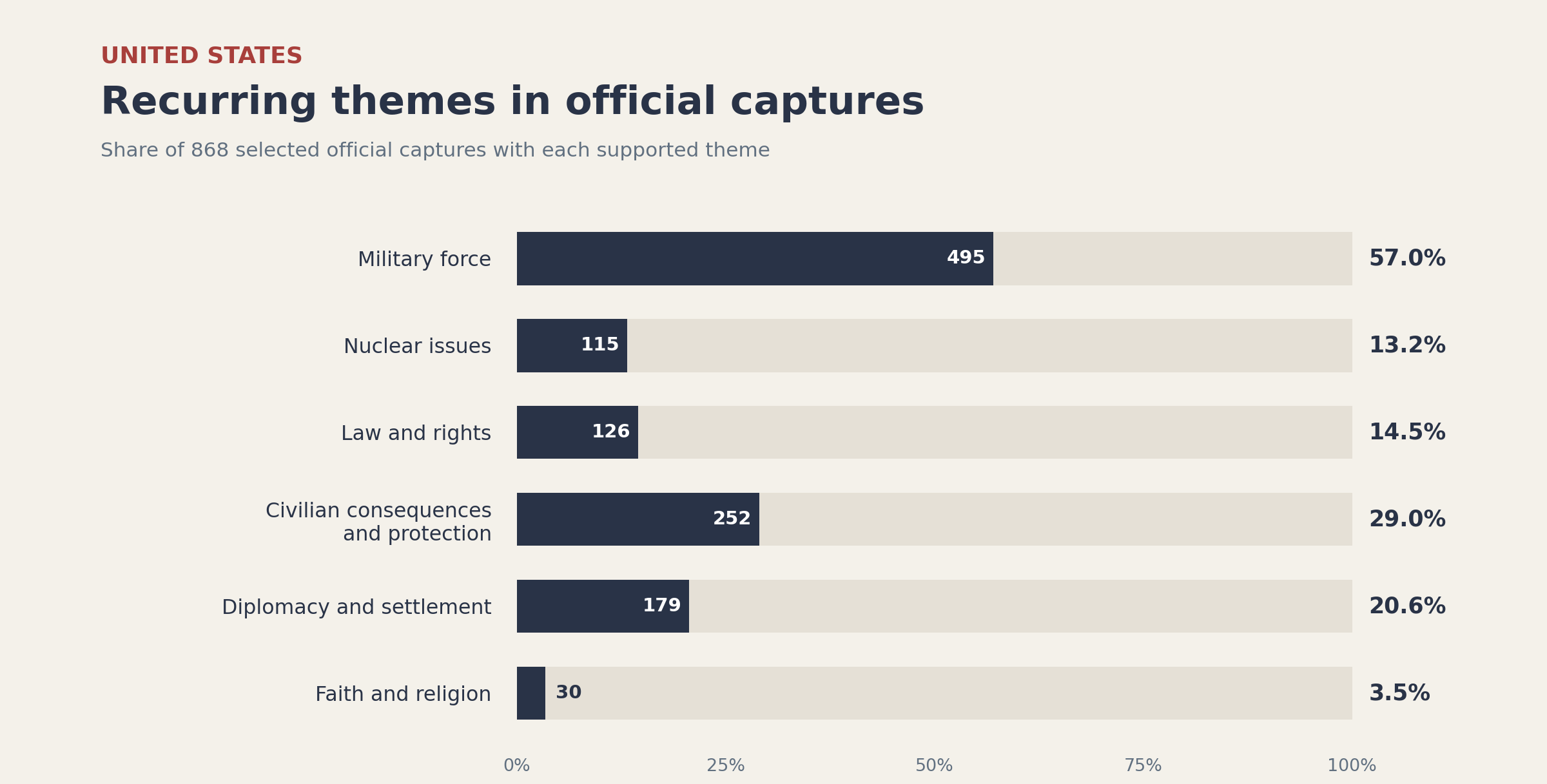
The United States named its campaign ‘Operation Epic Fury’ and presented it as an operation directed by President Trump in partnership with Israel. References to the June 2025 Operation Midnight Hammer placed it within a sequence of coercive action against Iran’s nuclear program. The claim that America was finishing an existing conflict also challenged the interpretation that the administration had chosen to begin a new war.
Trump’s presidential authority anchors much of the official communication, while the graphic below distinguishes the thematic emphases of political, diplomatic and military channels. The Department of War and CENTCOM supply battlefield metrics and operational explanations. The Department of State and the US mission to the UN connect force to diplomacy, regional security and international legitimacy. The White House attaches personal authorship to the campaign and presents military achievement as evidence of Trump’s resolve and bargaining power. These functions overlap. Political declarations, operational estimates and intelligence assessments also use different standards of certainty. Differences are visible even between speakers at the same military briefing. Their shared story of dominance leaves important questions about the relationship between military achievement and political objectives.
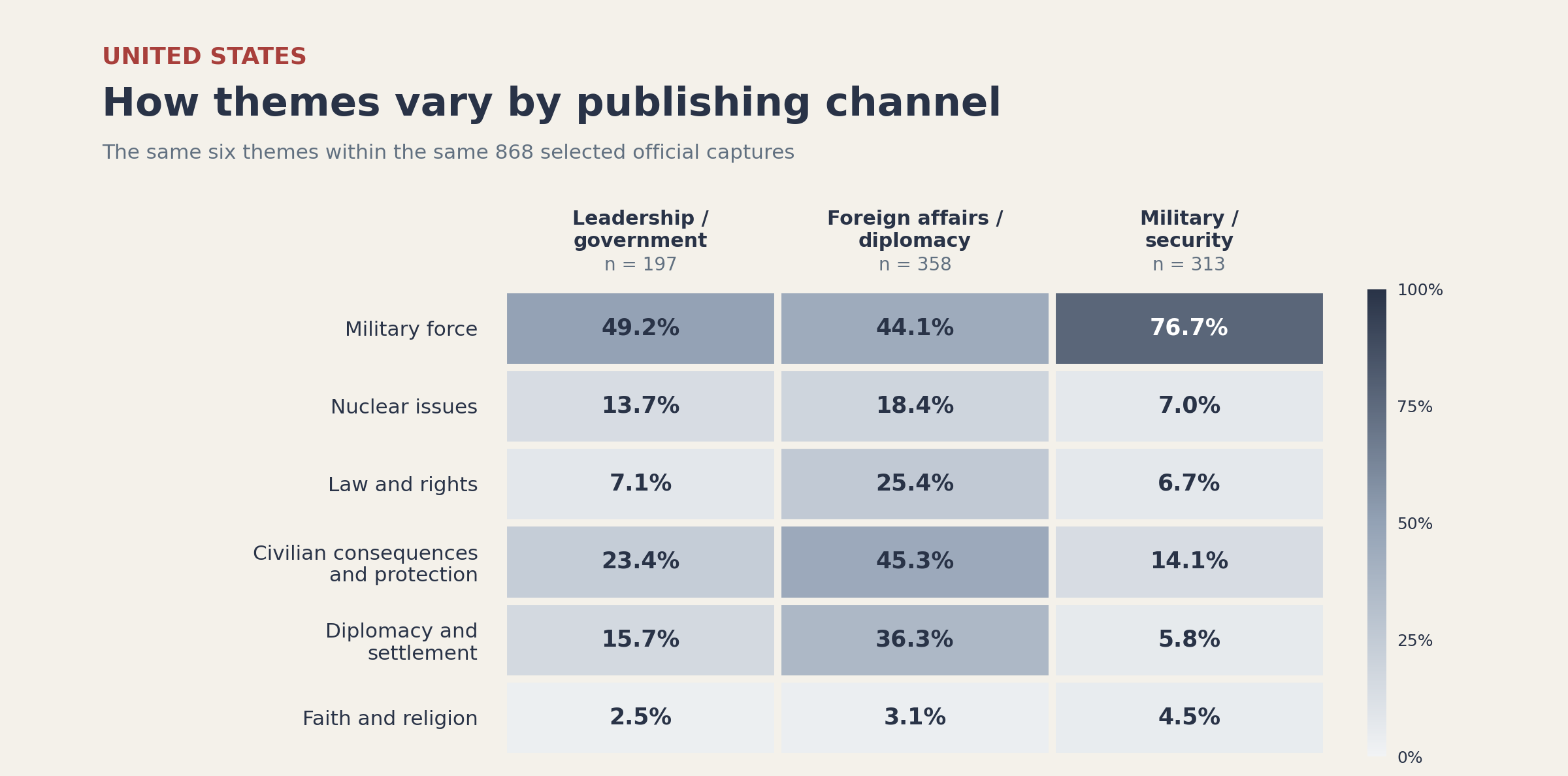
The following subsections examine the main narrative frames, military reporting formats and supporting political appeals. Their organizing relationship is the claim that decisive American power, released from earlier constraints and directed by the president, can compel compliance and finish a longstanding conflict without assuming responsibility for governing Iran afterward. The analysis therefore asks how destruction is presented as producing a negotiable adversary and lasting security, and which tasks remain necessary after military completion has been declared.
Peace through Strength
‘Peace through strength’ provides an explicit organizing principle for US communication. Diplomacy is described as preferable, but its effectiveness is made dependent on credible military power. The slogan asserts a causal relationship: pressure makes an agreement possible, and the agreement retrospectively validates the pressure.
My preference is to solve this problem through diplomacy, but one thing is certain: I will NEVER allow the world's number one sponsor of terror to have a nuclear weapon. We have to be strong. It's called peace through strength.
25 Feb, Trump (Department of State X)
This account also explains why negotiations could coexist with preparations for force. In the administration’s telling, Iran had been given an opportunity to settle and used diplomacy to delay while rebuilding its capabilities. The resort to war could consequently be represented as proof that an offer of peace had limits. Later restraint could be presented as the reward for compliance, rather than a revision of the original decision to attack.
The US research material makes the assumed relationship between pressure and peace more explicit. Before the war, Michael Singh advocated limited strikes alongside continued military, economic and diplomatic pressure, arguing that Washington could constrain the leadership without choosing between a narrow nuclear agreement and open-ended war.[167] His argument treats pressure as a continuing process through which behavior might change. It offers a distinct policy interpretation of “peace through strength”, rather than evidence that battlefield destruction automatically produces an agreement or that an agreement necessarily ends the need for pressure.
Maximum Pressure
Before the outbreak, officials presented sanctions as an important source of leverage alongside military preparations. Mike Waltz’s 17 February interview linked pressure on Iran’s currency and reserves to the unrest described in his account, crediting Trump’s policy with having ‘set the table’ for negotiations.
What has set the table, despite the fact that everyone is focused on the military pieces of this is President Trump’s maximum pressure campaign that we went back to last year that has their currency tanking, their foreign reserves tanking.
17 Feb, Waltz (usun.usmission.gov)
Within the wider narrative, economic pressure and military force belong to the same sequence: weaken the leadership’s resources, expose its vulnerability and make refusal more costly. The claim also narrows the apparent choice facing Tehran. Agreement is portrayed as a rational response to pressure, while continued resistance can be characterized as a decision by the “regime” to prolong avoidable costs.
Wartime communication also incorporates adjustments to economic instruments into the pressure narrative. On 22 March, Waltz defended the oil measure concerning cargoes already at sea while insisting that maximum pressure remained in place.[169] He argued that banking sanctions would prevent anticipated Iranian revenue and portrayed redirected oil supplies as a way to defeat Tehran’s disruption strategy.[170] An apparent relaxation was thus presented as tactical control over an opponent’s leverage. The narrative’s continuity rests on the asserted purpose of constraining Iran even when particular instruments change.
Historic Grievance
A recurring historical argument casts the 2026 campaign as the delayed conclusion of a conflict Iran had already begun. The forty-seven-year chronology relocates the relevant starting point from the immediate decision to strike to the period beginning with the Islamic Revolution. Different confrontations and attacks are assembled into a cumulative charge against the Iranian “regime”.
For 47 long years, the expansionist and Islamist regime in Tehran has waged a savage, one-sided war against America. [...]. We didn't start this war, but under President Trump, we are finishing it.
2 Mar, Hegseth (war.gov)
This chronology performs two tasks. It assigns initial responsibility to Iran and casts the administration as finally enforcing a boundary previous leaders failed to enforce. Historical grievance therefore justifies punishment as well as prevention of future threats.
Preemption
During the opening phase, Rubio presented the decision to attack as a way to prevent expected Iranian strikes on US forces following an Israeli attack. The asserted imminence was conditional on that anticipated sequence. It was therefore a specific explanation of why Washington acted when it did, rather than simply a claim that Iran would attack irrespective of preceding events.
There absolutely was an imminent threat, and the imminent threat was that we knew that if Iran was attacked [...] they would immediately come after us, and we were not going to sit there and absorb a blow [...] because the Department of War assessed that [...] if we waited for them to hit us first after they were attacked – and by someone else, Israel attacked them, [...] and we waited for them to hit us – we would suffer more casualties and more deaths.
2 Mar, Rubio (state.gov)
In the same exchange, Rubio maintained that the operation would have been necessary in any case because Iran was approaching a point at which its missiles and drones would make intervention prohibitively dangerous. The two arguments answer different questions: anticipated retaliation explains the timing, while future vulnerability supplies a preventive rationale. This framing reveals the complex and at times conflicting justifications of the administration for the military operation.
Rubio’s 3 March exchange defends American ownership of that decision. Challenging the interpretation that Washington acted because Israel required it, he insists that the president had already decided to strike and distinguishes intent from the timing of joint action.[173] He presents cooperation as maximizing the chance of success and going first as protecting American personnel. The same exchange describes Iran as exceptionally weak now but potentially untouchable later.[174] Weakness and danger perform different tasks: current vulnerability makes action feasible, while anticipated future immunity makes delay unacceptable. This defends presidential agency as well as the claimed necessity of force.
Nuclear Blackmail
A further rationale presents Iran’s expanding conventional capabilities as a shield for future nuclear coercion. Missiles and drones are dangerous in this account not only because of the damage they could inflict, but because they could deter others from stopping Iran’s nuclear ambitions. The argument therefore links the destruction of conventional forces to a nuclear objective.
Iran was building powerful missiles and drones to create a conventional shield for their nuclear blackmail ambitions. [...] A conventional shield for their nuclear blackmail ambitions, our bases, our people, our allies, all in their crosshairs. Iran had a conventional gun to our head as they tried to lie their way to a nuclear bomb.
2 Mar, Hegseth (war.gov)
The nuclear objective also joins distinct objects of intervention: enrichment facilities, material stockpiles, scientific expertise and the decision to pursue a weapon. Damage to facilities does not establish the disappearance of material or knowledge. Rubio’s prewar account allows attempted recovery to remain threatening even when enrichment is not currently taking place.[176] The administration can therefore maintain that the June 2025 campaign succeeded while arguing that further force is required against rebuilding. The meaning of completion depends on which capability, time horizon and form of prevention is being claimed.
The 8 April briefing exposes the continuing work beneath a declaration of nuclear success. Hegseth describes material as buried and watched continuously, while its removal remains a task to be carried out under the proposed arrangements. Surveillance and prospective extraction are presented as control over a remaining problem. They also show that military achievement and permanent prevention are different thresholds. The phrase “nuclear dust” diminishes the apparent significance of the residue, although the account still assigns it continuing attention.
Right now, their dust is deeply buried and watched 24/7 overhead.
8 Apr, Hegseth briefing (war.gov)
The policy commentary tests the assumption that increasing destruction necessarily brings lasting nuclear security closer. CSIS’s 2 April analysis examines remaining material and capabilities, verification and distrust of a future bargain.[178] The Washington Institute’s 5 March essay “The Abiding Question of the Iranian Bomb” argues that sustained attack may also increase surviving leaders’ incentive to seek a deterrent, while collapse could create risks around securing material.[179] These assessments expose a condition within the official argument: force must alter both capability and political choice, and a durable outcome requires arrangements for what survives.
War Objectives and Presidential Discretion
Officials repeatedly describe the operation through lists of concrete military objectives, but the lists are not identical. Hegseth’s 2 March formulation emphasized offensive missiles, missile production, the navy and other security infrastructure, alongside preventing a nuclear weapon. Rubio’s 30 March four-part list below explicitly includes the air force and factories. The consistent communicative feature is the claim of a defined, achievable mission.
Here are the clear objectives of the operation. You should write them down:
1. The destruction of Iran’s air force
2. The destruction of their navy
3. The severe diminishing of their missile launching capability
4. The destruction of their factories
30 Mar, Rubio (Department of State X)
The ambiguity is visible within individual statements, not merely between agencies. On 2 March, Hegseth denied that this was a regime-change war while immediately celebrating that the regime had changed. Killing or replacing leaders could thus be presented as political transformation even if the underlying governing system survived. This permits a military checklist and a broader aspiration to coexist, but complicates any claim that the campaign had one stable, exhaustive definition of victory.
Trump’s 6 March demand for unconditional surrender also attaches an explicit political and economic horizon to military success. It calls for the selection of acceptable leaders and promises to help make Iran economically stronger afterward. The communication goes beyond hoping that an existing leadership falls: it reserves a judgment about which successors are acceptable and presents future prosperity as following compliance. Denials of nation-building do not settle how much influence Washington claims over Iran’s political outcome, or how the promised reconstruction would be delivered.
After that, and the selection of a GREAT & ACCEPTABLE Leader(s), we, and many of our wonderful and very brave allies and partners, will work tirelessly to bring Iran back from the brink of destruction, making it economically bigger, better, and stronger than ever before.
6 Mar, Trump (Truth Social)
The 8 April briefing makes the altered meaning of “regime” particularly explicit. Hegseth describes new personnel who have witnessed American force, acquired a different calculation and changed their interaction with Washington.[182] Leavitt’s 25 March statement emphasizes leadership willing to work with the United States.[183] Rubio’s 30 March formulation conditionally welcomes people with a more reasonable outlook.[184] External behavior becomes a measure of sufficient political change. This allows a negotiable interlocutor to count as a result without demonstrating democratization or the dismantling of governing institutions.
This also mediates a tension in the description of the adversary. Rubio’s 16 February account presents clerics as making theological rather than geopolitical decisions, yet coercive diplomacy assumes that someone can respond to costs and incentives.[185] Changed personnel or a changed calculation supplies the bridge to later negotiations. The concession to possible reasonableness is conditional: Rubio also says Washington must prepare if that change has not occurred.[186] The communication retains a justification for force while making engagement possible without recognizing that the earlier portrayal of the opponent might have been too categorical.
Military lists do not, however, supply an independent rule for deciding when enough has been achieved. At the 31 March briefing, Hegseth makes that judgment the president’s alone. This personalizes both the military endpoint and the decision to exchange continued force for a deal. A declaration that the objectives are clear can coexist with flexibility about their completion because presidential judgment connects the checklist to the political interest claimed for the American people.
It will be the president's determination, and the president's determination alone, when those objectives are complete and when it serves the interest of the American people to cut that deal, to make sure that Iran doesn't have a nuclear capability.
31 Mar, Hegseth (war.gov)
Presidential authority is defended in constitutional terms as well. In the 3 March exchange, Rubio asserts compliance with congressional notification and briefing requirements while disputing the constitutionality of the War Powers framework.[188] Procedural reassurance is advanced alongside presidential prerogative. The president is represented as entitled to initiate action for American protection as well as to determine when its objectives have been sufficiently achieved.
Consistency itself becomes an object of official communication. The White House’s 1 April compilation assembles earlier statements under the claim of clear and unchanging objectives.[189] It offers a selected public record as proof that the mission has remained defined. A continuing principle, such as opposition to an Iranian nuclear weapon, can organize formulations that differ in their military scope or political implications. The compilation should therefore be read as an effort to establish coherence, alongside the statements whose relationship it seeks to settle.
The US research material exposes different assumptions about the connection between military tasks and political results. Jon Alterman’s 3 March analysis argues that removing leaders does not remove the networks and institutions through which Iran governs.[190] Washington Institute analyses of proxy agreements likewise distinguish cutting Iranian support from dismantling groups’ independent resources and political power.[191, 192] These arguments question whether destroying or replacing central nodes is sufficient to achieve the broader aims attributed to the campaign.
Ambiguity also permits more than one explanation. Flexible wording can accommodate changed circumstances and preserve presidential discretion. It may equally reflect unresolved policy choices or actual confusion. Simon Henderson’s 3 March commentary explicitly argues for the latter interpretation.[193] The recurrence of adaptable formulations establishes how declarations of success can remain available across different outcomes. It does not prove that all variation followed a deliberate communication plan or that officials agreed on a workable political endpoint.
Separating the Government from the People
American statements distinguish the Iranian “regime” from a population described as oppressed and deserving freedom. Trump’s 28 February appeal asks Iranians to take over their government after the military campaign. This makes popular political change a hoped-for result of US action, even where other officials deny that the operation is a regime-change war.
PRESIDENT TRUMP’s message to the great people of Iran: When we are finished, take over your government. It will be yours to take. America is backing you with overwhelming strength.
28 Feb, Trump (Department of State X)
The distinction also allocates responsibility for what follows. American power is said to create an opportunity. Iranians are asked to perform the political transformation on the ground. This can reassure audiences wary of occupation while threatening the existing leadership with consequences beyond military losses. Nevertheless, it leaves unresolved what the United States would do if the invitation produced no successful uprising.
The appeals distinguish choices within Iranian society. Civilians are invited to assume political authority, while members of the coercive apparatus are urged to withdraw their service. CENTCOM’s 26 March statement asks IRGC personnel to abandon their posts and return home to avoid further injury or death. Hegseth’s 19 March briefing also acknowledges efforts to deliver messages to particular Iranian audiences about their fate and choices. Communication is explicitly connected to attempts to weaken the leadership’s capacity to command, not simply to an expression of solidarity with its opponents.
Therefore, we call on every Iranian serving in the IRGC-N to immediately abandon their post and return home to avoid further risk of unnecessary injury or death.
26 Mar, Adm. Brad Cooper (CENTCOM X)
The sources establish the intended choices, but do not demonstrate successful defection or mobilization. Robert Satloff’s 2 March commentary places American promises of support within a history of frustrated regime-change expectations.[196] It raises a question beyond whether an uprising occurs: what protection or practical assistance is implied when overwhelming military backing is publicly offered to people who must bear the risks of acting?
Rebutting the Iraq Analogy
US officials, especially Hegseth, explicitly reject comparisons with the 2003 Iraq invasion and the prolonged commitments that followed. The rebuttal anticipates domestic concern that destroying an adversary’s military could become an open-ended project of occupation and political reconstruction.
You see, this is not 2003. This is not endless nation building under those types of quagmires we saw under Bush or Obama.
10 Mar, Hegseth (war.gov)
The promise of a bounded campaign draws a line between coercion and responsibility for governing what follows. That line is politically useful, but it does not resolve the relationship between limited military tasks and encouragement of “regime” overthrow. The administration can deny a nation-building mission while welcoming political change, leaving the consequences of that change outside the task list used to define military completion.
The rejection of earlier wars is also an explanation of why this campaign is expected to succeed. Hegseth’s 2 March and 5 March briefings contrast maximum battlefield authority with what he describes as restrictive rules, vague objectives and politically correct wars. His 4 March post repeats the claim that rules now unleash American power.[198] The obstacle in this account is not inadequate capability but past leadership’s failure to permit its effective use. Trump’s authority is credited with removing that obstacle, joining battlefield performance to a domestic argument about the inadequacy of previous administrations.
They had vague objectives with restrictive, minimalist rules of engagement. No more.
5 Mar, Hegseth (war.gov)
This produces an additional tension within the promise of bounded force. Officials deny an occupation or democracy-building project, yet describe their battlefield authorities and control of the timeline in expansive terms. The limit is primarily attached to the responsibility assumed after combat. During combat, discretion is offered as the reason the operation can succeed. Statements of lawful precision and statements about release from earlier restraints therefore perform different tasks within the same account of American effectiveness.
James M. Dubik’s 19 March CSIS essay challenges the narrower historical comparison by distinguishing fighting from waging war. He argues that battlefield success needs political coherence, diplomacy, institutional decision-making and a durable settlement.[200] Avoiding occupation would not, on that reasoning, remove the need for those tasks. His argument supplies a competing test of the official promise: the relevant question is whether military achievements can be converted into a sustainable political outcome, as well as whether this campaign resembles the force deployment of an earlier war.
Overwhelming Force and Military Scorecards
US communication repeatedly emphasizes overwhelming force through counts of targets struck, ships destroyed and Iranian capabilities degraded. Such metrics make military progress appear measurable and translate the scale of the operation into a claim of strategic dominance. General Dan Caine’s 8 April briefing, for example, presented a cumulative total of targets alongside estimates of losses to Iran’s air defenses and missile infrastructure.
Since the beginning of major combat operations, the United States Joint Force has struck more than 13,000 targets, including in that 13,000, more than 4,000 dynamic targets that popped up on the battlefield and were immediately addressed, thanks to the exceptional command and control system and intelligence acumen and agility of our Joint Force.
8 Apr, General Dan Caine (war.gov)
A tally of strikes does not by itself show that a political objective has been achieved. Official percentages and totals instead provide a visible basis for declaring a task complete. Their strategic meaning depends on the asserted link between destroyed capabilities, reduced danger and presidential leverage.
CENTCOM’s Karaj and Qom plant posts pair dated before-and-after captions with explanations of what the facilities produced and whom those products threatened as evidence that objectives are being achieved.[202, 203] They invite audiences to inspect a visible transformation and connect it to a security benefit. Nevertheless, a displayed change in a facility does not equal a demonstrated change in the adversary’s ability or willingness to act or rebuild.
Industrial targets supply a more specific claim about durability. Caine’s 8 April account links attacks on missile production and naval fabrication to an inability to reconstitute capabilities for years.[204] The scorecard is consequently about future reproduction as well as current inventories. Destroyed factories are offered as the connection between present damage and a longer period of reduced danger. That claim remains an assessment of capacity: it does not by itself establish changed political intentions, successful enforcement against rebuilding or the absence of other routes to coercion.
American supply and adaptation are presented through the opposite story. The 4 March briefing describes air-defense suppression as enabling a transition from expensive standoff weapons to plentiful guided gravity bombs.[205] CENTCOM publicizes the first combat use of Precision Strike Missiles and low-cost drones modeled on Iranian designs, describing the latter as American retribution.[206, 207] These messages portray an adversary losing the means to reproduce power while American forces sustain and adapt theirs. CSIS’s discussion of current inventories and later Tomahawk replenishment also separates sufficient resources for this campaign from costs and risks beyond it.[208, 209]
Official certainty is uneven. Political declarations of comprehensive dominance coexist with operational percentages and explanations of residual systems.[210] The intelligence community adds a conditional register: its 18 and 19 March statements describe the regime as intact but degraded and assess likely rebuilding if hostile leadership survives.[211, 212] Their missile assessment concerns technology Iran could use to begin developing a militarily viable ICBM before 2035, should it pursue that capability, and is subject to revision after the strikes.[213, 214] It neither establishes an imminent operational ICBM nor rules out development before that date. These statements assess different objects and moments. Their relationship to political assurances should be examined without presuming that differing language alone proves deception or disagreement.
Civilian Protection and Target Classification
American communication pairs accusations that Iran endangers civilians with declarations that US forces operate precisely and lawfully. CENTCOM’s 8 March warning to civilians in Iran, for example, stated that American forces did not target or intentionally risk civilian safety.
Unlike the Iranian regime, U.S. forces do not target or intentionally risk the safety of civilians.
3 Mar, CENTCOM X
The civilian warnings do more than contrast the parties’ intentions. CENTCOM’s 8 and 11 March statements identify Iranian military activity in civilian areas or ports, attribute the resulting danger to that use, characterize affected locations as potential or legitimate military targets, and advise civilians how to reduce their exposure.[216, 217] They also acknowledge that safety near those facilities cannot be guaranteed. Protective instructions thus accompany an explanation of responsibility for possible harm. The governing system is portrayed as having exposed its own population to the consequences of otherwise discriminating American action.
The same distinction is extended to infrastructure. On 22 March, Waltz invokes IRGC control of economic and infrastructural assets when defending their characterization as military targets.[218, 219] Challenges concerning civilian consequences are answered with references to "regime" repression, regional attacks and the blending of military and civilian uses. This language seeks to reconcile broad coercive threats with the declared protection of the Iranian people. "Regime" control and military use become the stated basis for expanding the target set.
Responses to allegations of civilian harm add a defense grounded in moral identity. In his 8 March NBC interview, Waltz answers a school-strike question by asking that the investigation proceed, asserting that American forces never deliberately attack civilians, and contrasting that intention with Iranian conduct.[220] Responsibility for a particular event is thereby discussed alongside claims about the character of the actors. An assertion of non-deliberate harm does not establish what caused the event or how it occurred. The moral contrast can preserve the wider account of American conduct while the specific allegation remains unresolved.
Disinformation Rebuttals
A recurring format on CENTCOM’s account addresses Iranian claims through a binary ‘lie/truth’ structure. It is an attempt to establish authority over the immediate interpretation of battlefield events. The 28 February denial of a claim that fifty US personnel had been killed illustrates the format and should be read as a statement about the situation at that time.
🚫The Iranian regime claims to have killed 50 U.S. service members. LIE. ✅There have been no reported U.S. casualties.
28 Feb, CENTCOM X
The compressed format is adapted to rapid circulation: it identifies an allegation, labels it false and supplies an authoritative replacement. It thereby contests the opponent’s credibility as well as the particular claim. Its categorical tone offers little space for uncertainty or later revision, making timing and scope important. This format should be distinguished from official accounts that reserve judgment pending investigation or supply technical reasons for a denial.
CENTCOM’s 31 March Lamerd statement illustrates the latter approach. It denies that US forces struck the city or its vicinity on the opening day and contests the identification of a munition through dimensions and silhouette.[222] Operational records and technical interpretation are offered as grounds for the replacement account. This differs from a general declaration of benevolent intent or a request to await findings. Each response seeks authority, but the kind of evidence offered determines which question it can answer.
Iranian Diplomatic Isolation
US representatives used the Bahrain-sponsored Security Council resolution adopted on 11 March as evidence that Iran’s regional attacks had produced diplomatic isolation. They highlighted its 135 co-sponsors as support for that claim. Waltz’s 15 March post turned that display of support into a broader claim that Iran’s strategy was backfiring.
135 nations—a UN record—sided with Gulf Arab countries in condemning Iran for attacking civilians. This shoot-in-all directions strategy is BACKFIRING. Even Russia & China have backed away. Iran has never been more isolated on the world stage
18 Mar, Mike Waltz X
The framing seeks to counter Iran’s own claim to be defending an international norm against aggression. Instead, the United States presents Iran’s response as the conduct that has mobilized international opposition. The inference has limits: supporting a condemnation of attacks on regional states is not equivalent to endorsing every US or Israeli action. Waltz’s statement that Russia and China had ‘backed away’ is part of this American narrative, not a demonstrated realignment.
Allied Burden Sharing
In the later stages of the war, statements increasingly question whether US allies are providing adequate access and support. Criticism of restrictions on the use of bases, including in Spain, links the Iran campaign to the value of established alliances. Rubio’s 1 April remarks frame alliance reciprocity as a practical test of whether partners assist the United States when it seeks to act.
Why are we in NATO? You have to ask that question. Why do we send trillions of dollars and have all of these American forces stationed in the region, if in our time of need, we won't be allowed to use those bases?
1 Apr, Rubio (Department of State X)
The argument addresses two audiences at once. It pressures allied governments to change their behavior and tells American audiences that the administration will not accept one-sided obligations. Access to bases and support for US military efforts become a measure of political reliability.
The burden argument coexists with a promise of global protection. Trump’s 3 March message commits American economic and military power to securing energy flows and offers insurance and possible naval escorts.[225] Later appeals assign greater responsibility to the states receiving those flows. Rubio’s 30 March statement nevertheless recognizes that limited direct American dependence does not eliminate the impact on global markets and allies.[226] The tension concerns who should provide and pay for a shared security benefit, rather than simply whether American leaders acknowledge the economic consequences.
Hormuz reveals how the narrative can allocate the remaining costs of an asserted victory. In his 14 March posts, Trump describes Iran as defeated while acknowledging that drones, mines and missiles can still threaten passage.[227] States receiving oil are told to help secure the waterway.[228] His 1 April address repeats that the hard part is done and asks those countries to take responsibility for the strait. Military success and restored navigation are therefore treated as separable achievements, with Washington claiming the first and assigning a substantial part of the second to beneficiaries abroad.
And Number two, build up some delayed courage… Go to the Strait and just take it. Protect it. Use it for yourselves. Iran has been essentially decimated. The hard part is done.
1 Apr, Trump address (whitehouse.gov)
Trump’s 1 April address attributes higher gasoline prices entirely to Iranian attacks and presents those attacks as further proof that Iran cannot be trusted with nuclear weapons. A consequence that could challenge the decision to wage war is incorporated into the original justification. The account directs blame toward the opponent and turns the continuing cost into evidence of the danger the campaign was meant to remove.
The maritime policy analyses identify a different unit of success from destroyed ships. Michael Eisenstadt and Assaf Orion examine the limits of military measures for reopening Hormuz.[230] Benjamin Jensen emphasizes that diversion and disruption can create leverage without a tanker being sunk.[231] Commercial confidence depends on expectations of safe, reliable passage, including residual threats. A defeated fleet and functioning trade are therefore distinct outcomes. This explains why remaining disruption cannot be assessed solely through conventional destruction totals, even when those totals accurately describe particular military losses.
Waltz’s 2 April UN remarks place Gulf prosperity and regional development within the order America claims to protect.[232] Simon Henderson’s 6 April analysis, however, argues that the war tests the security model supporting Gulf investment ties with the United States.[233] These perspectives locate allied confidence within the political outcome of the campaign. The administration’s claim to protect partners must eventually be assessed through the security and economic conditions those partners experience, as well as through their participation or willingness to provide access.
Media and Domestic Critics
White House communication also treats parts of the domestic press as adversarial actors. Claims that critical coverage reflects a desire for American failure tie judgments about the campaign to loyalty toward the president and the armed forces. Karoline Leavitt’s 17 March post makes that association explicit.
Must Read [...] op-ed on the overwhelmingly negative coverage on Operation Epic Fury in Iran, which continues to be a highly successful military campaign against a terrorist regime. We are combatting the Fake News daily at the White House, and it’s safe to say the American left-wing media is sadly rooting for President Trump, and therefore the United States Military, to fail.
17 Mar, Leavitt (White House Press Secretary X)
This creates a domestic contest over who may credibly describe the war. Negative reporting can be explained as hostility rather than as evidence against official success claims. It is important to keep this official portrayal separate from the views of American think tanks or commentators: their criticism belongs to debate about US policy, not automatically to contradiction within the administration’s own narrative.
Hegseth’s 13 March briefing supplies a particularly explicit rule for interpreting adverse developments. Coverage of a war intensifying or widening is to be replaced by an account of Iranian desperation and retreat. Attacks on civilian and energy targets are offered as signs that the opponent lacks better options, rather than evidence that American control is failing. The briefing contests the causal meaning of reported events, as well as the media’s loyalty: visible disruption can be admitted while being made compatible with the claim that US advantage is increasing.
How about, ‘Iran increasingly desperate,’ because they are.
13 Mar, Hegseth (war.gov)
The intended domestic audience is sometimes narrowed explicitly. Hegseth’s 19 March remarks identify patriotic, hardworking, taxpaying and God-fearing Americans as his audience, distancing them from much of the press.[236] When challenged about adverse nationwide polling on 22 March, Waltz responds with Republican and MAGA support and the president’s repeated nuclear red line.[237] These responses defend credibility through an identified constituency and a claimed consistent mandate. They do not demonstrate agreement across the American public. Loyalty, trust in military service and support for a particular policy are drawn together rhetorically even though they remain different judgments.
Religious Meaning and National Care
Religious language appears in some American accounts of protection, rescue and victory, particularly those voiced by Hegseth. In an account shared on 6 April, the rescue of a downed pilot is mapped onto the Easter sequence: being shot down on Good Friday, hiding and then returning on Sunday. This makes a military recovery legible as a story of deliverance.
Shot down on Good Friday, hidden in a cave, a crevice all of Saturday and rescued on Sunday.
6 Apr, Hegseth X
Rescue also supplies an account of national care. The April reports acknowledge a downed aircraft and the risks of recovery while celebrating skill, trust and the commitment to leave no American behind.[239, 240] Operational vulnerability is followed by a demonstration that the state will expend effort and accept danger to recover its people. The broader claim is that American power can care for individuals as well as advance national security, although success in a rescue mission cannot establish protection across the campaign.
At the 8 April briefing, Hegseth also credited divine providence alongside American military effort. Such passages add a religious interpretation to survival and success without replacing the campaign’s strategic rationales.
Tens of thousands of sorties, refuelings, and strikes carried out under the protection of divine providence, a massive effort with miraculous protection.
8 Apr, Hegseth (war.gov)
Mourning connects this providential register to obligations toward Americans. Hegseth’s 6 March statement promises action and vengeance in honoring the dead.[242] His 19 March remarks explain sacrifice through protection of a future generation from nuclear Iran. Loss is acknowledged and assigned a prospective political meaning: continuing to remove the threat becomes a way of fulfilling the obligation incurred by that loss. The account does not require an absence of casualties. It asks audiences to understand sacrifice as purchasing security that earlier inaction had failed to provide.
And I looked at him and I said, they died for you, son, so that your generation doesn't have to deal with a nuclear Iran.
19 Mar, Hegseth (war.gov)
The religious emphasis is also specific to speaker and audience. Hegseth’s language of providence and God-fearing patriotism differs from Waltz’s UN account of Gulf prosperity and religious and cultural leadership as an alternative to Iranian extremism.[244, 245] Both attach moral significance to the order being defended, but they address different communities through different vocabularies. The material supports an account of these situated appeals, rather than a single religious explanation shared uniformly by American institutions.
Victory and Continuing Enforcement
Early-April communication moves from claims that objectives are near completion to declarations of military victory. At the 8 April briefing, Hegseth explicitly described the operation as a decisive battlefield success.
Operation Epic Fury was a historic and overwhelming victory on the battlefield, a capital V military victory.
8 Apr, Hegseth (war.gov)
He also portrayed Iran as having begged for the ceasefire and Trump as having chosen mercy over additional destruction. The end of fighting was therefore presented as the consequence of retained coercive power, not reciprocal accommodation. By specifying a military victory, the administration can claim completion while questions about nuclear arrangements, Iran’s political future and the durability of the settlement remain open.
The ceasefire makes the boundary more precise. On 8 April, Hegseth says American forces will remain ready to enforce compliance and restart operations, while Caine describes continued readiness.[247] Ending major combat can thus coexist with retaining a regional posture and renewed-strike options. The promised limit concerns occupation and responsibility for governing Iran. It does not necessarily encompass monitoring, compelling or attacking it again. A short campaign is compatible with a continuing coercive mission. Whether that arrangement can preserve the claimed gains without renewed escalation is left open.
Mercy depends on a threat that remains available. Trump’s 13 March Kharg Island post attributes the decision to spare oil infrastructure to decency but makes it conditional on unobstructed passage through Hormuz.[248] Hegseth’s 8 April account similarly describes prepared infrastructure targets that were withheld after agreement.[249] Restraint thus becomes a demonstration of discretionary power over further destruction. It presents the president as controlling escalation and judging when compliance warrants relief, while avoiding a description of the ceasefire as a concession imposed by costs on the United States.
The overall victory claim consequently combines achievements measured in different ways. Destroyed capabilities supply a military endpoint. Changed calculations supply a diplomatic explanation. Retained force supplies an enforcement promise. The CSIS analysis of the 8 April ceasefire distinguishes a pause from a settled political outcome and identifies unresolved terms and risks.[250] The central question is whether the links asserted between these achievements hold. Declaring military completion does not establish that a compliant interlocutor, verified nuclear restrictions and dependable regional security have already been secured.
Comparing the Narratives
The three accounts place the beginning of the war at different points, assigning responsibility before individual operations are assessed. Iran locates the decisive rupture in the US-Israeli attack during negotiations on 28 February. Israel places that attack within a longer confrontation and a closing opportunity to prevent Iranian capabilities from becoming resistant to intervention. Washington combines a forty-seven-year history of Iranian hostility with an immediate argument about anticipated retaliation and a preventive argument about future nuclear coercion. The opening strikes can consequently be presented as aggression, a defensive initiative within an existing conflict, or an overdue response to decades of attacks. These chronologies establish different grounds for deciding whose conduct must change before security can be restored.
The nuclear dispute concentrates this disagreement. Iranian communication presents peaceful nuclear industry, enrichment and scientific knowledge as national entitlements, with verification offered as a negotiable means of reassurance. Israeli and American accounts connect retained capabilities to the possibility of future coercion and increasingly costly intervention. What Iran describes as the capacity to develop independently becomes, in its opponents’ account, a means of acquiring immunity from external restraint.
Diplomacy receives corresponding interpretations. Tehran cites participation as evidence of peaceful intent and attacks during talks as evidence of betrayal. Israeli statements portray negotiations as cover for construction and concealment. Washington treats agreement as evidence that pressure has changed the adversary’s calculation. Each account supplies an explanation for why talks might fail that preserves its existing justification for force.
The Iranian population occupies a central but disputed position in these arguments. Iranian officials present continued services, public gatherings and political succession as evidence that the country remains capable of governing itself. Israeli and American appeals ask the same population to demonstrate agency by withdrawing support from its rulers and taking political control. These are competing definitions of what Iranian independence should look like.
The external appeals also reserve judgments about acceptable outcomes: Israeli statements threaten the continuation of a hostile governing system, while Trump explicitly invokes acceptable successor leaders. Washington’s rejection of nation-building leaves responsibility for achieving political transformation largely with Iranians, despite the influence claimed over its direction. Iran, meanwhile, distinguishes the American public from its government when seeking opposition to the war, but generally offers Israeli society no comparable role apart from the adversary it condemns.
Civilian protection is defended through a recurring allocation of responsibility. Iranian accounts make damaged schools, hospitals and universities evidence that the attackers’ campaign reaches the nation itself. Israeli and American statements explain danger to civilians through the military use of civilian settings and the governing system’s control of productive infrastructure. Iran’s retaliatory warnings likewise extend responsibility through alleged operational contribution, financing or affiliation with its enemies. These classifications allow each party to describe an expanding range of targets while maintaining a protective identity. Warnings and opportunities to change conduct also place responsibility on recipients to avert the threatened consequences.
The political orders proposed through these narratives extend beyond protection from another attack. Iran’s demand for sovereign rights accompanies demands for the withdrawal of US combat forces and a regional security framework excluding the external power it identifies as the source of insecurity. Some IRGC statements place immediate resistance within a longer revolutionary horizon extending to Israel’s destruction. Israeli leaders connect protection to security zones beyond the border, the prevention of hostile reconstruction and continued freedom to intervene. Their promise of wider peace rests on the expectation that demonstrated strength will attract cooperation. Both accounts therefore seek changes in the arrangements through which neighboring states organize their security. Their respective claims to regional protection leave unresolved how much freedom those neighbors would retain to reject the proposed order.
Hormuz makes the disagreement concrete. Iran presents its capacity to impose costs on transit as leverage for recognition of its own security and economic rights. Israeli communication uses that coercion to demonstrate that the Iranian threat concerns governments far beyond the immediate battlefield. American statements claim the destruction of Iranian military capabilities while assigning substantial responsibility for restoring passage to the countries benefiting from it. The same disruption can thus be represented as effective resistance, proof of the necessity of intervention, or unfinished work that others should undertake after an American military victory. Destroyed ships and safe commercial passage measure different outcomes. The strait exposes the distance between superiority over an adversary’s forces and control over the political and economic consequences of war.
The contest also concerns who may credibly judge events. Iran treats the Security Council’s condemnation of its regional attacks as a reversal of victim and aggressor. Israel and the United States invoke that condemnation as international recognition of the Iranian threat, although it does not establish endorsement of their entire campaigns.
Official interventions in domestic debate similarly challenge adverse interpretations: Iranian appeals warn against divisive criticism, Israeli statements associate pessimism with assistance to the enemy, and American officials portray parts of the press as hoping for military failure. These interventions seek to protect the authority of the official account by questioning the standing or loyalty of those assessing it.
The three victory accounts consequently use different tests. Iran presents continued authority and resistance as achievement. Israel emphasizes a more favorable balance and retained initiative. The United States identifies destroyed capabilities and presidential bargaining power as the basis for declaring military completion. All three can celebrate a ceasefire because it answers different questions for each of them, while leaving different tasks unfinished. Tehran claims that resistance compelled acceptance of its negotiating framework. Israeli leaders claim substantial gains while explicitly retaining objectives to pursue by agreement or renewed fighting. Washington presents the pause as a presidential decision made possible by overwhelming military success.
These tests give adverse developments different meanings as well. Iranian leadership losses can become obligations to continue resistance, while institutional replacement demonstrates that attacks have failed to interrupt authority. Continuing missile fire can coexist with Israel’s claim that existential danger has been reduced to a threat it can withstand. American officials interpret Iranian disruption as desperation and distinguish completed military tasks from continuing enforcement. Such explanations help preserve claims of progress without requiring the disappearance of every cost or danger. It shows how each account can accommodate developments that might otherwise challenge its definition of success.
The unresolved issue across the three narratives is how military action produces a durable political result. Iranian survival and disruption must translate into recognized rights, implemented commitments and protection against another attack. Israel’s claimed degradation of hostile capabilities must constrain their reconstruction and sustain security beyond the present campaign. American declarations of completion leave continuing tasks of nuclear verification, maritime security and enforcement, despite the rejection of responsibility for governing Iran. The Lebanon dispute already demonstrates that even the geographic scope of restraint remains contested. On 8 April, the parties could claim achievement without agreeing on which rights, capabilities or regional relationships the ceasefire should preserve. Each account retains grounds for renewed force if its preferred terms remain unmet. Their declarations of victory therefore leave open the political conditions that would make another round of fighting unnecessary.
On 28 February 2026, the United States and Israel launched a military campaign against Iran. As strikes and retaliation spread, the three governments offered competing explanations of why the fighting was necessary, whom it was intended to protect and what it should accomplish. Their statements addressed citizens living with the consequences, foreign governments whose support they sought, and adversaries whose decisions they wanted to influence.
Iran presented itself as a sovereign state defending its rights against aggression. Israel described a preventive campaign against an interconnected system of nuclear, missile and proxy threats. The United States offered several rationales for an operation it portrayed as overwhelming, limited and capable of compelling an agreement. These accounts gave different meanings to the same political vocabulary: defense, deterrence, restraint and victory.
This article reconstructs each narrative by identifying recurring frames and the relationships between them. It distinguishes the central account of why the war is necessary, the roles assigned to the parties, the conduct presented as legitimate, and the conditions offered for ending the conflict.
Which Sources Have Been Analyzed
In order to answer these questions, a large body of official communication has been compiled and analyzed. The Source Stack contains 4,524 records of communication dated between 14 February and 8 April 2026: 1,637 attributed to Iran, 1,396 to Israel and 1,491 to the United States. A record refers to a collected source entry rather than necessarily a unique statement. Entries include short social media posts as well as longer statements and articles. Exact-text checks were used to identify duplicates. In the qualitative analysis, identified cross-posts and translated reproductions were treated as circulation of the same statement rather than confirmation. These entries cover the immediate pre-conflict phase, the outbreak of fighting on 28 February and communication surrounding the April ceasefire. The Source Stack reflects the availability of retrievable material and covers material available from the respective sources directly or indexed entries. However, it is not a statistically representative sample.
The collection was designed to cover major political and military communicators: heads of state and government, presidential and government offices, foreign ministries and ministers, armed forces and defense institutions, UN missions and ambassadors, and selected senior officials. It also contains think-tank and policy commentary. Such commentary helps locate official messages within a wider political and strategic debate, but its authors’ arguments are distinguished from statements made on behalf of a government. The graphic below summarizes the composition of this source base.
The analysis used AI-assisted reading of the source material to group passages according to the arguments they made about threats, responsibility, legitimate action and success. These arguments were compared across speakers and dates to identify recurring explanations, changes and contradictions. A frame is treated as central where its recurrence and explanatory role make it important to the justification, conduct or intended outcome of the war. The analysis also examines contradictions, ambiguous statements and differences between institutions. Coding decisions and translations were reviewed through subsequent AI checks, while an editorial review of selected quotations and interpretations was performed manually.
The object of analysis is what these sources communicated. Claims about civilian casualties, target destruction, legal entitlement and enemy intentions cannot be verified by this analysis and are attributed to the respective party accordingly. The material shows how the three governments sought to make their actions intelligible and legitimate. It does not establish whether audiences accepted that account, whether centrally coordinated instructions produced similar wording, or whether the stated military effects occurred.
Legalism and Retaliation
Iran Overview
Iran portrayed itself as a peaceful, ancient and Islamic-revolutionary nation attacked by the United States and Israel in the midst of diplomacy. Its central claim is that the nation remains capable of governing itself and defending its rights despite attempts to destroy its leadership or turn its people against the state. Civilian sacrifice, continued public participation, uninterrupted services and retaliatory reach become different forms of evidence for that claim. Endurance is also presented as a source of control over the war’s duration and its political conclusion. The wider resistance front connects national defense to a project of regional transformation. Negotiations must consequently appear to consolidate the rights and authority preserved by resistance, while the state retains the ability to resume force if those gains are denied. These arguments draw on several recurring themes, whose frequency in the collected Iranian communication is shown below.
Iran named its response to the February 2026 US-Israeli attacks ‘Operation True Promise 4’, continuing the sequence that included ‘Operation True Promise III’ during the June 2025 war. The naming reinforced the claim that attacks on Iran would continue to receive a military response. Official descriptions of the conflict as an ‘imposed war’ assigned responsibility for its outbreak to Washington and Israel, presenting Iran’s use of force as a defensive response rather than a decision to initiate hostilities.
The channel comparison below shows how thematic emphasis varies within this broader account. The Foreign Ministry, foreign minister and UN mission supply its principal legal and diplomatic arguments. Sepah News emphasizes operational military updates, retaliation accounts and religiously framed statements. Government and presidential channels combine civilian-harm reporting with routine governance accounts, while the leadership’s communication stresses continuity, national endurance and Islamic-revolutionary commitment. Senior officials on X sometimes use sharper, more idiomatic appeals to Western political debates.
The following subsections examine the main narrative frames alongside the supporting appeals that sustain them.
Legal Rights and Diplomatic Restraint
Legalism is a central organizing frame within Iran’s diplomatic and international-facing communication. The initial attacks, Iranian military responses, nuclear rights and the use of regional territory are repeatedly discussed through specific legal instruments. This register is especially associated with the Foreign Ministry and UN mission.
In response to this act of aggression, the Islamic Republic of Iran will exercise its inherent and legal right to self-defense in accordance with Article 51 [...]. Accordingly, all bases, installations, and assets of the hostile forces in the region are considered legitimate military targets.
1 Mar, mfa.gov.ir
The recurring anchors are Article 51 of the United Nations (UN) Charter on self-defense and Article 2(4) on the prohibition of force. Iranian diplomats also invoke General Assembly Resolution 3314, particularly its provision concerning territory placed at another state’s disposal for aggression, to argue that regional hosts are responsible for attacks launched from their territory.
References to the Non-Proliferation Treaty and the International Atomic Energy Agency (IAEA) extend the same rights-based argument to the nuclear dispute. Pezeshkian’s 17 February statement pairs a denial of weapons ambitions and an offer of verification with refusal to abandon peaceful nuclear industry. Khamenei’s communication on the same date links that industry to medicine, agriculture and energy.[2] The nuclear program is presented as the country’s capacity to develop and govern ordinary life. External verification procedures may be negotiated, but abandoning the technological capacity itself is presented as surrendering a national entitlement.
We are ready for any verification in this regard. However, we will not accept abandoning Iran’s peaceful nuclear industry for medical, agricultural, industrial and other purposes.
17 Feb, Pezeshkian (dolat.ir)
Diplomatic efforts are an anchor for Iranian argumentation. The Foreign Ministry’s 28 February statement stresses that the US-Israeli attack occurred while negotiations were underway and presents Iran’s participation in those talks as evidence that it had sought to prevent war. This places responsibility for the transition from negotiation to violence on Washington and Israel. Iran’s nuclear and missile capabilities cease to be the primary question. The conduct of the states attacking it becomes the issue that the international community is asked to judge.
This renewed military aggression by the United States and the Zionist regime has occurred while Iran and the United States were in the midst of a diplomatic process.
28 Feb, en.mfa.gov.ir
The 28 February statement also says Iran entered negotiations despite anticipating another attack, in order to demonstrate its position before the international community. Diplomacy thus serves a second purpose beyond reaching an agreement: participation becomes evidence that the state had exhausted a peaceful route.
The nuclear dispute sharpens the argument about failed protection against external aggression. Araghchi’s 17 February disarmament speech contrasts Iran’s membership of the Non-Proliferation Treaty with Israel’s position outside it, and accuses a treaty depositary, the United States, of attacking a member alongside a non-member.[5] His 5 April letter extends the accusation to the credibility of IAEA safeguards and warns that institutional failure could erode other states’ confidence too. The intended audience includes governments that rely on the same arrangements. Iran asks them whether accepting verification and treaty obligations still secures the protection those institutions are supposed to provide.
Recent developments have shown that any assurances from the Agency, even if given, cannot be relied upon as a guarantee of national security, the protection of national interests, or the inalienable rights of States to the peaceful use of nuclear energy.
5 Apr, Araghchi letter to the UN (mfa.gov.ir)
In consequence, Iranian communication connects the stated breach of legal rights to a legitimate right of retaliaton. International law supplies the account of illegal actions and the rights that must be restored. Military resistance is presented as necessary because the institutions charged with protection have failed. Force is presented as necessary in securing an enforceable settlement and preventing a repetition of illegal actions. The narrative therefore preserves an appeal to the legal order while arguing that its promises cannot substitute for Iran’s own capacity to respond to its violation.
Reversing Victim and Aggressor
Closely connected to legalism is criticism of international bodies, especially the UN Security Council. Following the Council’s 11 March resolution condemning Iranian attacks on neighboring states, Iran argued that the institution had reversed the roles of victim and aggressor. The dispute concerned the chronology used to assign responsibility: a resolution centered on Iran’s regional attacks appeared, in Tehran’s account, to detach those actions from the US-Israeli attack that preceded them.
The very purpose of this biased and politically motivated text [...] is clear: to reverse the roles of victim and aggressor [...]. Today it is Iran; tomorrow it could be any other sovereign State.
12 Mar, Amb. Iravani (newyork.mfa.ir)
This allows Iran to defend the authority of international law while challenging the institutions applying it. The appeal to other sovereign states broadens the stakes: accepting this reversal would, Iran argues, establish a precedent that could later be used against them. Legal vocabulary therefore serves both a claim to protection within the international order and a condemnation of its selective enforcement.
Civilian Harm and the Minab School Strike
Iranian communication repeatedly inventories damage to homes, hospitals, schools and cultural sites. The strike on the Minab girls’ school on 28 February becomes a particularly prominent reference point across diplomatic, presidential and military statements. It condenses a complex argument into an immediately recognizable image: children killed in a campaign justified by the attackers as a response to a security threat.
Over 150 schoolgirls in the southern Iranian city of Minab were murdered [...]. Children whose feet did not even reach the floor from their school desks — how exactly were they an 'imminent threat' [...]?
1 Mar, Iran UN Mission X
The question of how schoolchildren could constitute an imminent threat directly contests the adversary’s justification for war. Minab also connects mourning to demands for accountability and retaliation.
Civilian-harm reporting also describes what is at stake in national survival. Pezeshkian’s 2 March distinction between hospitals as life and schools as the nation’s future makes the damaged institutions signify something beyond its immediate function. Later Foreign Ministry accounts of attacks on universities and the Pasteur Institute, alongside the response to threats to return Iran to the Stone Age, portray the campaign as an assault on knowledge, health and Iranian existence.[9, 10] This challenges the adversary’s distinction between fighting the governing system and supporting its people: harm to the country’s means of reproducing ordinary life is presented as evidence that the population itself is under attack.
Attacks on hospitals strike at life itself. Attacks on schools target a nation's future.
1 Mar, Pezeshkian X
Martyrdom and the Meaning of Loss
The language of shahadat, or martyrdom, repeatedly gives death a religious meaning, particularly in leadership and armed-forces communication. Killed leaders, soldiers and civilians are placed within a tradition of righteous sacrifice. Loss is acknowledged, but its significance is redefined: the death of a defender can affirm the cause instead of demonstrating its futility.
The lofty spirit of the leader [...] Imam Khamenei, joined the kingdom of heaven by drinking the nectar of martyrdom in the holy month of Ramadan.
1 Mar, Supreme National Security Council statement (dolat.ir)
Attacks on senior leaders could be read as evidence of a state unable to protect its own leadership. Martyrdom recasts those losses as an obligation to remain loyal and continue resistance. It supplies a political and religious reason why material loss should not produce submission.
Martyrdom also makes retaliation a duty owed to particular people. Mojtaba Khamenei’s 12 March message describes every killed Iranian as an independent case in a continuing process of accountability, gives special weight to Minab, and links reparations to the seizure or destruction of enemy assets if payment is refused. The state is presented as the custodian of an obligation to its people beyond the immediate battle.
Every member of the nation martyred by the enemy constitutes an independent case in the file of revenge.
12 Mar, Mojtaba Khamenei (farsi.khamenei.ir)
Institutional Continuity and National Cohesion
Institutional continuity supplies a complementary answer to the killing of senior figures. Where martyrdom explains the meaning of death, succession messaging explains why government and resistance can continue. A 6 March publication on Khamenei’s website republished his earlier account of the Assembly of Experts to argue that leadership selection prevents an interruption in the Islamic system.
The existence and establishment of the Assembly [of Experts] means that the movement of the Islamic system does not stop; no interruption occurs.
6 Mar, Earlier remarks by Ali Khamenei republished (farsi.khamenei.ir)
The subsequent announcement of Mojtaba Khamenei’s selection on 8 March turned that principle into a public demonstration of succession under attack. Allegiance to the successor and continued military activity could then be presented as evidence that the system had survived attempted decapitation. This is crucial to the wider narrative: later retaliation and negotiations are presented as acts of a continuing sovereign authority, rather than concessions by a state whose political center has collapsed.
The Assembly of Experts [...], despite the acute war conditions and direct threats by the enemies against this popular institution [...], did not hesitate for a moment in the process of selecting and introducing the leadership of the Islamic system and, in accordance with the duties stipulated in the Constitution and the internal regulations of the Assembly of Experts, put the necessary measures and arrangements on its agenda to hold an extraordinary session and introduce the new leader.
8 Mar, mfa.gov.ir
Continuity is also located in the population. In his 12 March message, Mojtaba Khamenei credits the people with maintaining the country’s authority during the absence of a leader and commander-in-chief. His 20 March Nowruz message presents unity across religious, cultural and political differences as thwarting the enemy’s effort to detach the population from the governing system. The Government Information Council had already called for common resistance on 28 February while acknowledging public grievances.[16] These statements allow disagreement with domestic conditions to coexist with defense of the country. They also contest the US-Israeli appeal to separate Iranians from their rulers: official Iranian communication represents public participation as the reason that separation cannot be accomplished by bombardment.
It was you, the people, who led the country and guaranteed its authority.
12 Mar, Mojtaba Khamenei (farsi.khamenei.ir)
Public gatherings serve both as a claimed demonstration of political authority and as an instruction to keep reproducing it. The population’s continued presence is offered as evidence that external pressure has failed to make it withdraw. Participation thus becomes a means of maintaining the authority it is invoked to demonstrate.
Routine government communication supplies a practical counterpart. The opening government notice assures citizens about medicine, fuel, basic goods and banking.[18] Aref’s 28 March account links municipal reconstruction and continued services to the presence of people in the streets and fighters in the field. Such reporting makes governing capacity part of the war’s meaning: a state that continues to provide for citizens is presented as capable of surviving attacks on its leadership and infrastructure.
The path of serving the people and progressing the country will continue without interruption, even in wartime conditions.
28 Mar, Vice President Aref (dolat.ir)
The Nowruz message also makes economic performance part of defense. Mojtaba Khamenei identifies longstanding economic and managerial weaknesses as an opening for enemy exploitation, then describes livelihoods, infrastructure and the creation of public wealth as means of countering economic war.[20] Continued services and production acquire a further strategic meaning: they are supposed to reduce the vulnerability through which pressure could turn citizens against the state. Acknowledging shortcomings can thus support the resistance narrative when attached to an official promise to address them.
The appeal to cohesion also places limits on acceptable public disagreement. The Nowruz message describes media attention to weaknesses as a possible contribution to the enemy’s campaign against national unity.[21] Praise for a population with different political backgrounds therefore sits alongside pressure to subordinate criticism to collective defense. The narrative invites a broad national constituency while reserving official authority to decide when disagreement becomes harmful to the nation.
I therefore recommend that our domestic media, despite the intellectual, political and cultural differences they may possess, seriously refrain from concentrating upon points of weakness.
20 Mar, Mojtaba Khamenei (farsi.khamenei.ir)
The concern with cohesion belongs to a wider account of war against minds and hearts. A 25 February commentary describes psychological and media warfare as continuing between military confrontations, with fear, rumors and the presentation of surrender as reasonable designed to remove citizens from the defense effort. Mojtaba Khamenei’s 20 March account connects the earlier military conflict, January events described as a coup, and the present war within an ongoing hostile campaign. They make political passivity, as well as active opposition, interpretable as an effect of enemy pressure.
The victims of cognitive war are not killed; they are removed from the defense front through passivity or by joining the enemy.
25 Feb, commentary on khamenei.ir
An 18 February Sepah News interview with the head of IRGC intelligence, Majid Khadami, places economic pressure, cognitive operations and domestic unrest within a campaign to preserve a condition of “neither war nor peace”.[24] This supplies an official security account alongside the commentary about hearts and minds. Military attack, sanctions and pressure on the domestic political sphere are represented as instruments that can substitute for one another. A lull in bombing therefore need not mean that the campaign against Iran has ended.
There is a different proposed answer to that vulnerability in the wider policy discussion. A 21 February SCFR essay argues that foreign exploitation of protest is best countered through governance reform, transparent institutions and legal channels for peaceful demands, while distinguishing protest from organized violence. This is an author’s prescription, rather than a government commitment. It shows that the Source Stack contains an argument for strengthening security by preserving political participation, alongside official pressure to restrain criticism during war.
The first strategy is to strengthen legal mechanisms to express demands and protest peacefully.
21 Feb, scfr.ir
Continued Operations and Control over Duration
Sepah News devotes extensive coverage to military operations. A recurring format combines a numbered wave of Operation True Promise 4, a religious code phrase, a target list and claims of successful strikes. Technical descriptions of missiles and drones sit alongside invocations of Shiite religious figures. This is a reporting format through which the broader claim of effective resistance is made visible.
The "twenty-seventh" wave of Operation Sadiq's Promise 4 with the blessed code "Ya Haider Karar peace be upon him" was successfully implemented during a combined drone and missile operation against American and Zionist targets.
7 Mar, sepahnews.ir
The serial structure has a distinctive function. Each additional wave presents retaliation as an ongoing capacity rather than an isolated response. Named weapons and locations give the claims specificity, while reported penetration of enemy defenses challenges the image of US and Israeli military invulnerability.
The strategic claim behind continued operations concerns who can determine the war’s duration. Araghchi’s 1 March post invokes lessons from American campaigns to Iran’s east and west and identifies “Decentralized Mosaic Defense” as the reason attacks on the capital cannot dictate the outcome. The IRGC spokesperson’s 8 March claim that the armed forces could sustain six months of intense war similarly disputes the prospect of a quick collapse. Dispersed capacity and institutional replacement are presented as depriving decapitation and bombardment of their expected political result.
Bombings in our capital have no impact on our ability to conduct war.
1 Mar, Araghchi X
The Armed Forces have the capability to continue at least six months of intense war at the current operational tempo.
8 Mar, IRGC Spokesperson (sepahnews.ir)
This turns time into a resource that Iran claims to possess and the aggressor must pay for. Resistance is expected to erode opposing forces and raise the political and economic costs of continuing until the enemy accepts a different settlement. The claim reaches beyond deterring another attack: Iran presents itself as able to frustrate the present attempt at coercion by sustaining the conflict on terms the opponent cannot cheaply terminate.
The same reasoning contests the indicators through which military decline might be inferred. Ghalibaf’s 11 March post says large early salvos were intended to blind enemy defenses and that fewer missiles can now reach chosen targets. A possible sign of depleted capacity is recast as evidence of a completed preparatory task and improved efficiency. Serial waves establish continuing agency, while this explanation protects the claim of effectiveness when the volume of launches changes.
Now, Iran can target any location it chooses with fewer missiles.
11 Mar, Ghalibaf X
Retaliation
Retaliatory rhetoric links the costs Iran suffers to costs it promises to impose. Some statements specify reciprocal categories, such as infrastructure for infrastructure. Others threaten a response exceeding equivalence. The two formulations share a deterrent purpose but establish different expectations about the scale of punishment.
Today we establish the rule of "an eye for an eye" — without ceremony, without exception. If they start a war against infrastructure, we will undoubtedly target infrastructure.
10 Mar, Ghalibaf X
This time the equation will no longer be an eye for an eye; wait!
27 Mar, IRGC Aerospace Force Commander Mousavi quoted by farsi.khamenei.ir
The movement from reciprocal language to threats of punishment beyond equivalence broadens what resistance is claimed to permit. Diplomatic statements continue to emphasize lawful defense, while military and political voices stress the costs the adversary must suffer. This is a tension between registers within Iran’s communication.
The target category also expands through claims about participation in the enemy’s war. The IRGC’s 31 March notice identifies American technology and other companies as contributors to targeting and threatens their regional facilities in response to assassinations. Employees and nearby residents are warned to leave. The communicative move is to recategorize commercial infrastructure as part of the machinery of aggression, then present attacks on it as retaliation with prior warning. That claimed connection extends the reach of punishment while preserving an asserted distinction between the target and people around it.
Since the main element in designing and tracking terrorist targets are American ICT and AI companies, in response to these terrorist operations, from now on, the main institutions effective in terrorist operations will be our legitimate targets.
31 Mar, IRGC notice No. 51 (sepahnews.ir)
Other statements extend the target category through different kinds of association. The IRGC’s 14 March bank warning uses reciprocity with attacks on Iranian banks, and its 29 March university warning applies a similar logic to universities identified with the United States and Israel.[33, 34] Ghalibaf’s 22 March post invokes financial support for the American military and explicitly addresses purchasers of Treasury bonds. Alongside the technology-company notice, these statements move from operational contribution to financing and affiliation with an enemy state. Each connection broadens who can be made to bear the costs of war.
U.S. Treasury bonds are stained with the blood of Iranians.
22 Mar, Ghalibaf X
Prior warnings and opportunities to prevent retaliation are part of the justification. Recipients are told that changing their conduct, distancing themselves or pressing Washington to act can avert an attack. Responsibility is thereby pushed outward onto the state, institution or people given the warning. This asserted opportunity to avoid harm supports Iran’s presentation of restraint, while the widening grounds for inclusion create a tension with its initial emphasis on hostile military assets. Notice and asserted association do not establish that a proposed target is lawful.
Iran’s international-facing communication makes a parallel claim to restraint. Araghchi’s 10 March interview denies intentional attacks on civilians, distinguishes unintended harm from deliberate targeting, and accuses the United States of deliberately striking civilian facilities. The UN mission’s 7 March statement offers a further explanation for some non-military impacts, suggesting that US electronic defenses may have diverted projectiles.[36] These claims give audiences ways to reconcile civilian harm with Iran’s account of lawful resistance.
There may be collateral damage, but that is not our plan.
10 Mar, Araghchi interview (mfa.gov.ir)
Military communication sometimes gives civilian experience a more affirmative role in the account of retaliation. Sepah News on 19 March presents prolonged Israeli shelter life as an effect of Iranian strikes, and its 1 April account associates shelter confinement with the Passover holiday.[38] Such passages make fear and disruption part of the evidence that resistance has imposed a cost. This sits uneasily alongside the diplomatic emphasis on unintended civilian harm. Celebrating civilian distress does not by itself prove intentional targeting of civilians, but it shows that their experience can be incorporated into the claimed achievement of operations.
Life in the shelter has become the daily routine of the Zionists, and sometimes they cannot come out.
19 Mar, IRGC operational account (sepahnews.ir)
Asymmetric Adversary Characterization
Israel and the United States are characterized differently. Israel is almost never called simply "Israel". Iranian official sources commonly use terms such as ‘the Zionist regime’ and ‘the occupying regime’, alongside accusations of child-killing and genocide. This vocabulary challenges Israel’s political legitimacy and associates it with a continuous record of wrongdoing. Israel is mostly treated as a unitary, essentially criminal actor and a consideration of Israeli society as a prospective partner against Israeli government actions is not evident in the material examined for this analysis.
The Israeli regime has committed the most heinous crimes with complete impunity over the past eight decades. [...] There is no crime that it has not committed and no red line that it has not crossed.
17 Feb, dolat.ir
As the conflict progresses, Iranian sources issue direct threats against Israel and prominent Israeli figures such as Netanyahu. Such passages illustrate the intensity of adversary characterization without establishing that every Iranian institution employed identical language. More severe explicit threats are almost exclusively found within Sepah News communication.
The unknown fate of the criminal Zionist Prime Minister [...] reveals the crisis and the weakness of the Zionists. If this child killer is alive, we will continue to pursue and kill him with force.
15 Mar, sepahnews.ir
The United States receives a parallel but different treatment. Formal references to the US government coexist with descriptions such as ‘American terrorists’ or ‘the terrorist army’. At the same time, officials explicitly distinguish the American people from the government’s policies.
We do not regard the American people as our enemy. We regard the policies of the U.S. government against Iran as hostile.
20 Feb, mfa.gov.ir
Appeals to American Opinion
The distinction between the American government and public permits severe threats against leaders alongside appeals to Americans who might reject the war. Iranian officials present US involvement as serving Israeli interests at American expense. Araghchi’s response to Rubio’s account of the war’s immediate trigger, for instance, frames American intervention alongside Israel as political subordination.
Mr. Rubio admitted what we all knew: U.S. has entered a war of choice on behalf of Israel. [...] Shedding of both American and Iranian blood is thus on Israel Firsters. American people deserve better and should take back their country.
3 Mar, Araghchi X
References to American protests, such as a Marine’s floor protest in Congress or the “No Kings” protesters, and criticism reinforce this attempt to separate the public from the administration.[44, 45] Its distinctive feature is the use of the opponent’s political vocabulary: ‘Israel Firsters’ challenges the administration’s claim to put America first. Iranian communication thus seeks support without requiring Americans to endorse Iran’s government. It asks them to see the war as contrary to their own interests.
The same engagement reaches the opponent’s central vocabulary. Larijani’s 5 March post uses the deaths of the Minab schoolgirls to challenge “peace through strength”. Pezeshkian’s 6 March post juxtaposes Netanyahu’s appeals to Iranians, Americans and his domestic audience as evidence of audience-dependent deception.[46] These are efforts to expose inconsistency inside the adversary’s account. They ask audiences to reinterpret the opponent’s own language of peace and liberation through the harm attributed to its actions.
With the mass martyrdom of innocent girls from Minab in a school at the hands of American-Israeli criminals, the theory of “peace through strength” has been stained with blood.
5 Mar, Larijani X
Pezeshkian’s 1 April letter gives this appeal a longer history and a test Americans can apply themselves. It moves from the 1953 coup through sanctions and attacks during negotiations, locating distrust in repeated US choices rather than an inherited hostility toward Americans. It also points to Iranian graduates working in Western universities and technology firms and invites readers to consult people who have visited Iran. Familiar encounters with Iranians are offered as a way to challenge the threatening image attributed to US messaging. The letter combines an indictment of American policy with recognition of Americans’ ability to reach a different judgment.
Do these realities align with the distortions you are being told about Iran and its people?
1 Apr, Pezeshkian X
The hierarchy assigned to the two adversaries differs across these appeals. Araghchi’s 3 March appeal and Pezeshkian’s 1 April letter to Americans cast Washington as acting for Israel. Mojtaba Khamenei’s 1 April letter to Hezbollah instead calls Israel America’s regional proxy, placing the struggle within resistance to American domination. Both formulations describe an interconnected hostile front, but reverse the relationship of direction and dependence. Audience adaptation could help explain this reversal, although differences between speakers and occasions also remain possible explanations.
Without a doubt, perseverance, resistance and patience in the face of the most stubborn enemies of the Islamic world, namely America and its proxy force in the region - the cruel Zionist regime - were among the most prominent characteristics of the martyred Imam.
1 Apr, Mojtaba Khamenei letter to Hezbollah (farsi.khamenei.ir)
Regional Solidarity and Security Order
Regional states receive a dual message. Expressions of neighborliness coexist with warnings about the use of their territory by US forces. Iranian officials describe attacks on American facilities as directed against the United States, while urging host governments to prevent those facilities from being used against Iran. This is a coercive choice presented in the language of regional solidarity.
The countries of the region must either prevent the United States from using their territory against Iran themselves, or we will prevent it.
7 Mar, Larijani X
This argument also challenges the security bargain between neighboring states and Washington. Mojtaba Khamenei’s 12 March message urges the closure of American bases and describes the US promise of security as a lie.[51] The neighbors are offered friendship while being told that hosting US forces exposes them to the conflict. Iranian coercion is thereby represented as revealing the danger of dependence on an external protector. The promise of a safer region remains conditional on those governments changing the arrangements Iran identifies as the source of insecurity.
The tension between regional friendship and coercion becomes especially visible in the handling of apology. On 7 March, Pezeshkian apologized to neighbors affected by Iran’s responses and announced a conditional instruction against attacking them unless attacks originated from their territory. Araghchi’s 8 March explanation said Trump had misread the initiative as weakness and destroyed the possibility of de-escalation.[52] His 18 March interview described apology as strength and honor while assigning responsibility for regional harm to the original American attack.[53] Iran thus tries to acknowledge injured neighbors without abandoning either its justification for retaliation or its claim to political resolve.
We apologize to neighbors affected during our responses to enemy aggression.
7 Mar, Pezeshkian X
The various explanations for harm should be kept distinct. A conditional apology acknowledges that regional people were affected. Claims of unintended damage or diverted projectiles dispute targeting or responsibility for particular impacts. Leadership claims that some attacks were false flags deny Iranian involvement altogether.[55] These arguments perform different tasks and cannot be combined into one factual explanation. Their coexistence reveals the difficulty of preserving good-neighborliness while widening retaliation, without demonstrating an internal dispute over command.
Hormuz extends the same reasoning beyond the bases. In his 12 March message, Mojtaba Khamenei explicitly called for continuing the leverage associated with closing the strait. The implication is that Iran’s insecurity cannot be confined to Iran: regional hosts and the wider economy also have something to lose if attacks continue. This creates pressure for intervention on behalf of a ceasefire, but strains the claim of good-neighborliness by exposing neighboring societies and third parties to the costs of resistance.
The leverage of closing the Strait of Hormuz must definitely continue to be employed.
12 Mar, Mojtaba Khamenei X
The diplomatic treatment of Hormuz adds a claim to regulated passage. The Foreign Ministry’s 22 March statement denies that the strait is closed and offers safe passage to non-hostile vessels that meet its conditions and coordinate with Iranian authorities. It also insists that any future maritime security arrangement respect Iranian rights and involve those authorities. This presents Iran as an indispensable participant in regional order, with authority to distinguish legitimate commerce from assistance to its attackers. The leadership’s language of closure and the ministry’s language of conditional passage differ, but both claim a capacity to determine the terms on which transit can occur.
Non‑hostile vessels belonging to or associated with other countries, provided they do not participate or cooperate in the aggressive operations against Iran and comply with the declared safety and security rules and measures, may benefit from safe passage through the Strait of Hormuz in coordination with the competent Iranian authorities.
22 Mar, en.mfa.gov.ir
Araghchi’s 22 March formulation also links freedom of navigation to freedom of trade. This rejects a division in which the international community protects passage through the strait while accepting restrictions on Iran’s economic exchange. Maritime order is presented as reciprocal, and Iran’s capacity to interrupt it as a means of forcing recognition of its own economic rights.
Freedom of Navigation cannot exist without Freedom of Trade.
22 Mar, Araghchi X
There is also a positive account of what should replace reliance on American protection. Ghalibaf’s 20 March Eid message proposes bilateral and multilateral security and economic agreements among regional states, grounded in Islamic brotherhood. The government’s 8 April presentation of its demands includes the withdrawal of US combat forces.[59] The proposed settlement would alter the source and distribution of regional security, giving local states a common framework while excluding the external actor portrayed as producing insecurity. This official regional project is more concrete than the wider commentary about multipolarity.
Through bilateral and multilateral security and economic agreements, we can establish a new system in the region from which all its countries benefit: stable and trustworthy security, without the enemies of Islam and humanity being able to infiltrate it.
20 Mar, Ghalibaf Eid message X
The promise of relations without Iranian domination coexists with demands that neighboring governments change their security arrangements and with Iran’s assertion of authority over passage through Hormuz. The tension is substantive: the proposed order claims to restore the region’s own agency, yet Iran’s capacity to impose costs supplies leverage over which choices its neighbors can safely retain. Islamic and regional solidarity provide a language of common benefit, while coercion is used to move states toward the arrangement Iran advocates.
Resistance Front and Revolutionary Horizon
The resistance front gives this regional horizon an ideological and military element. Mojtaba Khamenei’s 12 March message identifies resistance as inseparable from the values of the Islamic Revolution and thanks Hezbollah and Iraqi and Yemeni actors for their participation. Quds Force commander Esmail Qaani’s 20 March message praises the front’s capacities while claiming that its members entered the war independently.[61] Sepah News then presents the 31 March wave as part of an expanding effort involving Iranian forces and those partners.[62] Solidarity, claimed autonomy and combined operational effects all support the same account of a front larger than the Iranian state.
We regard the countries of the Resistance Front as our best friends, and resistance and the Resistance Front as an inseparable part of the values of the Islamic Revolution.
12 Mar, Mojtaba Khamenei (farsi.khamenei.ir)
That front connects two political horizons. Immediate resistance is justified as defending Iran against attack. The 31 March IRGC account also describes a longer process of eroding US and Israeli power in preparation for a final struggle over Jerusalem. A 13 March IRGC statement explicitly links the liberation of Quds to the destruction of Israel, using the designation “usurper”.[64] The communication therefore includes a revolutionary objective that extends beyond restoring Iran’s prewar security. Presenting the entire system only through peaceful self-defense would leave that declared horizon unexplained.
We have considered a long-term horizon for the erosion of the power of the Zionist regime and the American army in the region in order to prepare the ground for the final battle and the movement of the Islamic Ummah towards the occupied Jerusalem.
31 Mar, IRGC account of wave 88 (sepahnews.ir)
The front also defines the geographic scope of an acceptable peace. Araghchi’s 18 March interview requires an end to war across the region, and the government’s 8 April demands specifically include Lebanon’s Islamic Resistance.[66] His 8 April post treats continued Israeli fighting in Lebanon as incompatible with Washington’s ceasefire commitment. Partner protection is thereby placed inside Iran’s own test of settlement. This resists an outcome in which Iran pauses its operations while its allies remain exposed, and makes US responsibility include the conduct of Israel on another front.
The ball is in the U.S. court, and the world is watching whether it will act on its commitments.
8 Apr, Araghchi X
Civilizational Durability
Iran’s antiquity is set against the comparative youth of the United States and Israel to portray national endurance as deeper than any military campaign. This recurring self-presentation becomes a direct reply to coercive threats in the UN mission’s 2 April statement, issued after Trump’s threat to “bomb Iran back to the Stone Age”. Civilizational continuity is offered as a limit on what military destruction can accomplish.
Iran’s civilisation spans more than 7,000 years, whereas the U.S. is scarcely 250 years old. [...]. Such a civilisation cannot be destroyed by bombing.
2 Apr, Iran UN Mission
This shifts the scale on which damage should be interpreted. Buildings and military assets may be destroyed, but the nation is represented as something longer-lived than either the attackers or the current war. The register can also speak beyond a specifically revolutionary constituency: defending Iran’s historical existence offers a basis for national solidarity that does not require identical attitudes toward its political institutions.
The civilization being defended is also presented as capable of future development. Pezeshkian’s 1 April letter points to advances in education, healthcare and technology, while Araghchi’s 29 March response to attacks on universities says knowledge cannot be bombed away.[69] Ancient continuity and modern scientific achievement reinforce one another: the nation’s depth explains why coercion cannot extinguish it, and its ability to reproduce knowledge explains how it can continue despite physical destruction.
Israel and its partner-in-crime believe that knowledge can be bombed away.
29 Mar, Araghchi X
The appeal to national continuity can include citizens beyond the majority religion. Ghalibaf’s 5 April posts honor a Christian Iranian killed in the conflict and relate Christian sacrifice to defense of the country.[71, 72] His 7 April post invokes damage to a Tehran synagogue to accuse Zionism of hostility to authentic religiosity.[73] These examples bring religious minorities inside the national constituency while preserving the distinction between Judaism and the “Zionist” enemy. They support a broad claim about who belongs to Iran, without establishing how widely that claim is accepted.
Moral Authority and the Critique of the West
Civilizational comparison also contests the moral authority claimed by the West. A 26 February essay on Khamenei’s website uses the Epstein case to argue that liberal individualism and weakened religion have produced moral decline. This is policy commentary on an official platform, but the motif also circulates through statements by senior officials. Its role is to challenge the standing of Western leaders to judge Iran in the language of humanity and human rights.
The Epstein case should not be regarded merely as the crimes of one individual. [...]. The decline of the United States is not limited to economic indicators or military power. It is also a decline of moral authority and soft power.
26 Feb, farsi.khamenei.ir
Ali Khamenei’s 17 February post treats the “morally corrupt island” as an outcome of Western civilization and liberal democracy.[75] Larijani’s 13 March post contrasts Iranian leaders’ claimed presence among the people with American leaders on Epstein’s island.[76] Ghalibaf’s 23 March post then places Gaza and Iran on one side of a moral division and the “Epstein class” and child torturers on the other. Civilian suffering, elite corruption and the loss of Western moral authority are brought into a common accusation.
The world is either with Gaza and against this colonial terror regime, or it stands with the Epstein class and child torturers. There is no middle ground.
23 Mar, Ghalibaf X
Multipolarity and Resistance to US Primacy
A broader geopolitical interpretation appears in commentary from the Strategic Council of Foreign Relations. In a 21 March essay, the council’s secretary, Seyed Jalal Dehghani Firouzabadi, argued that the war could accelerate a multipolar order, weaken US alliances and shift power toward China. Endurance could therefore matter beyond the survival of the state itself. This is an interpretation within Iran’s wider policy discourse, rather than a position attributable to every official institution.
The most important structural consequences of the Ramadan war are as follows: facilitating and accelerating the formation and establishment of a multipolar international order; Strengthening the triple management model of America, China and Russia in the international balance of power system; Weakening America's shaky alliances and deepening the trust gap with allies; Redefining the role and function of NATO and transatlantic relations due to the deepening of the gap between America and Europe; Weakening the internal cohesion and then the functioning of NATO in the international system; Disruption of the balance of power in the Asia-Pacific region in favor of China; The shift in the balance of global power from the United States to China.
21 Mar, scfr.ir
Ceasefire and the Consolidation of Victory
Prominent 8 April statements cast the ceasefire as an outcome compelled by Iranian resistance. Rather than accepting the pause as evidence of exhaustion, the Supreme National Security Council’s account presents Washington as having accepted Iran’s negotiating framework. At the same time, military communication distinguishes a temporary ceasefire from a final end to the war.
Supreme National Security Council: The criminal US has been compelled to accept Iran's 10-point proposal.
8 Apr, Iran_GOV X
It is obvious that a temporary ceasefire does not mean the end of the war, and Islamic Iran considers the official end of the war only dependent on the full realization of all its legitimate demands [...].
8 Apr, sepahnews.ir
The conditions offered for peace precede the final ceasefire announcement. Pezeshkian’s 11 March formulation requires recognition of rights, reparations and guarantees against future aggression. The government’s 8 April presentation adds continued control over Hormuz, recognition of enrichment and the lifting of sanctions.
The only way to end this war, ignited by the Zionist regime and the United States, is recognizing Iran's legitimate rights, payment of reparations, and firm international guarantees against future aggression.
11 Mar, Pezeshkian X
The return to negotiations requires an additional explanation because diplomacy has already been presented as a setting for American betrayal. Pezeshkian’s 8 April calls with the Japanese and Pakistani prime ministers describe acceptance of the ceasefire as a responsible exercise of power, conditional on genuine commitments.[82, 83] The Islamic Propaganda Coordination Council’s statement that day, published by Sepah News, makes negotiations the continuation of the battlefield and of the people’s presence in the streets. Diplomatic engagement is thus authorized as the conversion of resistance into enforceable gains. The earlier narrative of betrayal remains available to explain why trust must be conditional.
This is the victory of the field and the presence of the street, which will be translated into the language of diplomacy in the coming days, and the huge capital is at the disposal of Iran's senior negotiators.
8 Apr, Islamic Propaganda Coordination Council statement (sepahnews.ir)
Pezeshkian’s ceasefire message retains public cohesion as a measure of achievement. Its promise to continue together in diplomacy, defense, the streets and service provision makes the population’s participation part of the settlement’s meaning. The claimed political result is an ability to remain a collective actor despite the violence.
Our being together is victory.
8 Apr, Pezeshkian (president.ir)
Public cohesion also protects the authority to negotiate. The Coordination Council urges trust in the Supreme National Security Council, warns against doubts and divisive comments, and calls for continued public presence and readiness for whatever course the leadership chooses.[86] Official decisions must appear to embody the strength of the public, while the public is asked to avoid interpretations that would recast negotiation as abandonment of sacrifice. This is an effort to govern the meaning of a pause as well as the conduct of the war.
A prewar IPIS essay by Seyed Mohammad Hosseini makes a less absolute victory logic explicit. On 22 February, it argues that both parties could construct a victory narrative from an agreement, even one materially more favorable to Washington, because American acceptance of a give-and-take relationship would confer prestige and status on Iran. The article is an expert’s interpretation and expressly does not represent the institute’s position. The essay offers a possible lens for interpreting the prestige attached to negotiation with Washington, but does not establish that this logic underlies the later official language of enemy capitulation.
The state of the negotiations shows that it is possible to reach an agreement from which both sides can construct a victory narrative.
22 Feb, ipis.ir
Victory remains divided between acceptance of a framework and its implementation. Ghalibaf’s 8 April post says three provisions were already violated, citing Lebanon, an airspace intrusion and denial of enrichment. These are his allegations, but they show how a claim that Washington accepted Iran’s basis for talks can coexist with rejection of the conduct following that acceptance. Recognition of the framework, delivery of its terms and a durable end to hostilities are separate thresholds. Celebrating the first leaves grounds for contesting the others and potentially resuming force.
Now, the very “workable basis on which to negotiate” has been openly and clearly violated, even before the negotiations began.
8 Apr, Ghalibaf X
Existential Framing and Proxy Threat
Israel Overview
Israel portrayed the campaign as a decision to seize the initiative before a hostile “regime’s” integrated nuclear, missile and proxy capabilities became too difficult to overcome. The argument connects the trauma of 7 October to a claimed change in how Israel acts: surprise and proactive force replace exposure to surprise attack. Military degradation, public endurance and the US alliance are presented as means of sustaining that initiative. The political horizon extends to an Iranian population freed from its rulers and a wider regional peace, while the military indicators of progress remain more concrete than the conditions for achieving that future. Preserving freedom of action connects these claims: Israel seeks to retain the ability to intervene, prevent the reconstruction of hostile capabilities and shape the conditions under which fighting might end. The graphic below summarizes the broader thematic emphasis accompanying this account of preventive force.
Israel has named the February 2026 military campaign against Iran "Operation Roaring Lion". It is thus a direct continuation of, and a rhetorical escalation from, "Operation Rising Lion", the June 2025 military operation against Iran's nuclear and missile programs. The 2026 campaign is also referred to as a "joint operation" between Israel and the US.
Institutions give different emphases to this account, as the channel comparison below illustrates. The IDF provides operational updates, military explanations and security guidance for the Israeli public, but also legal arguments and explanations of politically consequential targets. The Ministry of Foreign Affairs presents Iran and its partners as an international threat. The prime minister supplies the campaign’s overarching account of historical context, strategic goals and regional order, while the presidency connects the conflict to civilian experience and the wider Jewish world.
The following subsections examine the main narrative frames alongside the operational formats and supporting appeals that sustain them. Their relationships are central: the account of existential danger explains initiative, initiative requires public endurance, and military success is presented as creating an opportunity for wider political change.
Existential Threat and the Logic of Prevention
A central Israeli narrative portrays the threat from Iran as existential and cumulative. Nuclear ambitions, missiles, allied armed groups and hostile intent are treated as parts of one connected project. The argument is not simply that a dangerous capability exists, but that waiting will make it more costly or impossible to remove.
The IDF and the U.S Armed Forces have launched a broad & joint operation to thoroughly degrade the Iranian terrorist regime and to remove existential threats to Israel over time. The Iranian regime has not abandoned its plan to destroy Israel.
28 Feb, idf.il
This gives the campaign a preventive logic: present force is justified by a future in which Iran might acquire the capacity to deter effective intervention. Framing the threat as an interconnected system also allows action against a broad range of targets to be presented as components of a single defensive undertaking.
The claimed closing window has a specific physical basis in the official account. Netanyahu’s 8 March address describes nuclear and ballistic capabilities being buried beneath mountains to obtain “underground immunity”. The Foreign Ministry’s 11 March post portrays negotiations above ground and construction below ground as a coordinated deception. Waiting is therefore represented as allowing the means of intervention to disappear, even before an immediately usable nuclear weapon is demonstrated. The argument turns an uncertain future threat into a present deadline for action.
Fake negotiations above ground while building missiles and nuclear facilities deep underground. The goal: buying time to get immunity from neutralization.
11 Mar, Ministry of Foreign Affairs X
The IDF adds a distinct argument about the conflict’s temporal boundaries. Its 4 March legal explanation places the operation within a years-long armed conflict involving Iranian direct attacks, proxy activity, cyber operations and covert attacks. Iran is assigned responsibility for initiating that wider confrontation. This shifts the question of who started the war away from the opening strikes of February 2026 and toward an accumulated history of aggression.
Operation “Roaring Lion” was not the initiation of a new armed conflict.
4 Mar, idf.il
Proactive conduct and defensive identity can consequently coexist in the official account. Israel claims the ability to choose the moment of attack while denying that this choice initiated the underlying war. The preventive argument explains why action is necessary now and the continuity argument assigns prior responsibility for the conflict.
Netanyahu embeds the claimed deadline in a broader account of learning after 7 October. His 8 March address describes a “polar shift” toward proactive and surprising operations. On 29 March he repeats the contrast between being surprised and surprising the enemy. The campaign is thus offered as evidence that Israel has changed its own strategic conduct. Success includes restored agency over the sequence of events, not only destruction of Iranian assets. This claim also permits operations across several fronts to be joined as manifestations of the same change in security policy.
Instead of them surprising us, we are surprising them. We are the ones taking action, we are the ones attacking, we are the ones taking the initiative, and we are deep within their territory.
29 Mar, Netanyahu (gov.il)
Proxy Threats and Territorial Security
Hezbollah, Hamas, Palestinian Islamic Jihad and the Houthis are repeatedly placed within an Iranian-centered threat system. The ‘octopus’ metaphor makes the relationship especially clear: action against Iran attacks the head, while operations against allied armed groups attack its arms. Their conflicts are thereby connected to one strategic center.
We have cut off the head of the Iranian octopus, and we are now acting to crush and sever the octopus's arms.
3 Mar, Israel Katz X
This serves as further proof that Hezbollah and Iran are one and the same.
3 Apr, IDF live updates (idf.il)
The framing can attribute both dependence and responsibility to these groups. They are presented as instruments of Iran, yet their entry into the fighting can also be described as a culpable choice. This allows Israeli communication to connect geographically separate operations while holding each adversary accountable.
The connected threat system also underpins a territorial account of protection. Netanyahu’s 19 February speech rejects containment and the accumulation of hostile armed forces near Israel’s borders.[95] His 29 March statement describes security zones in Syria, Gaza and Lebanon as means of preventing invasion and pushing threats away from Israeli communities.[96] Herzog’s 23 March northern visit also invokes strategic depth.[97] These statements place the safety of Israeli communities at the center of a policy that reorganizes the space beyond the border. Forward defense is presented as a lasting correction to the vulnerability exposed on 7 October.
Katz states the spatial consequences particularly explicitly. On 22 March, he connects destruction of homes in Lebanese border villages to the Beit Hanoun and Rafah model in Gaza.[98] On 24 March, he links terrorism and missiles to the absence of homes and residents and says the IDF will control a security zone up to the Litani.[99] His formulation should remain attributed to him rather than treated as identical to every institution’s position. It nevertheless reveals how a narrative of protecting Israeli civilians can authorize an extensive transformation of neighboring civilian space. Success is represented through the geography from which future threats can emerge, as well as through the weapons already destroyed.
Separating the Government from the People
Senior Israeli statements distinguish the criminalized Iranian “regime” from an Iranian population described as oppressed and potentially friendly. Netanyahu’s appeal on 28 February even addresses named ethnic communities and invites them to remove their rulers.
The time has come for all sections of the people in Iran - the Persians, the Kurds, the Azeris, the Baluchis and the Ahwazis - to remove the yoke of tyranny from them and bring a free and peace-loving Iran.
28 Feb, Netanyahu X
For we do not seek to divide Iran. We seek to liberate Iran and live in peace with it.
8 Mar, Netanyahu (gov.il)
There is variation though in how specifically an Iranian political future is described. Gila Gamliel’s 15 February post names Reza Pahlavi as leading Iranians toward freedom and democracy and calls for regime change. Netanyahu’s later appeals place the decisive responsibility on the population without making that named successor the campaign’s declared objective.
The Iranian people, led by Reza Pahlavi, are marching powerfully towards freedom and democracy.
15 Feb, Gila Gamliel X
These appeals establish political transformation as a desired consequence of military action. They do not, by themselves, make the installation of a successor government a defined Israeli military task. Israel presents attacks on Iranian military and government capabilities as creating conditions in which Iranians might remove their rulers. It claims solidarity with the population while assigning the decisive political act on the ground to that population. This leaves the promised liberation unresolved if military capabilities are degraded but the governing system survives, even where narrower security objectives can be presented as achieved.
The liberation account nevertheless has an operational component. Netanyahu’s 8 March address links a plan to destabilize the governing system to threats against Revolutionary Guard personnel who suppress people in the streets. The IDF’s 10 March account of strikes in Ilam names Basij, internal security and intelligence facilities, including an IRGC command center responsible for battalions that suppress protests.[103] Military action is thereby explained as removing instruments of domestic repression, so that an appeal to rise up can be attached to claimed changes in the population’s immediate environment.
Regarding what we will do next in Iran: We have an organized plan with many surprises to destabilize the regime and enable change.
8 Mar, Netanyahu (gov.il)
Netanyahu’s 17 March Nowruz appeal, delivered from an air force command center, gives this relationship a protective image. He addresses Iranians celebrating in the streets while describing Israeli forces as watching from above.[105] A coercive military presence is offered as reassurance to the population and pressure on those who might suppress it. The narrative proposes a relationship between aerial action and popular freedom, but the source does not demonstrate that this relationship can produce a stable political transition.
The effort to enable popular agency is accompanied by interference with political succession. On 8 March, the IDF explains that it struck the Assembly of Experts building to prevent selection of a new leader, placing that objective within attacks on command and control because the supreme leader commands armed forces and affiliated groups.[106] Katz’s 4 March statement threatens any successor who continues the specified hostile and repressive policies, regardless of identity or location.[107] These accounts present political continuity as restoration of a military threat. The tension is therefore specific: Iranians are said to choose their future, while Israel claims authority to obstruct the continuation of a governing system it identifies as threatening.
Measuring Destruction and Recovery
Israel’s military publishes numerical tallies of strikes, targets and destroyed capabilities throughout the campaign. These figures turn an abstract promise to dismantle a threat into apparently observable increments of progress. Their accumulation also helps depict the operation as systematic and advancing.
The IDF continues to strike targets across Iran: More than 3,000 Iranian terror regime targets struck since the start of Operation Roaring Lion
24 Mar, idf.il
In recent days, the Air Force has destroyed 70% of Iran's steel production capacity.
3 Apr, Netanyahu (gov.il)
The units counted are politically significant. A total of targets struck measures activity, while a percentage of production capacity destroyed claims a change in the adversary’s ability to regenerate. The industrial figures also explain what the campaign is intended to deny. Netanyahu’s 3 April statement connects the claimed destruction of steel capacity to IRGC financing and weapons production.[110] On 6 April, he describes petrochemical destruction as dismantling its financial resources.[111] IDF accounts link petrochemicals to export revenue and military materials, the Arak heavy-water plant to nuclear inputs and income, and university facilities to military research.[112, 113, 114, 115] The official target system encompasses the means of reproducing military power, including finance and technical knowledge. Destruction of a factory is offered as a constraint on future recovery, rather than simply another strike completed.
This creates a tension with government/people separation. Productive assets with a place in Iran’s national economy are described through their relationship to regime finance and military production. That classification allows broad economic destruction to be narrated as action against rulers while solidarity with the population is maintained. The population’s ability to rebuild after liberation nevertheless depends on capacities that war may also damage. The narrative explains why these assets are attacked, but it does not establish the full civilian consequences or resolve how destruction and future reconstruction fit together.
Precision and Civilian Protection
A recurring contrast presents Israel as striking “regime” and military targets with precision while accusing Iran of deliberately attacking civilians. It pairs a claim about Israeli conduct with a claim about Iranian intention. The distinction is central to the moral account of the campaign.
While Israel is targeting only regime and military targets, Iran is deliberately striking Israeli civilians.
1 Mar, Ministry of Foreign Affairs X
The IDF operates in accordance with international law and adheres to the principles of distinction, proportionality, and precaution. It targets lawful military objectives such as missile launchers, command centers, and weapons production sites, while incorporating measures to mitigate civilian harm, including the selection of munitions, timing of strikes, and advance warnings where feasible.
6 Apr, idf.il
References to distinction, proportionality and precaution give this contrast a legal vocabulary. Statements about target selection and civilian warnings seek to demonstrate a controlled use of force. Descriptions of Iranian attacks depict civilian harm as intrinsic to the opponent’s methods.
The legal vocabulary also classifies targets. In its account of the Khamenei strike, the IDF’s formal argument rests on his asserted role as commander-in-chief, the anticipated military advantage and proportionality and precaution assessments.[118] Its explanation of targeting the Basij invokes the force’s incorporation into Iran’s armed forces under Iranian law.[119] Calling an opponent a terrorist provides moral condemnation. Identifying the military role supplies a separate claimed legal basis for attack. The narrative combines these arguments.
Claims about warnings likewise need to be read alongside the broader policy they support. The IDF’s 19 March explanation describes its messages to Lebanese civilians as advance warnings rather than compulsory evacuation orders and portrays them as evidence of precautions beyond legal requirements.[120] Katz’s later language about areas having no homes or residents, examined in the discussion of territorial security, describes a more consequential spatial outcome.[121] Individual warnings can be narrated as protection while population absence becomes part of a desired security geography. Precision and precautions at the level of a strike do not, by themselves, resolve the implications of that wider policy.
Israeli accounts also accuse adversaries of operating from civilian settings. IDF reports describe weapons or fighters in schools and other civilian facilities, especially in the Lebanon theater.
Inside the school, troops located hundreds of weapons and combat materials. [...] What made the discovery even more striking were clear markings of the United Nations’ UNHCR agency found within the compound.
27 Mar, idf.il
The communicative function is to redirect responsibility for danger to civilians toward the adversary allegedly using those spaces. It complements the claim of Israeli precision: if a civilian site is struck, the audience has already been given an explanation based on the opponent’s conduct.
The US-Israel Alliance
Military cooperation with Washington is repeatedly personalized through the Trump-Netanyahu relationship. Presenting the campaign as a joint operation demonstrates access to exceptional military power and helps portray Israeli action as part of a major alliance undertaking. Claims about the unprecedented closeness of the two leaders add a political interpretation to operational cooperation.
A short while ago he told me this: 'The relationship between us is a hundred times stronger than any relationship that has ever existed between an American president and a prime minister in Israel.'
12 Mar, Netanyahu (gov.il)
The alliance thus functions as evidence of both capacity and diplomatic standing. It also creates a narrative dependence: the presentation of a shared campaign does not establish identical objectives or identical willingness to continue fighting. Israel’s emphasis on US commitments during the ceasefire seeks to preserve the image of common purpose as the campaign moves from military action toward negotiation.
Alliance communication also defends the autonomy of both partners. Before the campaign, Netanyahu describes Israel as fighting for itself and proposes moving over time from American financial aid toward joint investment and partnership.[124] In his 19 March foreign-press address, he rejects the claim that Israel dragged the United States into war and portrays Trump as acting on his own judgment of American interests.[125] The preferred relationship is between a capable Israeli partner and an autonomous American president. These statements counter the images of Israel as a dependent client and Washington as an instrument of Israeli policy.
The personal alliance can also impose political costs. INSS’s 26 March analysis warns that the war may intensify partisan polarization around Israel in the United States.[126] Its earlier assessment emphasizes possible differences over an acceptable stopping point and recommends presenting the campaign in terms of American interests.[127] The research layer thus distinguishes immediate access to presidential support from the durability of broader American consent. Operational coordination, personal closeness and long-term political support are related resources, but each requires a different claim and faces a different vulnerability.
Public Endurance and Governing Competence
Civilian behavior is part of that account of agency. The IDF spokesperson’s opening message explicitly calls public resilience and adherence to Home Front Command instructions a critical element of campaign success. Netanyahu’s 8 March address similarly joins civilian steadfastness to the determination still required. Protection instructions consequently have a strategic role: the public’s ability to withstand retaliation is represented as sustaining the military’s freedom to continue. Continued incoming attacks need not invalidate initiative if society is said to retain that capacity.
It is necessary to listen to the instructions of the Home Front Command, which are updated from time to time - the resilience of the citizens and the adherence to the instructions save lives and are a critical element in the success of the campaign.
28 Feb, IDF Spokesperson X
The appeal to endurance also involves a claim about governing competence. Netanyahu’s 12 March address says shelter adherence gives the government and military the backing and “breathing room” needed to achieve the campaign’s goals.[129] His 17 March statement pairs determination with promises of expanded compensation and assistance to the North.[130] Citizens are asked to sustain the operation, while the state presents itself as managing the costs imposed on them. Civilian protection thus supports both operational latitude and confidence that continued fighting remains governable.
Military reassurance is more qualified than a promise of complete safety. On 5 March, the chief of the general staff reports substantial launcher destruction but emphasizes that the threat remains and every missile is dangerous.[131] Home Front Command later explains efforts to reduce irrelevant early warnings and balance protection with an effective emergency routine, including education.[132, 133] Such communication makes continuing danger compatible with progress while trying to preserve the public’s ability to live under restrictions.
The research material also emphasizes why endurance should be distinguished from consent to particular war aims. INSS surveys report that support for continuing until the Iranian "regime" is overthrown fell from 63% at the beginning of the campaign to 45.5% in late March.[134, 135] Over the same period, the proportion assessing that the home front could endure more than a month rose from 29% to 56%. The survey conducted on 29–30 March used a weighted sample of 959 adults interviewed in Hebrew and Arabic. It also reported 77% trust in the IDF and 30% trust in the government.[136] These repeated surveys do not establish individual-level change or the effects of official messaging.
Hormuz and Regional Order
Israeli communication extends the threat argument to audiences beyond the region. Netanyahu’s 22 March statement points to claimed Iranian long-range missile activity and pressure on shipping through Hormuz to present the campaign as a defense of wider international interests. The appeal asks foreign governments to view the war through their own exposure to insecurity.
Iran has proven again in the last 48 hours that it is the enemy of civilization and a danger to the free world: targeting children, families, and the elderly with terror missiles, threatening Jerusalem’s holy sites, launching long-range missiles, and trying to blackmail the world through the Strait of Hormuz. I ask the leaders of the free world: what are you waiting for? Israel is fighting not only for itself, but for all of you.
22 Mar, Netanyahu X
This enlarges the constituency Israel claims to protect. Distance no longer guarantees safety if missiles can reach farther, while disruption of maritime trade makes the conflict economically consequential for states outside the immediate battlefield. The argument seeks to convert sympathy into support by making non-participation appear shortsighted.
The global argument is adapted to particular audiences. At his 17 March press conference with Estonia’s foreign minister, Sa’ar connects Iran to the war in Ukraine and warns that maritime coercion could become a problem in the Baltic, Black or Mediterranean seas.[138] The listener’s own security geography makes a distant campaign locally consequential. Netanyahu’s 19 March foreign-press address likewise asks audiences to imagine Iran’s current regional attacks and maritime coercion backed by nuclear warheads.[139]
Sa’ar’s 10 March remarks add a claim about historical judgment. Earlier Israeli attacks on nuclear programs and the example of North Korea are invoked to argue that delayed action can create a danger that becomes impossible to remove.[140] Immediate condemnation is implicitly measured against future recognition of the threat prevented. Calls for de-escalation can consequently be portrayed as increasing the risk of a much larger later escalation. The narrative asks foreign audiences to judge the campaign by the catastrophe claimed to have been avoided.
Military action is also represented as producing a positive regional order. Netanyahu’s 8 March address presents Israeli strength as attracting cooperation while accusing international institutions and Western states of failing threatened populations.[141] On 25 March, he says perceived Israeli strength, military determination and public resilience are creating previously unimaginable alliance opportunities.[142] Protective capacity is offered as a source of political standing: countries should turn toward Israel because it acts effectively against dangers that others have failed to confront. The war is thereby presented as a route to wider peace and Israeli regional indispensability.
The inference from military strength to political acceptance remains contested among Israeli actors. INSS’s 30 March regional-arrangement paper argues that Gulf states may seek stronger defense cooperation while fearing Iranian collapse, prolonged war and Israeli hegemony.[143] Cooperation can reflect shared risk management without acceptance of Israel’s entire preferred regional order. The same paper warns that elevating freedom of action into a sufficient strategy can produce repeated fighting without a political horizon.[144] Preserving the ability to intervene is therefore both a claimed achievement and a possible indication that durable stabilization has not been secured.
Protecting Jewish Communities Abroad
Statements about attacks on Jewish communities abroad connect diaspora insecurity with the danger faced by Israelis. Herzog’s 9 March response to shootings in the Toronto area places both experiences within a shared account of Jewish vulnerability.
This most recent series of shooting attacks on synagogues and Jewish communal institutions in the Greater Toronto Area targeted our sisters and brothers in the Jewish Diaspora while Iranian missiles continue to target our people here in Israel.
9 Mar, Herzog (gov.il)
Diaspora appeals have an operational dimension as well as a solidarity function. The National Security Council’s 5 March notice warns of increased threats to Israelis and Jews abroad in connection with the campaign and issues precautionary guidance.[146] Shared vulnerability can therefore mobilize identification with Israel while also acknowledging that the conflict extends exposure beyond its territory.
Religious and Historical Memory
Israeli leaders also interpret the war through Jewish religious and historical memory, including references to Purim and Passover. The language of recurring enemies links a present security threat to a longer experience of persecution.
We read in this week's parshah "Remember what Amalek did to you." We remember - and we act.
2 Mar, Netanyahu X
This was the case in the exodus from Egypt, this was the case in many generations of exile and persecution, and this is also the case in our generation. In every generation enemies rise up against us.
3 Apr, Netanyahu X
The phrase ‘we remember, and we act’ makes the connection between memory and agency explicit. The state is presented as able to prevent the repetition of historical vulnerability rather than merely commemorate it. This reinforces the argument for acting before an enemy’s capabilities become overwhelming.
Chikli’s 2 March Purim message gives recovered agency a specifically political interpretation. It associates Oslo, withdrawal from Lebanon and disengagement from Gaza with flight from national identity and a condition resembling exile within Israel itself.[149] The end of restraint and containment is presented as restoration of sovereignty. In his formulation, forward action validates who Israel has become as well as what its forces can accomplish; this historical interpretation cannot be assumed to be shared by every Israeli institution.
Historical Persia also supplies a different relationship to the present. Herzog’s 20 March Nowruz message invokes longstanding Persian-Jewish ties and Cyrus the Great as grounds for future friendship.[150] The contemporary rulers can occupy the role of persecutor while the Iranian population is associated with a recoverable history of cooperation. This gives government/people separation cultural substance and presents future peace as restoration of an older friendship. The historical account therefore contains both recurring danger and a claim that Iran itself need not remain an enduring enemy.
Foreign Ministry messages further widen the protective identity by describing alleged Iranian attacks near Jewish, Christian and Muslim holy sites and Israeli protection of the sacred places of all religions. Sa’ar’s 17 March remarks and the ministry’s 30 March post connect this appeal to the religious calendars of the affected communities.[151, 152] Israel is represented as a guardian of shared religious heritage alongside its role as the sovereign protector of Jewish life. This offers foreign audiences a broader basis for identification.
Authority and the Delegitimization of Critics
Foreign Ministry communication also contests the authority of international critics. In a 16 February speech, Gideon Sa’ar singled out Francesca Albanese and urged the delegitimization of those he described as antisemites seeking to delegitimize Israel. Because this statement precedes the outbreak, it illustrates an existing repertoire of argument that forms part of the campaign’s political setting, rather than a response generated by the Iran war itself.
Speaking [...] at the Conference of Presidents of Major American Jewish Organizations [...] Minister of Foreign Affairs Gideon Sa’ar addressed the gathering and referred to Francesca Albanese, the UN Special Rapporteur on the Occupied Palestinian Territories, saying: “We must delegitimize the antisemites who are delegitimizing the Jewish state.”
16 Feb, Gideon Sa'ar (gov.il)
The mechanism shifts attention from the criticism to the critic’s standing. If the speaker is categorized as hostile to the Jewish state, their allegations can be presented as part of the threat environment rather than as an independent judgment on Israeli conduct.
During the campaign, related arguments also target domestic dissent. Netanyahu’s 17 March statement asks the public to ignore pessimistic television channels while emphasizing historic achievements and determination.[154] Chikli’s 27 March response to Bennett portrays criticism of military performance as giving hope to enemy audiences.[155] In these interventions, disagreement about outcomes is recast as a contribution to the opponent’s morale. The mechanism connects claims of success to the public endurance needed for continued fighting.
International authority is also used selectively. The Foreign Ministry’s 12 March post invokes the Security Council’s condemnation of Iranian attacks and the breadth of sponsorship as recognition that Iran threatens global peace.[156] Netanyahu’s 8 March address, by contrast, accuses the UN and Western states of failing to protect threatened populations.[157] Favorable international judgments are offered as validation while adverse or ineffective institutions can be disqualified. This is a contest over which authorities deserve credibility, rather than a uniform rejection of international engagement.
Victory and the Limits of the Ceasefire
The repeated contrast between a stronger Israel and a weaker Iranian “regime” supplies a relative measure of victory. It is more flexible than a promise that every threat will disappear. Damage, uncertainty and unfinished tasks can coexist with success as long as the overall balance is described as having shifted in Israel’s favor.
Indeed, we have already achieved the great change: Israel is stronger than ever, Iran's terrorist regime is weaker than ever.
3 Apr, Netanyahu X
Sa’ar supplies a more specific threshold in his 1 April Passover address. He claims that the danger of Israel’s elimination has been removed while acknowledging that enemies can still attack. He rejects a promise of a last war and makes preservation of the achievement depend on continued strength and willingness to fight. Victory is thus represented as a downgrade from existential danger to a threat that Israel can withstand and confront. Continued missile fire does not necessarily contradict that definition, although the statement does not independently establish that the claimed downgrade has occurred.
Yes, they can still fire at us. No, they can no longer place us in existential danger.
1 Apr, Gideon Sa'ar (gov.il)
The political choice is also more specific than an opposition between force and diplomacy. In his 15 February address, Netanyahu sets out conditions for an acceptable agreement: removal of enriched material, dismantlement of enrichment equipment and infrastructure, constraints concerning missiles and the regional armed network, and effective inspections.[160] These prewar demands form part of the campaign’s political setting rather than an achieved settlement. They present negotiated commitments as credible only when backed by material changes and verification. Accusations that negotiations conceal reconstruction can therefore coexist with support for an agreement reached under altered conditions of power.
Israeli research presents competing tests for converting these claims into strategic success. A 31 March JISS scenarios paper argues that achieving nuclear objectives, especially removal of enriched material, could support a success account even if the regime survives.[161] An INSS paper of the same date advocates physical dismantlement and warns that a surviving "regime" might become more committed to nuclear deterrence after the war.[162] These are analytical prescriptions, not official commitments. They show why damage to an existing capability, reduction of the motivation to rebuild and an enforceable stopping point cannot be assumed to follow from one another.
A JISS analysis of decentralized defense similarly argues that leadership losses need not cause institutional collapse and may complicate enforcement of a ceasefire if surviving units are difficult to control.[163] This tests the implication of the octopus imagery: striking a central leadership does not automatically remove the operational agency of every component. The question is whether the campaign changes the system’s ability to regenerate and coordinate, rather than whether enough prominent figures can be counted as eliminated.
This flexibility is particularly useful at the ceasefire. Netanyahu’s 8 April statement celebrates a stronger Israel and weaker Iran while saying that remaining objectives can be achieved by agreement or renewed fighting. Progress can therefore be claimed without declaring every objective complete. The pause is presented as a possible route to consolidation, with renewed force retained as an alternative. Diplomacy and further military action become different means of pursuing unfinished goals.
We have more goals to complete - and we will achieve them either by agreement or by resuming fighting.
8 Apr, Netanyahu X
Sa’ar’s 8 April statement makes the geographic boundary explicit: Lebanon is not Iranian territory and is not part of the ceasefire.[165] The same threat system can therefore be treated as connected when explaining the need to fight, yet differentiated when explaining which operations must stop. The narrative permits a pause against the center without accepting that every associated front is covered.
The boundary of the pause is itself contested. Araghchi’s 8 April post treats continued Israeli fighting in Lebanon as incompatible with the US commitment to a ceasefire. Israel’s account of one Iranian-centered threat system can therefore support continued action against one component, while Iran’s account of an interconnected resistance front supports a demand to stop across fronts. The disagreement concerns which relationships bind Washington and Israel to the settlement, as well as which operations are covered by it.
Israel’s account of victory therefore connects a favorable balance to the freedom to act again. Its unresolved task is to preserve that balance if the Iranian governing system survives and its military capabilities and regional networks can regenerate. Retained initiative is a means of enforcing security, but cannot by itself demonstrate a durable political settlement.
Peace through Strength and Political Ambiguity
US Overview
The United States portrayed Operation Epic Fury as President Trump’s overwhelming but bounded answer to an Iranian “regime” accused of waging a forty-seven-year war on Americans, preparing to attack US forces after an expected Israeli strike, and building conventional capabilities to shield future nuclear coercion. These were distinct rationales, voiced in different formulations, rather than one consistent account of an imminent threat. Military dominance was then presented as the means of compelling a settlement on American terms. The graphic below shows how frequently military, nuclear, diplomatic and other themes appear in the collected US communication.
The United States named its campaign ‘Operation Epic Fury’ and presented it as an operation directed by President Trump in partnership with Israel. References to the June 2025 Operation Midnight Hammer placed it within a sequence of coercive action against Iran’s nuclear program. The claim that America was finishing an existing conflict also challenged the interpretation that the administration had chosen to begin a new war.
Trump’s presidential authority anchors much of the official communication, while the graphic below distinguishes the thematic emphases of political, diplomatic and military channels. The Department of War and CENTCOM supply battlefield metrics and operational explanations. The Department of State and the US mission to the UN connect force to diplomacy, regional security and international legitimacy. The White House attaches personal authorship to the campaign and presents military achievement as evidence of Trump’s resolve and bargaining power. These functions overlap. Political declarations, operational estimates and intelligence assessments also use different standards of certainty. Differences are visible even between speakers at the same military briefing. Their shared story of dominance leaves important questions about the relationship between military achievement and political objectives.
The following subsections examine the main narrative frames, military reporting formats and supporting political appeals. Their organizing relationship is the claim that decisive American power, released from earlier constraints and directed by the president, can compel compliance and finish a longstanding conflict without assuming responsibility for governing Iran afterward. The analysis therefore asks how destruction is presented as producing a negotiable adversary and lasting security, and which tasks remain necessary after military completion has been declared.
Peace through Strength
‘Peace through strength’ provides an explicit organizing principle for US communication. Diplomacy is described as preferable, but its effectiveness is made dependent on credible military power. The slogan asserts a causal relationship: pressure makes an agreement possible, and the agreement retrospectively validates the pressure.
My preference is to solve this problem through diplomacy, but one thing is certain: I will NEVER allow the world's number one sponsor of terror to have a nuclear weapon. We have to be strong. It's called peace through strength.
25 Feb, Trump (Department of State X)
This account also explains why negotiations could coexist with preparations for force. In the administration’s telling, Iran had been given an opportunity to settle and used diplomacy to delay while rebuilding its capabilities. The resort to war could consequently be represented as proof that an offer of peace had limits. Later restraint could be presented as the reward for compliance, rather than a revision of the original decision to attack.
The US research material makes the assumed relationship between pressure and peace more explicit. Before the war, Michael Singh advocated limited strikes alongside continued military, economic and diplomatic pressure, arguing that Washington could constrain the leadership without choosing between a narrow nuclear agreement and open-ended war.[167] His argument treats pressure as a continuing process through which behavior might change. It offers a distinct policy interpretation of “peace through strength”, rather than evidence that battlefield destruction automatically produces an agreement or that an agreement necessarily ends the need for pressure.
Maximum Pressure
Before the outbreak, officials presented sanctions as an important source of leverage alongside military preparations. Mike Waltz’s 17 February interview linked pressure on Iran’s currency and reserves to the unrest described in his account, crediting Trump’s policy with having ‘set the table’ for negotiations.
What has set the table, despite the fact that everyone is focused on the military pieces of this is President Trump’s maximum pressure campaign that we went back to last year that has their currency tanking, their foreign reserves tanking.
17 Feb, Waltz (usun.usmission.gov)
Within the wider narrative, economic pressure and military force belong to the same sequence: weaken the leadership’s resources, expose its vulnerability and make refusal more costly. The claim also narrows the apparent choice facing Tehran. Agreement is portrayed as a rational response to pressure, while continued resistance can be characterized as a decision by the “regime” to prolong avoidable costs.
Wartime communication also incorporates adjustments to economic instruments into the pressure narrative. On 22 March, Waltz defended the oil measure concerning cargoes already at sea while insisting that maximum pressure remained in place.[169] He argued that banking sanctions would prevent anticipated Iranian revenue and portrayed redirected oil supplies as a way to defeat Tehran’s disruption strategy.[170] An apparent relaxation was thus presented as tactical control over an opponent’s leverage. The narrative’s continuity rests on the asserted purpose of constraining Iran even when particular instruments change.
Historic Grievance
A recurring historical argument casts the 2026 campaign as the delayed conclusion of a conflict Iran had already begun. The forty-seven-year chronology relocates the relevant starting point from the immediate decision to strike to the period beginning with the Islamic Revolution. Different confrontations and attacks are assembled into a cumulative charge against the Iranian “regime”.
For 47 long years, the expansionist and Islamist regime in Tehran has waged a savage, one-sided war against America. [...]. We didn't start this war, but under President Trump, we are finishing it.
2 Mar, Hegseth (war.gov)
This chronology performs two tasks. It assigns initial responsibility to Iran and casts the administration as finally enforcing a boundary previous leaders failed to enforce. Historical grievance therefore justifies punishment as well as prevention of future threats.
Preemption
During the opening phase, Rubio presented the decision to attack as a way to prevent expected Iranian strikes on US forces following an Israeli attack. The asserted imminence was conditional on that anticipated sequence. It was therefore a specific explanation of why Washington acted when it did, rather than simply a claim that Iran would attack irrespective of preceding events.
There absolutely was an imminent threat, and the imminent threat was that we knew that if Iran was attacked [...] they would immediately come after us, and we were not going to sit there and absorb a blow [...] because the Department of War assessed that [...] if we waited for them to hit us first after they were attacked – and by someone else, Israel attacked them, [...] and we waited for them to hit us – we would suffer more casualties and more deaths.
2 Mar, Rubio (state.gov)
In the same exchange, Rubio maintained that the operation would have been necessary in any case because Iran was approaching a point at which its missiles and drones would make intervention prohibitively dangerous. The two arguments answer different questions: anticipated retaliation explains the timing, while future vulnerability supplies a preventive rationale. This framing reveals the complex and at times conflicting justifications of the administration for the military operation.
Rubio’s 3 March exchange defends American ownership of that decision. Challenging the interpretation that Washington acted because Israel required it, he insists that the president had already decided to strike and distinguishes intent from the timing of joint action.[173] He presents cooperation as maximizing the chance of success and going first as protecting American personnel. The same exchange describes Iran as exceptionally weak now but potentially untouchable later.[174] Weakness and danger perform different tasks: current vulnerability makes action feasible, while anticipated future immunity makes delay unacceptable. This defends presidential agency as well as the claimed necessity of force.
Nuclear Blackmail
A further rationale presents Iran’s expanding conventional capabilities as a shield for future nuclear coercion. Missiles and drones are dangerous in this account not only because of the damage they could inflict, but because they could deter others from stopping Iran’s nuclear ambitions. The argument therefore links the destruction of conventional forces to a nuclear objective.
Iran was building powerful missiles and drones to create a conventional shield for their nuclear blackmail ambitions. [...] A conventional shield for their nuclear blackmail ambitions, our bases, our people, our allies, all in their crosshairs. Iran had a conventional gun to our head as they tried to lie their way to a nuclear bomb.
2 Mar, Hegseth (war.gov)
The nuclear objective also joins distinct objects of intervention: enrichment facilities, material stockpiles, scientific expertise and the decision to pursue a weapon. Damage to facilities does not establish the disappearance of material or knowledge. Rubio’s prewar account allows attempted recovery to remain threatening even when enrichment is not currently taking place.[176] The administration can therefore maintain that the June 2025 campaign succeeded while arguing that further force is required against rebuilding. The meaning of completion depends on which capability, time horizon and form of prevention is being claimed.
The 8 April briefing exposes the continuing work beneath a declaration of nuclear success. Hegseth describes material as buried and watched continuously, while its removal remains a task to be carried out under the proposed arrangements. Surveillance and prospective extraction are presented as control over a remaining problem. They also show that military achievement and permanent prevention are different thresholds. The phrase “nuclear dust” diminishes the apparent significance of the residue, although the account still assigns it continuing attention.
Right now, their dust is deeply buried and watched 24/7 overhead.
8 Apr, Hegseth briefing (war.gov)
The policy commentary tests the assumption that increasing destruction necessarily brings lasting nuclear security closer. CSIS’s 2 April analysis examines remaining material and capabilities, verification and distrust of a future bargain.[178] The Washington Institute’s 5 March essay “The Abiding Question of the Iranian Bomb” argues that sustained attack may also increase surviving leaders’ incentive to seek a deterrent, while collapse could create risks around securing material.[179] These assessments expose a condition within the official argument: force must alter both capability and political choice, and a durable outcome requires arrangements for what survives.
War Objectives and Presidential Discretion
Officials repeatedly describe the operation through lists of concrete military objectives, but the lists are not identical. Hegseth’s 2 March formulation emphasized offensive missiles, missile production, the navy and other security infrastructure, alongside preventing a nuclear weapon. Rubio’s 30 March four-part list below explicitly includes the air force and factories. The consistent communicative feature is the claim of a defined, achievable mission.
Here are the clear objectives of the operation. You should write them down:
1. The destruction of Iran’s air force
2. The destruction of their navy
3. The severe diminishing of their missile launching capability
4. The destruction of their factories
30 Mar, Rubio (Department of State X)
The ambiguity is visible within individual statements, not merely between agencies. On 2 March, Hegseth denied that this was a regime-change war while immediately celebrating that the regime had changed. Killing or replacing leaders could thus be presented as political transformation even if the underlying governing system survived. This permits a military checklist and a broader aspiration to coexist, but complicates any claim that the campaign had one stable, exhaustive definition of victory.
Trump’s 6 March demand for unconditional surrender also attaches an explicit political and economic horizon to military success. It calls for the selection of acceptable leaders and promises to help make Iran economically stronger afterward. The communication goes beyond hoping that an existing leadership falls: it reserves a judgment about which successors are acceptable and presents future prosperity as following compliance. Denials of nation-building do not settle how much influence Washington claims over Iran’s political outcome, or how the promised reconstruction would be delivered.
After that, and the selection of a GREAT & ACCEPTABLE Leader(s), we, and many of our wonderful and very brave allies and partners, will work tirelessly to bring Iran back from the brink of destruction, making it economically bigger, better, and stronger than ever before.
6 Mar, Trump (Truth Social)
The 8 April briefing makes the altered meaning of “regime” particularly explicit. Hegseth describes new personnel who have witnessed American force, acquired a different calculation and changed their interaction with Washington.[182] Leavitt’s 25 March statement emphasizes leadership willing to work with the United States.[183] Rubio’s 30 March formulation conditionally welcomes people with a more reasonable outlook.[184] External behavior becomes a measure of sufficient political change. This allows a negotiable interlocutor to count as a result without demonstrating democratization or the dismantling of governing institutions.
This also mediates a tension in the description of the adversary. Rubio’s 16 February account presents clerics as making theological rather than geopolitical decisions, yet coercive diplomacy assumes that someone can respond to costs and incentives.[185] Changed personnel or a changed calculation supplies the bridge to later negotiations. The concession to possible reasonableness is conditional: Rubio also says Washington must prepare if that change has not occurred.[186] The communication retains a justification for force while making engagement possible without recognizing that the earlier portrayal of the opponent might have been too categorical.
Military lists do not, however, supply an independent rule for deciding when enough has been achieved. At the 31 March briefing, Hegseth makes that judgment the president’s alone. This personalizes both the military endpoint and the decision to exchange continued force for a deal. A declaration that the objectives are clear can coexist with flexibility about their completion because presidential judgment connects the checklist to the political interest claimed for the American people.
It will be the president's determination, and the president's determination alone, when those objectives are complete and when it serves the interest of the American people to cut that deal, to make sure that Iran doesn't have a nuclear capability.
31 Mar, Hegseth (war.gov)
Presidential authority is defended in constitutional terms as well. In the 3 March exchange, Rubio asserts compliance with congressional notification and briefing requirements while disputing the constitutionality of the War Powers framework.[188] Procedural reassurance is advanced alongside presidential prerogative. The president is represented as entitled to initiate action for American protection as well as to determine when its objectives have been sufficiently achieved.
Consistency itself becomes an object of official communication. The White House’s 1 April compilation assembles earlier statements under the claim of clear and unchanging objectives.[189] It offers a selected public record as proof that the mission has remained defined. A continuing principle, such as opposition to an Iranian nuclear weapon, can organize formulations that differ in their military scope or political implications. The compilation should therefore be read as an effort to establish coherence, alongside the statements whose relationship it seeks to settle.
The US research material exposes different assumptions about the connection between military tasks and political results. Jon Alterman’s 3 March analysis argues that removing leaders does not remove the networks and institutions through which Iran governs.[190] Washington Institute analyses of proxy agreements likewise distinguish cutting Iranian support from dismantling groups’ independent resources and political power.[191, 192] These arguments question whether destroying or replacing central nodes is sufficient to achieve the broader aims attributed to the campaign.
Ambiguity also permits more than one explanation. Flexible wording can accommodate changed circumstances and preserve presidential discretion. It may equally reflect unresolved policy choices or actual confusion. Simon Henderson’s 3 March commentary explicitly argues for the latter interpretation.[193] The recurrence of adaptable formulations establishes how declarations of success can remain available across different outcomes. It does not prove that all variation followed a deliberate communication plan or that officials agreed on a workable political endpoint.
Separating the Government from the People
American statements distinguish the Iranian “regime” from a population described as oppressed and deserving freedom. Trump’s 28 February appeal asks Iranians to take over their government after the military campaign. This makes popular political change a hoped-for result of US action, even where other officials deny that the operation is a regime-change war.
PRESIDENT TRUMP’s message to the great people of Iran: When we are finished, take over your government. It will be yours to take. America is backing you with overwhelming strength.
28 Feb, Trump (Department of State X)
The distinction also allocates responsibility for what follows. American power is said to create an opportunity. Iranians are asked to perform the political transformation on the ground. This can reassure audiences wary of occupation while threatening the existing leadership with consequences beyond military losses. Nevertheless, it leaves unresolved what the United States would do if the invitation produced no successful uprising.
The appeals distinguish choices within Iranian society. Civilians are invited to assume political authority, while members of the coercive apparatus are urged to withdraw their service. CENTCOM’s 26 March statement asks IRGC personnel to abandon their posts and return home to avoid further injury or death. Hegseth’s 19 March briefing also acknowledges efforts to deliver messages to particular Iranian audiences about their fate and choices. Communication is explicitly connected to attempts to weaken the leadership’s capacity to command, not simply to an expression of solidarity with its opponents.
Therefore, we call on every Iranian serving in the IRGC-N to immediately abandon their post and return home to avoid further risk of unnecessary injury or death.
26 Mar, Adm. Brad Cooper (CENTCOM X)
The sources establish the intended choices, but do not demonstrate successful defection or mobilization. Robert Satloff’s 2 March commentary places American promises of support within a history of frustrated regime-change expectations.[196] It raises a question beyond whether an uprising occurs: what protection or practical assistance is implied when overwhelming military backing is publicly offered to people who must bear the risks of acting?
Rebutting the Iraq Analogy
US officials, especially Hegseth, explicitly reject comparisons with the 2003 Iraq invasion and the prolonged commitments that followed. The rebuttal anticipates domestic concern that destroying an adversary’s military could become an open-ended project of occupation and political reconstruction.
You see, this is not 2003. This is not endless nation building under those types of quagmires we saw under Bush or Obama.
10 Mar, Hegseth (war.gov)
The promise of a bounded campaign draws a line between coercion and responsibility for governing what follows. That line is politically useful, but it does not resolve the relationship between limited military tasks and encouragement of “regime” overthrow. The administration can deny a nation-building mission while welcoming political change, leaving the consequences of that change outside the task list used to define military completion.
The rejection of earlier wars is also an explanation of why this campaign is expected to succeed. Hegseth’s 2 March and 5 March briefings contrast maximum battlefield authority with what he describes as restrictive rules, vague objectives and politically correct wars. His 4 March post repeats the claim that rules now unleash American power.[198] The obstacle in this account is not inadequate capability but past leadership’s failure to permit its effective use. Trump’s authority is credited with removing that obstacle, joining battlefield performance to a domestic argument about the inadequacy of previous administrations.
They had vague objectives with restrictive, minimalist rules of engagement. No more.
5 Mar, Hegseth (war.gov)
This produces an additional tension within the promise of bounded force. Officials deny an occupation or democracy-building project, yet describe their battlefield authorities and control of the timeline in expansive terms. The limit is primarily attached to the responsibility assumed after combat. During combat, discretion is offered as the reason the operation can succeed. Statements of lawful precision and statements about release from earlier restraints therefore perform different tasks within the same account of American effectiveness.
James M. Dubik’s 19 March CSIS essay challenges the narrower historical comparison by distinguishing fighting from waging war. He argues that battlefield success needs political coherence, diplomacy, institutional decision-making and a durable settlement.[200] Avoiding occupation would not, on that reasoning, remove the need for those tasks. His argument supplies a competing test of the official promise: the relevant question is whether military achievements can be converted into a sustainable political outcome, as well as whether this campaign resembles the force deployment of an earlier war.
Overwhelming Force and Military Scorecards
US communication repeatedly emphasizes overwhelming force through counts of targets struck, ships destroyed and Iranian capabilities degraded. Such metrics make military progress appear measurable and translate the scale of the operation into a claim of strategic dominance. General Dan Caine’s 8 April briefing, for example, presented a cumulative total of targets alongside estimates of losses to Iran’s air defenses and missile infrastructure.
Since the beginning of major combat operations, the United States Joint Force has struck more than 13,000 targets, including in that 13,000, more than 4,000 dynamic targets that popped up on the battlefield and were immediately addressed, thanks to the exceptional command and control system and intelligence acumen and agility of our Joint Force.
8 Apr, General Dan Caine (war.gov)
A tally of strikes does not by itself show that a political objective has been achieved. Official percentages and totals instead provide a visible basis for declaring a task complete. Their strategic meaning depends on the asserted link between destroyed capabilities, reduced danger and presidential leverage.
CENTCOM’s Karaj and Qom plant posts pair dated before-and-after captions with explanations of what the facilities produced and whom those products threatened as evidence that objectives are being achieved.[202, 203] They invite audiences to inspect a visible transformation and connect it to a security benefit. Nevertheless, a displayed change in a facility does not equal a demonstrated change in the adversary’s ability or willingness to act or rebuild.
Industrial targets supply a more specific claim about durability. Caine’s 8 April account links attacks on missile production and naval fabrication to an inability to reconstitute capabilities for years.[204] The scorecard is consequently about future reproduction as well as current inventories. Destroyed factories are offered as the connection between present damage and a longer period of reduced danger. That claim remains an assessment of capacity: it does not by itself establish changed political intentions, successful enforcement against rebuilding or the absence of other routes to coercion.
American supply and adaptation are presented through the opposite story. The 4 March briefing describes air-defense suppression as enabling a transition from expensive standoff weapons to plentiful guided gravity bombs.[205] CENTCOM publicizes the first combat use of Precision Strike Missiles and low-cost drones modeled on Iranian designs, describing the latter as American retribution.[206, 207] These messages portray an adversary losing the means to reproduce power while American forces sustain and adapt theirs. CSIS’s discussion of current inventories and later Tomahawk replenishment also separates sufficient resources for this campaign from costs and risks beyond it.[208, 209]
Official certainty is uneven. Political declarations of comprehensive dominance coexist with operational percentages and explanations of residual systems.[210] The intelligence community adds a conditional register: its 18 and 19 March statements describe the regime as intact but degraded and assess likely rebuilding if hostile leadership survives.[211, 212] Their missile assessment concerns technology Iran could use to begin developing a militarily viable ICBM before 2035, should it pursue that capability, and is subject to revision after the strikes.[213, 214] It neither establishes an imminent operational ICBM nor rules out development before that date. These statements assess different objects and moments. Their relationship to political assurances should be examined without presuming that differing language alone proves deception or disagreement.
Civilian Protection and Target Classification
American communication pairs accusations that Iran endangers civilians with declarations that US forces operate precisely and lawfully. CENTCOM’s 8 March warning to civilians in Iran, for example, stated that American forces did not target or intentionally risk civilian safety.
Unlike the Iranian regime, U.S. forces do not target or intentionally risk the safety of civilians.
3 Mar, CENTCOM X
The civilian warnings do more than contrast the parties’ intentions. CENTCOM’s 8 and 11 March statements identify Iranian military activity in civilian areas or ports, attribute the resulting danger to that use, characterize affected locations as potential or legitimate military targets, and advise civilians how to reduce their exposure.[216, 217] They also acknowledge that safety near those facilities cannot be guaranteed. Protective instructions thus accompany an explanation of responsibility for possible harm. The governing system is portrayed as having exposed its own population to the consequences of otherwise discriminating American action.
The same distinction is extended to infrastructure. On 22 March, Waltz invokes IRGC control of economic and infrastructural assets when defending their characterization as military targets.[218, 219] Challenges concerning civilian consequences are answered with references to "regime" repression, regional attacks and the blending of military and civilian uses. This language seeks to reconcile broad coercive threats with the declared protection of the Iranian people. "Regime" control and military use become the stated basis for expanding the target set.
Responses to allegations of civilian harm add a defense grounded in moral identity. In his 8 March NBC interview, Waltz answers a school-strike question by asking that the investigation proceed, asserting that American forces never deliberately attack civilians, and contrasting that intention with Iranian conduct.[220] Responsibility for a particular event is thereby discussed alongside claims about the character of the actors. An assertion of non-deliberate harm does not establish what caused the event or how it occurred. The moral contrast can preserve the wider account of American conduct while the specific allegation remains unresolved.
Disinformation Rebuttals
A recurring format on CENTCOM’s account addresses Iranian claims through a binary ‘lie/truth’ structure. It is an attempt to establish authority over the immediate interpretation of battlefield events. The 28 February denial of a claim that fifty US personnel had been killed illustrates the format and should be read as a statement about the situation at that time.
🚫The Iranian regime claims to have killed 50 U.S. service members. LIE. ✅There have been no reported U.S. casualties.
28 Feb, CENTCOM X
The compressed format is adapted to rapid circulation: it identifies an allegation, labels it false and supplies an authoritative replacement. It thereby contests the opponent’s credibility as well as the particular claim. Its categorical tone offers little space for uncertainty or later revision, making timing and scope important. This format should be distinguished from official accounts that reserve judgment pending investigation or supply technical reasons for a denial.
CENTCOM’s 31 March Lamerd statement illustrates the latter approach. It denies that US forces struck the city or its vicinity on the opening day and contests the identification of a munition through dimensions and silhouette.[222] Operational records and technical interpretation are offered as grounds for the replacement account. This differs from a general declaration of benevolent intent or a request to await findings. Each response seeks authority, but the kind of evidence offered determines which question it can answer.
Iranian Diplomatic Isolation
US representatives used the Bahrain-sponsored Security Council resolution adopted on 11 March as evidence that Iran’s regional attacks had produced diplomatic isolation. They highlighted its 135 co-sponsors as support for that claim. Waltz’s 15 March post turned that display of support into a broader claim that Iran’s strategy was backfiring.
135 nations—a UN record—sided with Gulf Arab countries in condemning Iran for attacking civilians. This shoot-in-all directions strategy is BACKFIRING. Even Russia & China have backed away. Iran has never been more isolated on the world stage
18 Mar, Mike Waltz X
The framing seeks to counter Iran’s own claim to be defending an international norm against aggression. Instead, the United States presents Iran’s response as the conduct that has mobilized international opposition. The inference has limits: supporting a condemnation of attacks on regional states is not equivalent to endorsing every US or Israeli action. Waltz’s statement that Russia and China had ‘backed away’ is part of this American narrative, not a demonstrated realignment.
Allied Burden Sharing
In the later stages of the war, statements increasingly question whether US allies are providing adequate access and support. Criticism of restrictions on the use of bases, including in Spain, links the Iran campaign to the value of established alliances. Rubio’s 1 April remarks frame alliance reciprocity as a practical test of whether partners assist the United States when it seeks to act.
Why are we in NATO? You have to ask that question. Why do we send trillions of dollars and have all of these American forces stationed in the region, if in our time of need, we won't be allowed to use those bases?
1 Apr, Rubio (Department of State X)
The argument addresses two audiences at once. It pressures allied governments to change their behavior and tells American audiences that the administration will not accept one-sided obligations. Access to bases and support for US military efforts become a measure of political reliability.
The burden argument coexists with a promise of global protection. Trump’s 3 March message commits American economic and military power to securing energy flows and offers insurance and possible naval escorts.[225] Later appeals assign greater responsibility to the states receiving those flows. Rubio’s 30 March statement nevertheless recognizes that limited direct American dependence does not eliminate the impact on global markets and allies.[226] The tension concerns who should provide and pay for a shared security benefit, rather than simply whether American leaders acknowledge the economic consequences.
Hormuz reveals how the narrative can allocate the remaining costs of an asserted victory. In his 14 March posts, Trump describes Iran as defeated while acknowledging that drones, mines and missiles can still threaten passage.[227] States receiving oil are told to help secure the waterway.[228] His 1 April address repeats that the hard part is done and asks those countries to take responsibility for the strait. Military success and restored navigation are therefore treated as separable achievements, with Washington claiming the first and assigning a substantial part of the second to beneficiaries abroad.
And Number two, build up some delayed courage… Go to the Strait and just take it. Protect it. Use it for yourselves. Iran has been essentially decimated. The hard part is done.
1 Apr, Trump address (whitehouse.gov)
Trump’s 1 April address attributes higher gasoline prices entirely to Iranian attacks and presents those attacks as further proof that Iran cannot be trusted with nuclear weapons. A consequence that could challenge the decision to wage war is incorporated into the original justification. The account directs blame toward the opponent and turns the continuing cost into evidence of the danger the campaign was meant to remove.
The maritime policy analyses identify a different unit of success from destroyed ships. Michael Eisenstadt and Assaf Orion examine the limits of military measures for reopening Hormuz.[230] Benjamin Jensen emphasizes that diversion and disruption can create leverage without a tanker being sunk.[231] Commercial confidence depends on expectations of safe, reliable passage, including residual threats. A defeated fleet and functioning trade are therefore distinct outcomes. This explains why remaining disruption cannot be assessed solely through conventional destruction totals, even when those totals accurately describe particular military losses.
Waltz’s 2 April UN remarks place Gulf prosperity and regional development within the order America claims to protect.[232] Simon Henderson’s 6 April analysis, however, argues that the war tests the security model supporting Gulf investment ties with the United States.[233] These perspectives locate allied confidence within the political outcome of the campaign. The administration’s claim to protect partners must eventually be assessed through the security and economic conditions those partners experience, as well as through their participation or willingness to provide access.
Media and Domestic Critics
White House communication also treats parts of the domestic press as adversarial actors. Claims that critical coverage reflects a desire for American failure tie judgments about the campaign to loyalty toward the president and the armed forces. Karoline Leavitt’s 17 March post makes that association explicit.
Must Read [...] op-ed on the overwhelmingly negative coverage on Operation Epic Fury in Iran, which continues to be a highly successful military campaign against a terrorist regime. We are combatting the Fake News daily at the White House, and it’s safe to say the American left-wing media is sadly rooting for President Trump, and therefore the United States Military, to fail.
17 Mar, Leavitt (White House Press Secretary X)
This creates a domestic contest over who may credibly describe the war. Negative reporting can be explained as hostility rather than as evidence against official success claims. It is important to keep this official portrayal separate from the views of American think tanks or commentators: their criticism belongs to debate about US policy, not automatically to contradiction within the administration’s own narrative.
Hegseth’s 13 March briefing supplies a particularly explicit rule for interpreting adverse developments. Coverage of a war intensifying or widening is to be replaced by an account of Iranian desperation and retreat. Attacks on civilian and energy targets are offered as signs that the opponent lacks better options, rather than evidence that American control is failing. The briefing contests the causal meaning of reported events, as well as the media’s loyalty: visible disruption can be admitted while being made compatible with the claim that US advantage is increasing.
How about, ‘Iran increasingly desperate,’ because they are.
13 Mar, Hegseth (war.gov)
The intended domestic audience is sometimes narrowed explicitly. Hegseth’s 19 March remarks identify patriotic, hardworking, taxpaying and God-fearing Americans as his audience, distancing them from much of the press.[236] When challenged about adverse nationwide polling on 22 March, Waltz responds with Republican and MAGA support and the president’s repeated nuclear red line.[237] These responses defend credibility through an identified constituency and a claimed consistent mandate. They do not demonstrate agreement across the American public. Loyalty, trust in military service and support for a particular policy are drawn together rhetorically even though they remain different judgments.
Religious Meaning and National Care
Religious language appears in some American accounts of protection, rescue and victory, particularly those voiced by Hegseth. In an account shared on 6 April, the rescue of a downed pilot is mapped onto the Easter sequence: being shot down on Good Friday, hiding and then returning on Sunday. This makes a military recovery legible as a story of deliverance.
Shot down on Good Friday, hidden in a cave, a crevice all of Saturday and rescued on Sunday.
6 Apr, Hegseth X
Rescue also supplies an account of national care. The April reports acknowledge a downed aircraft and the risks of recovery while celebrating skill, trust and the commitment to leave no American behind.[239, 240] Operational vulnerability is followed by a demonstration that the state will expend effort and accept danger to recover its people. The broader claim is that American power can care for individuals as well as advance national security, although success in a rescue mission cannot establish protection across the campaign.
At the 8 April briefing, Hegseth also credited divine providence alongside American military effort. Such passages add a religious interpretation to survival and success without replacing the campaign’s strategic rationales.
Tens of thousands of sorties, refuelings, and strikes carried out under the protection of divine providence, a massive effort with miraculous protection.
8 Apr, Hegseth (war.gov)
Mourning connects this providential register to obligations toward Americans. Hegseth’s 6 March statement promises action and vengeance in honoring the dead.[242] His 19 March remarks explain sacrifice through protection of a future generation from nuclear Iran. Loss is acknowledged and assigned a prospective political meaning: continuing to remove the threat becomes a way of fulfilling the obligation incurred by that loss. The account does not require an absence of casualties. It asks audiences to understand sacrifice as purchasing security that earlier inaction had failed to provide.
And I looked at him and I said, they died for you, son, so that your generation doesn't have to deal with a nuclear Iran.
19 Mar, Hegseth (war.gov)
The religious emphasis is also specific to speaker and audience. Hegseth’s language of providence and God-fearing patriotism differs from Waltz’s UN account of Gulf prosperity and religious and cultural leadership as an alternative to Iranian extremism.[244, 245] Both attach moral significance to the order being defended, but they address different communities through different vocabularies. The material supports an account of these situated appeals, rather than a single religious explanation shared uniformly by American institutions.
Victory and Continuing Enforcement
Early-April communication moves from claims that objectives are near completion to declarations of military victory. At the 8 April briefing, Hegseth explicitly described the operation as a decisive battlefield success.
Operation Epic Fury was a historic and overwhelming victory on the battlefield, a capital V military victory.
8 Apr, Hegseth (war.gov)
He also portrayed Iran as having begged for the ceasefire and Trump as having chosen mercy over additional destruction. The end of fighting was therefore presented as the consequence of retained coercive power, not reciprocal accommodation. By specifying a military victory, the administration can claim completion while questions about nuclear arrangements, Iran’s political future and the durability of the settlement remain open.
The ceasefire makes the boundary more precise. On 8 April, Hegseth says American forces will remain ready to enforce compliance and restart operations, while Caine describes continued readiness.[247] Ending major combat can thus coexist with retaining a regional posture and renewed-strike options. The promised limit concerns occupation and responsibility for governing Iran. It does not necessarily encompass monitoring, compelling or attacking it again. A short campaign is compatible with a continuing coercive mission. Whether that arrangement can preserve the claimed gains without renewed escalation is left open.
Mercy depends on a threat that remains available. Trump’s 13 March Kharg Island post attributes the decision to spare oil infrastructure to decency but makes it conditional on unobstructed passage through Hormuz.[248] Hegseth’s 8 April account similarly describes prepared infrastructure targets that were withheld after agreement.[249] Restraint thus becomes a demonstration of discretionary power over further destruction. It presents the president as controlling escalation and judging when compliance warrants relief, while avoiding a description of the ceasefire as a concession imposed by costs on the United States.
The overall victory claim consequently combines achievements measured in different ways. Destroyed capabilities supply a military endpoint. Changed calculations supply a diplomatic explanation. Retained force supplies an enforcement promise. The CSIS analysis of the 8 April ceasefire distinguishes a pause from a settled political outcome and identifies unresolved terms and risks.[250] The central question is whether the links asserted between these achievements hold. Declaring military completion does not establish that a compliant interlocutor, verified nuclear restrictions and dependable regional security have already been secured.
Comparing the Narratives
The three accounts place the beginning of the war at different points, assigning responsibility before individual operations are assessed. Iran locates the decisive rupture in the US-Israeli attack during negotiations on 28 February. Israel places that attack within a longer confrontation and a closing opportunity to prevent Iranian capabilities from becoming resistant to intervention. Washington combines a forty-seven-year history of Iranian hostility with an immediate argument about anticipated retaliation and a preventive argument about future nuclear coercion. The opening strikes can consequently be presented as aggression, a defensive initiative within an existing conflict, or an overdue response to decades of attacks. These chronologies establish different grounds for deciding whose conduct must change before security can be restored.
The nuclear dispute concentrates this disagreement. Iranian communication presents peaceful nuclear industry, enrichment and scientific knowledge as national entitlements, with verification offered as a negotiable means of reassurance. Israeli and American accounts connect retained capabilities to the possibility of future coercion and increasingly costly intervention. What Iran describes as the capacity to develop independently becomes, in its opponents’ account, a means of acquiring immunity from external restraint.
Diplomacy receives corresponding interpretations. Tehran cites participation as evidence of peaceful intent and attacks during talks as evidence of betrayal. Israeli statements portray negotiations as cover for construction and concealment. Washington treats agreement as evidence that pressure has changed the adversary’s calculation. Each account supplies an explanation for why talks might fail that preserves its existing justification for force.
The Iranian population occupies a central but disputed position in these arguments. Iranian officials present continued services, public gatherings and political succession as evidence that the country remains capable of governing itself. Israeli and American appeals ask the same population to demonstrate agency by withdrawing support from its rulers and taking political control. These are competing definitions of what Iranian independence should look like.
The external appeals also reserve judgments about acceptable outcomes: Israeli statements threaten the continuation of a hostile governing system, while Trump explicitly invokes acceptable successor leaders. Washington’s rejection of nation-building leaves responsibility for achieving political transformation largely with Iranians, despite the influence claimed over its direction. Iran, meanwhile, distinguishes the American public from its government when seeking opposition to the war, but generally offers Israeli society no comparable role apart from the adversary it condemns.
Civilian protection is defended through a recurring allocation of responsibility. Iranian accounts make damaged schools, hospitals and universities evidence that the attackers’ campaign reaches the nation itself. Israeli and American statements explain danger to civilians through the military use of civilian settings and the governing system’s control of productive infrastructure. Iran’s retaliatory warnings likewise extend responsibility through alleged operational contribution, financing or affiliation with its enemies. These classifications allow each party to describe an expanding range of targets while maintaining a protective identity. Warnings and opportunities to change conduct also place responsibility on recipients to avert the threatened consequences.
The political orders proposed through these narratives extend beyond protection from another attack. Iran’s demand for sovereign rights accompanies demands for the withdrawal of US combat forces and a regional security framework excluding the external power it identifies as the source of insecurity. Some IRGC statements place immediate resistance within a longer revolutionary horizon extending to Israel’s destruction. Israeli leaders connect protection to security zones beyond the border, the prevention of hostile reconstruction and continued freedom to intervene. Their promise of wider peace rests on the expectation that demonstrated strength will attract cooperation. Both accounts therefore seek changes in the arrangements through which neighboring states organize their security. Their respective claims to regional protection leave unresolved how much freedom those neighbors would retain to reject the proposed order.
Hormuz makes the disagreement concrete. Iran presents its capacity to impose costs on transit as leverage for recognition of its own security and economic rights. Israeli communication uses that coercion to demonstrate that the Iranian threat concerns governments far beyond the immediate battlefield. American statements claim the destruction of Iranian military capabilities while assigning substantial responsibility for restoring passage to the countries benefiting from it. The same disruption can thus be represented as effective resistance, proof of the necessity of intervention, or unfinished work that others should undertake after an American military victory. Destroyed ships and safe commercial passage measure different outcomes. The strait exposes the distance between superiority over an adversary’s forces and control over the political and economic consequences of war.
The contest also concerns who may credibly judge events. Iran treats the Security Council’s condemnation of its regional attacks as a reversal of victim and aggressor. Israel and the United States invoke that condemnation as international recognition of the Iranian threat, although it does not establish endorsement of their entire campaigns.
Official interventions in domestic debate similarly challenge adverse interpretations: Iranian appeals warn against divisive criticism, Israeli statements associate pessimism with assistance to the enemy, and American officials portray parts of the press as hoping for military failure. These interventions seek to protect the authority of the official account by questioning the standing or loyalty of those assessing it.
The three victory accounts consequently use different tests. Iran presents continued authority and resistance as achievement. Israel emphasizes a more favorable balance and retained initiative. The United States identifies destroyed capabilities and presidential bargaining power as the basis for declaring military completion. All three can celebrate a ceasefire because it answers different questions for each of them, while leaving different tasks unfinished. Tehran claims that resistance compelled acceptance of its negotiating framework. Israeli leaders claim substantial gains while explicitly retaining objectives to pursue by agreement or renewed fighting. Washington presents the pause as a presidential decision made possible by overwhelming military success.
These tests give adverse developments different meanings as well. Iranian leadership losses can become obligations to continue resistance, while institutional replacement demonstrates that attacks have failed to interrupt authority. Continuing missile fire can coexist with Israel’s claim that existential danger has been reduced to a threat it can withstand. American officials interpret Iranian disruption as desperation and distinguish completed military tasks from continuing enforcement. Such explanations help preserve claims of progress without requiring the disappearance of every cost or danger. It shows how each account can accommodate developments that might otherwise challenge its definition of success.
The unresolved issue across the three narratives is how military action produces a durable political result. Iranian survival and disruption must translate into recognized rights, implemented commitments and protection against another attack. Israel’s claimed degradation of hostile capabilities must constrain their reconstruction and sustain security beyond the present campaign. American declarations of completion leave continuing tasks of nuclear verification, maritime security and enforcement, despite the rejection of responsibility for governing Iran. The Lebanon dispute already demonstrates that even the geographic scope of restraint remains contested. On 8 April, the parties could claim achievement without agreeing on which rights, capabilities or regional relationships the ceasefire should preserve. Each account retains grounds for renewed force if its preferred terms remain unmet. Their declarations of victory therefore leave open the political conditions that would make another round of fighting unnecessary.